 833-377-8663

Buy Wholesale Inset Kitchen Cabinets: A 2026 Buyer's Guide

Table of Contents
- What Are Inset Kitchen Cabinets and Why Buy Wholesale?
- Wholesale Kitchen Cabinet Suppliers: What to Look For
- RTA Inset Cabinets vs. Pre-Assembled: Which Saves More?
- Inset vs. Overlay Cabinets: Design, Function, and Wholesale Value
- Understanding the Cost of Inset Cabinets at Wholesale Prices
- Hardware Compatibility and Cabinet Adjustment: Long-Term Value
- How to Buy Wholesale Inset Kitchen Cabinets: Step-by-Step
- Conclusion
Buy Wholesale Inset Kitchen Cabinets: A 2026 Buyer's Guide
Last Updated: July 16, 2026
What Are Inset Kitchen Cabinets and Why Buy Wholesale Inset Kitchen Cabinets?
Inset kitchen cabinets represent the highest standard in cabinetry construction. Unlike overlay cabinets where doors cover the frame, inset cabinet doors sit flush within the face frame, creating clean lines and a built-in appearance. This precision requires tighter tolerances and more skilled craftsmanship, which is why architects and designers consistently specify inset cabinets for premium projects.
Buying wholesale inset kitchen cabinets removes the retail markup, typically 30-50% above manufacturing cost, that traditional cabinet showrooms add. For a 20-cabinet kitchen project, wholesale pricing can save thousands of dollars without compromising quality. That savings can be reinvested in hardware upgrades, professional installation, or other design elements that elevate your final result.
The Inset Cabinet Advantage
The recessed door design creates visual depth and shadow lines that add dimension to your kitchen. This architectural quality works across design styles, from contemporary minimalist to traditional farmhouse. Manufacturers who produce true inset cabinets invest in better materials, superior joinery, and rigorous quality control, dovetail drawer boxes, solid wood frames, and concealed hinges become standard features rather than upgrades.
Wholesale Kitchen Cabinet Suppliers: What to Look For
Not all wholesale cabinet suppliers operate the same way. Understanding what separates quality suppliers from commodity players helps you make decisions that protect your investment.
Evaluating Supplier Credentials
Start by verifying that a supplier actually manufactures or directly sources their cabinets. Many retailers claim to offer "wholesale pricing" while still marking up factory prices significantly. True wholesale suppliers either own manufacturing facilities or have exclusive direct relationships with manufacturers.
Look for suppliers who provide detailed specifications: wood species, plywood grades, joinery methods, hardware brands, and finish options. Request samples before committing to large orders. Examine the quality of construction: check door alignment, feel the weight of the boxes, inspect the joinery, and verify that hardware operates smoothly.
Comparing Supplier Options
When evaluating wholesale inset kitchen cabinet suppliers, compare these factors:
- Customization capability: Can they produce custom sizes and custom colors?
- Lead times: Standard inventory cabinets ship in weeks; custom orders take longer.
- Design support: Do they offer free kitchen design services?
- Material options: Can they source solid wood construction in multiple species?
- Hardware compatibility: Which hinge systems and drawer slides do they use?
- Warranty coverage: What's covered and for how long?
| Supplier Factor | Impact on Project | What to Verify |
|---|---|---|
| Custom sizing capability | Fit and appearance in non-standard spaces | Can they produce sizes outside standard ranges? |
| Lead time | Project timeline and scheduling | Standard vs. custom order timeframes |
| Design services | Installation accuracy and final result quality | Is design consultation included or separate? |
| Material quality | Durability and long-term performance | Solid wood vs. veneered, plywood vs. particle board |
| Hardware options | Functionality and aesthetic consistency | Concealed hinges, soft-close, specialty finishes available? |
RTA Inset Cabinets vs. Pre-Assembled: Which Saves More?
The choice between ready-to-assemble (RTA) and pre-assembled inset cabinets involves trade-offs between cost, timeline, and labor.
Ready-to-Assemble Advantages
RTA inset cabinets arrive in flat boxes with components ready for assembly. This format reduces shipping costs significantly since flat boxes use less truck space than assembled cabinets. Assembly requires basic tools and mechanical skill, with most cabinet boxes assembling in 30-45 minutes with two people. RTA cabinets also ship faster, manufacturers maintain inventory of standard configurations, so orders ship within days rather than weeks.
Pre-Assembled Benefits
Pre-assembled inset cabinets arrive ready to install. You unbox them, position them, and secure them to walls. This eliminates assembly work and potential assembly errors. Factory alignment is difficult to replicate during on-site assembly, making pre-assembled options ideal if door alignment is critical to your aesthetic.
The trade-off: pre-assembled cabinets cost more because manufacturing labor is built into the price. They also require larger shipping vehicles and typically have 4-6 week lead times for custom orders, whereas RTA custom options often ship in 3-4 weeks.
Inset vs. Overlay Cabinets: Design, Function, and Wholesale Value
The distinction between inset and overlay cabinetry affects not just appearance but construction quality, maintenance requirements, and long-term value.
Visual and Functional Differences
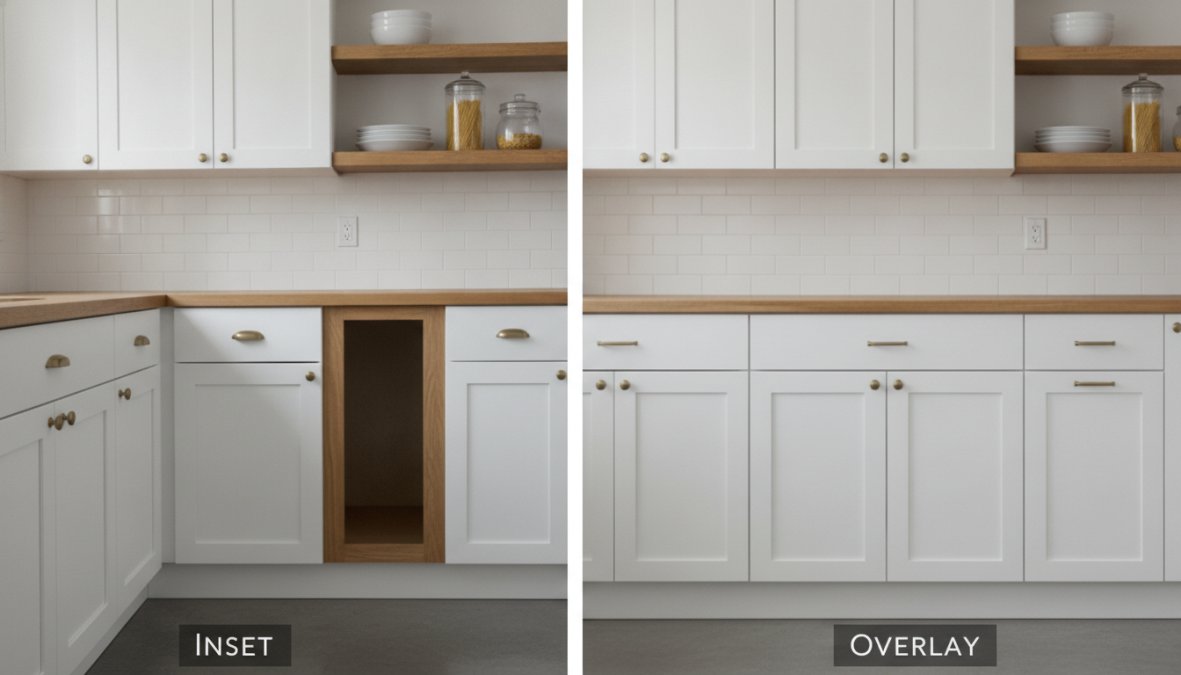
Inset cabinet doors sit recessed within the face frame, creating a flush appearance where the door aligns perfectly with the frame edge. This design requires precise manufacturing and careful door alignment during installation. Overlay cabinets have doors that cover the face frame, sitting proud of the cabinet box. This design is simpler to manufacture and install, with more forgiving tolerances.
Inset doors have less forgiving tolerances, if a door shifts slightly during use, it becomes noticeable immediately. Overlay doors can shift slightly without appearing misaligned because they cover the frame.
Construction Quality Implications
Inset cabinetry requires superior construction throughout. Face frames must be perfectly square and stable. Cabinet boxes must be rigid enough to maintain alignment under load. Manufacturers who produce inset cabinets typically use solid wood frames, plywood box construction, and quality hardware as standard features, not upgrades.
When you buy wholesale inset kitchen cabinets, you're purchasing cabinetry that demands and delivers superior construction quality. This translates to longevity: inset cabinets from quality manufacturers remain functional and beautiful for 20+ years with basic maintenance.
Understanding the Cost of Inset Cabinets at Wholesale Prices
Wholesale inset kitchen cabinet pricing depends on multiple factors beyond the cabinet style itself.
What Affects Your Total Investment
Cabinet pricing varies based on wood species, finish type, hardware, and customization. Solid oak construction costs more than maple; custom colors require additional finishing time; premium hardware adds per-unit cost. Custom sizing increases costs compared to standard dimensions, though custom sizing often proves more cost-effective than purchasing standard cabinets and modifying them on-site.
Lead times affect cost indirectly. Standard inventory cabinets available for immediate shipment represent lower manufacturing costs. Custom orders with longer lead times require scheduling manufacturing capacity, which some suppliers price higher.
Hidden Costs and How to Budget
Shipping costs vary dramatically based on cabinet weight, destination, and whether cabinets arrive assembled or flat-packed. Request shipping quotes before finalizing supplier selection. Some wholesale suppliers absorb shipping costs; others charge separately.
Hardware compatibility matters for long-term costs. If your chosen cabinets use proprietary hinges or drawer slides, future replacements require ordering from the original manufacturer. Standard hardware can be sourced from multiple suppliers if replacement becomes necessary.
Installation costs depend on cabinet complexity and your installer's experience with inset cabinetry. Budget for an installer experienced with inset work; attempting installation with someone unfamiliar with inset specifications risks poor results and costly corrections.
Design services, when offered free by your wholesale supplier, save significant money. Professional kitchen design ensures cabinets fit your space perfectly and meet your functional needs. This design work typically costs $500-1500 when purchased separately.
Hardware Compatibility and Cabinet Adjustment: Long-Term Value
The hardware you choose for inset cabinets affects both immediate function and long-term maintenance requirements.
Choosing the Right Hardware
Concealed hinges have become standard for inset cabinetry because they hide behind doors, maintaining clean lines and the architectural appearance that makes inset cabinets special. Concealed hinges also offer adjustment capability, you can fine-tune door alignment after installation if needed.
Soft-close mechanisms prevent slamming and extend hardware life. They add cost but reduce noise and wear on hinges and doors. Drawer slides determine how smoothly drawers operate and how much weight they can handle. Ball-bearing slides outperform friction slides in durability and smoothness. Full-extension slides let you access the entire drawer depth, while standard slides leave the back portion unreachable.
Maintenance and Door Alignment
Inset cabinet doors require periodic adjustment to maintain perfect alignment. Environmental changes, humidity fluctuations, and seasonal wood movement can shift door alignment slightly over time. Quality concealed hinges include adjustment screws that let you fine-tune alignment without removing doors.
Most concealed hinge systems allow three-dimensional adjustment: side-to-side, up-and-down, and depth. A half-turn of an adjustment screw can restore perfect alignment if doors shift slightly. Soft-close mechanisms occasionally require resetting if they become sluggish, a five-minute task that restores performance.
How to Buy Wholesale Inset Kitchen Cabinets: Step-by-Step
Purchasing wholesale inset kitchen cabinets follows a logical sequence that prevents costly mistakes.
Step 1: Measure Your Space Accurately
Precise measurements form the foundation of successful cabinet ordering. Measure cabinet opening heights, widths, and depths in multiple locations, as walls are rarely perfectly square. Note the location of windows, doors, appliances, and electrical outlets. Photograph your existing kitchen from multiple angles.
Measure from finished surface to finished surface. Many wholesale suppliers offer free design services that include measurement verification, use this service to catch errors before manufacturing begins.
Step 2: Define Your Cabinet Specifications
Determine your cabinet layout: base cabinets, wall cabinets, specialty cabinets, and island cabinets. Decide on wood species, finish type, and hardware. Consider functionality: how many drawers versus shelves? Do you need pull-out organizers or specialty hardware?
Document your preferences clearly. Create a detailed specification sheet listing cabinet dimensions, quantities, wood species, finish, hardware, and any special features. This documentation becomes your order confirmation and ensures the manufacturer produces exactly what you envision.
Step 3: Request Quotes and Compare
Contact multiple wholesale suppliers and request detailed quotes based on your specifications. Ensure each quote includes the same components, wood species, finish, hardware, and any design services. Request itemized pricing so you understand what each component costs.
Compare quotes based on total cost of ownership: unit pricing plus shipping, design services, and lead time. Ask about payment terms and deposit requirements. Reputable wholesale suppliers typically require a deposit to begin manufacturing custom orders.
Step 4: Review Lead Times and Shipping
Confirm lead times before placing your order. Standard cabinets available from inventory typically ship within days. Custom orders require 3-6 weeks of manufacturing time, depending on complexity and current production schedules.
Understand shipping logistics. Will cabinets arrive assembled or flat-packed? How will they be protected during shipping? Coordinate shipping with your installation timeline to avoid storing cabinets for extended periods. Verify that your installer can access your kitchen on the delivery date.
| Step | Timeline | Key Deliverable | Critical Detail |
|---|---|---|---|
| Measure and design | 1-2 weeks | Detailed kitchen layout with measurements | Accuracy prevents costly errors |
| Define specifications | 1 week | Complete cabinet specification sheet | Itemize every detail to avoid surprises |
| Request and compare quotes | 1-2 weeks | Quotes from 2-3 suppliers | Compare total cost, not just per-unit price |
| Place order | 1 day | Purchase order and deposit | Confirm lead time and delivery schedule |
| Manufacturing | 3-6 weeks | Notification when cabinets ship | Track shipment and coordinate delivery |
| Installation | 2-5 days | Cabinets installed and aligned | Professional installation ensures quality results |
Purchasing wholesale inset kitchen cabinets transforms your kitchen renovation economics. When you work with a supplier offering custom color inset cabinetry in custom sizes at wholesale pricing, you gain access to professional-grade quality without the retail showroom markup. RTA Wholesalers provides the design expertise, material options, and wholesale pricing that make premium inset cabinetry achievable for your project. Explore our selection of inset cabinet options and get started with a free kitchen design consultation to ensure your cabinets arrive perfectly sized and finished for your space.
Frequently Asked Questions
What are the main benefits of buying wholesale inset kitchen cabinets?
Wholesale inset kitchen cabinets offer superior construction quality with solid wood frames and precise door alignment compared to overlay options. At wholesale pricing, you access factory-direct rates typically unavailable to retail customers. Inset cabinetry provides a premium aesthetic with doors and drawers recessed into the frame, creating clean lines and a custom appearance. Wholesale suppliers often provide options like custom colors, multiple wood species, and RTA or pre-assembled configurations, allowing you to choose the solution that best fits your budget and timeline.
How do RTA inset cabinets compare to pre-assembled options for wholesale buyers?
RTA inset cabinets ship flat and require assembly on-site, reducing shipping costs and lead times, often available in just 5 weeks. Pre-assembled inset cabinets arrive ready to install but incur higher shipping expenses. RTA options work well for DIY installers or contractors with assembly expertise, while pre-assembled cabinets suit those prioritizing installation speed. Both deliver the same quality inset construction with concealed hinges and dovetail drawer boxes. Your choice depends on labor availability, budget constraints, and project timeline. Wholesale suppliers typically offer both to match different project needs.
What is the cost difference between wholesale inset and overlay cabinets?
Inset cabinets generally command higher wholesale pricing than full overlay cabinets due to their superior construction, solid wood frames, precise manufacturing tolerances, and more complex hardware requirements like concealed hinges. However, wholesale pricing significantly reduces the retail premium. The actual cost difference depends on wood species, finish (stain colors or Sherwin Williams paint options), customization (custom sizes and colors), and order volume. Request quotes from multiple wholesale suppliers to compare. Consider total cost of ownership: inset cabinets' durability and lower maintenance often justify the initial investment over time.
Can I customize wholesale inset kitchen cabinets for my specific project?
Yes. Most wholesale suppliers offer custom inset cabinetry in various configurations. You can specify custom sizes to fit non-standard spaces, select custom colors beyond standard stains, and choose wood species (oak, maple, cherry, etc.) or paint finishes like Sherwin Williams colors. Many suppliers provide free kitchen design services to help optimize your layout and specifications. Lead times vary based on customization, standard configurations may ship faster than fully custom orders. Contact your wholesale supplier with your measurements and design preferences to receive a customized quote and timeline.


