 833-377-8663

Ready to Assemble Cabinets: The Complete 2026 Buyer's Guide

Table of Contents
- What Are Ready to Assemble Cabinets?
- Pros and Cons of Ready to Assemble Cabinets
- RTA Cabinet Assembly Tools You'll Actually Need
- How to Assemble RTA Cabinets: Step-by-Step Process
- Customization Options and Finishes for RTA Cabinetry
- Best Places to Buy Ready to Assemble Cabinets
- Durability, Materials, and Long-Term Value
- Conclusion
Last Updated: July 8, 2026
What Are Ready to Assemble Cabinets?
Ready to assemble cabinets are kitchen or bathroom storage units shipped flat-packed and designed for quick assembly at home or on-site. Unlike pre-assembled cabinets that arrive fully constructed, RTA cabinets require you to connect the cabinet box, attach doors, install hardware, and secure them to your walls. The flat-pack format means lower shipping costs, reduced damage during transit, and flexibility in your installation timeline.
How RTA Cabinets Differ from Pre-Assembled Options
The core difference lies in labor and logistics. Pre-assembled cabinets arrive ready to hang, but you pay for the manufacturer's assembly labor baked into the price. Ready to assemble cabinets shift that labor to you, reducing your upfront cost significantly. Many quality RTA cabinets use the same plywood construction, dovetail drawers, and soft-close hinges as pre-assembled options, the difference is packaging, not materials.
Flat-pack design also means better quality control during shipping. Pre-assembled cabinets risk damage to doors, hinges, and finish during transport. Lead time matters too: pre-assembled cabinets often require 8-12 weeks of production before shipping, while RTA cabinets from RTA Wholesalers are available in just 5 weeks in multiple wood species, stain colors, or unlimited Sherwin Williams paint colors.
Pros and Cons of Ready to Assemble Cabinets
Advantages of RTA cabinetry:
Accessibility is the biggest win. Ready to assemble cabinets make quality cabinetry available to homeowners who'd otherwise choose builder-grade alternatives. You get real wood options, custom finishes, and professional construction at wholesale pricing.
Assembly is more straightforward than most people expect. Modern RTA cabinets use cam-lock systems and clearly labeled components. Most people complete a single base cabinet in 30-45 minutes.
Shipping flexibility reduces logistics headaches. A kitchen's worth of cabinets ships in compact boxes that fit standard doorways and tight spaces where a fully assembled cabinet wouldn't pass.
Customization options exceed what pre-assembled suppliers typically offer. Custom Order Inset and Custom Color Inset cabinets are available in custom sizes and unlimited colors at wholesale pricing.
Disadvantages and real limitations:
Assembly requires time and basic tools. If you're uncomfortable with hand tools or have limited time, hiring a contractor to assemble cabinets adds labor costs that can approach pre-assembled pricing.
Quality varies significantly between manufacturers. Budget options use particle board and cam-locks that loosen over time. Higher-grade options use plywood construction and dovetail drawers that hold up for decades.
Mistakes during assembly are costly. A misaligned cam-lock or stripped screw hole can't be easily undone. Cabinet boxes are engineered to tight tolerances, and assembly errors compound quickly.
Returns and warranty support depend on your supplier. Choosing a reliable supplier like RTA Wholesalers with a free kitchen design service protects you against these headaches.
RTA Cabinet Assembly Tools You'll Actually Need
Assembly requires specific tools, but you likely own most of them already. Having the right tools prevents frustration and risks to expensive cabinetry.
Essential Tools Checklist
- Drill-driver (cordless recommended): Powers screws and drives cam-locks efficiently.
- Screwdriver set (Phillips and flat-head): For adjusting hinges and attaching hardware.
- Cam-lock wrench or hex key set: Most manufacturers include the wrench.
- Pocket hole jig or clamp system: Connects cabinet components without visible fasteners.
- Wood glue (polyurethane or PVA): Reinforces all joints beyond cam-locks alone.
- Level (24" minimum): Ensures cabinets hang perfectly straight.
- Stud finder: Locates wall studs for secure mounting. Wall cabinets must anchor into studs, not drywall alone.
- Tape measure (25' minimum): Measures openings, marks stud locations, and verifies spacing.
- Pencil and marking knife: Marks screw locations and cut lines.
Optional Tools That Save Time
- Impact driver: Drives fasteners faster than a standard drill, cutting assembly time by 20-30%.
- Brad nailer (18-gauge): Secures backing panels and trim without visible fasteners.
- Kreg jig system: Premium pocket hole system that creates invisible joints.
- Oscillating multi-tool: Cuts notches and adjusts openings for plumbing or electrical.
- Cabinet assembly stand or work table: Holds cabinet boxes at comfortable working height.
| Tool | Essential | Time Saved | Typical Cost |
|---|---|---|---|
| Drill-driver | Yes | 60% vs manual | $50-150 |
| Cam-lock wrench | Yes | 30% vs improvised | Included |
| Level | Yes | Prevents rework | $15-40 |
| Stud finder | Yes | 20% vs tapping | $15-30 |
| Impact driver | No | 20% additional | $80-200 |
| Brad nailer | No | 15% additional | $100-300 |
| Pocket hole jig | No | 25% additional | $20-150 |
How to Assemble RTA Cabinets: Step-by-Step Process
Assembly follows a logical sequence. Skipping steps or changing the order creates problems that compound throughout the project.
Preparation and Layout
Start by inspecting every component before touching a tool. Open all boxes and lay out parts in your workspace. Verify that you have every piece listed on the packing slip. Read the assembly instructions completely before beginning.
Clear a large, flat workspace. You need room to lay out panels, assemble the box, and test-fit doors before final installation. Organize hardware into small containers, cam-locks, screws, hinges, and handles are easy to lose. Check your tools are in working order: charge drill batteries fully, test that screwdrivers fit fasteners properly, and verify your level works.
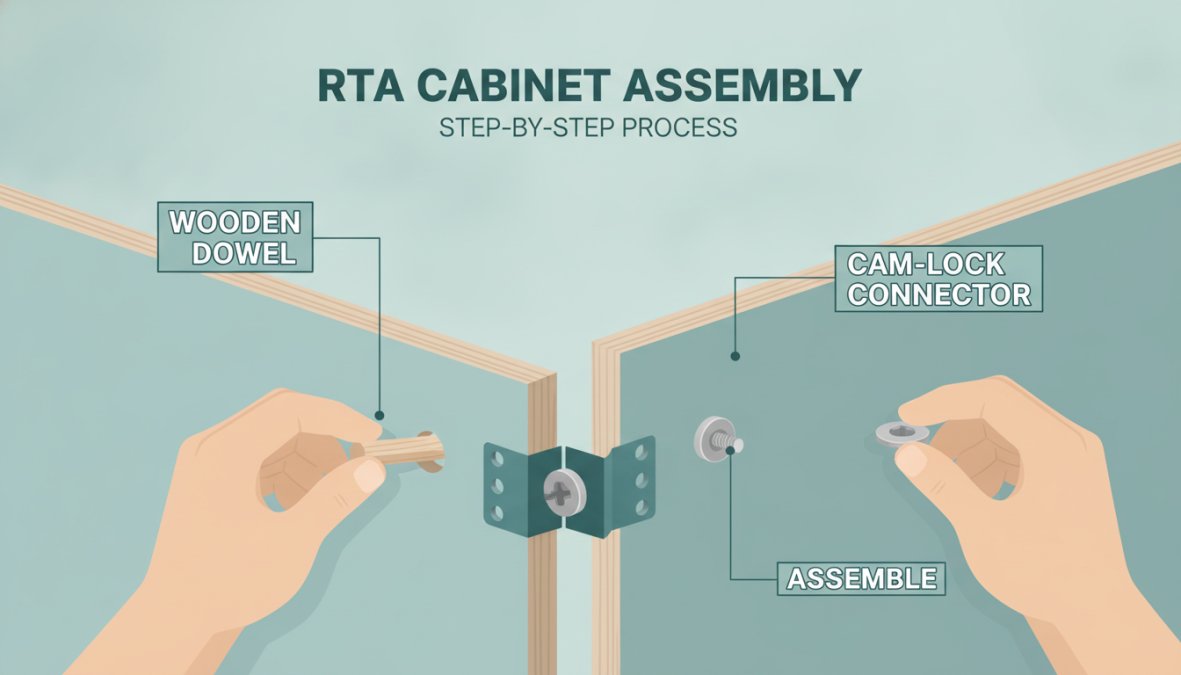
Building the Cabinet Box
Lay out the side panels, top, bottom, and back panel in the configuration shown in your instructions. Dry-fit everything without fasteners first. This reveals any misaligned components before you commit to assembly.
Apply wood glue to all connection points. This reinforces cam-locks and creates joints that improve durability over decades of use. Install cam-locks according to your instructions, hand-tight is sufficient; over-tightening can strip the plastic inserts.
Secure the back panel with brad nails or screws. The back panel squares the entire cabinet box. Check squareness with your level and a tape measure. Measure diagonally from corner to corner; both measurements should be identical. If they differ by more than 1/8", adjust cam-locks or loosen and re-square before the glue sets.
Installing Hardware and Doors
Install hinges on the cabinet box first, following the template or measurements in your instructions. Attach doors to hinges before mounting the cabinet. This lets you adjust hinge alignment on your workbench rather than fighting gravity while standing on a ladder.
Adjust hinges for perfect alignment. Most cabinet hinges have adjustment screws that move doors left-right, up-down, and in-out. Install drawer slides according to manufacturer specifications. Slides must be level and parallel or drawers will bind. Mount handles and knobs last.
Troubleshooting Common Assembly Errors
Cam-locks that won't tighten: The dowel or insert has stripped. Contact your supplier immediately for replacement parts.
Cabinet box that's out of square: Loosen cam-locks slightly and tap the box into square using a rubber mallet. Check diagonals again and re-tighten.
Doors that won't close or rub: Hinges need adjustment. Start with the in-out screw. If the door still rubs after hinge adjustment, the cabinet box itself may be out of square.
Drawers that bind or stick: Slides are misaligned. Check that both slides are level and parallel. Loosen slide fasteners, adjust for level, and re-tighten.
Customization Options and Finishes for RTA Cabinetry
Customization separates RTA cabinets from generic builder-grade alternatives. The options available determine whether your kitchen looks generic or tailored to your specific vision.
Wood Species and Stain Choices
Oak is a classic choice with prominent grain and warm tones. Maple offers tighter grain and lighter color, suiting modern kitchens. Cherry provides warm reddish tones that deepen over time. Hickory has dramatic grain variation and rustic character. Special Order Oak Inset Kitchen Cabinets are available for those seeking the timeless appeal of oak construction.
Stain colors range from light naturals to deep espresso tones. Request sample doors before committing to a full kitchen. Seeing stain samples in your actual lighting, both natural daylight and artificial kitchen lighting, prevents color regret.
Paint Colors and Custom Finishes
Paint offers unlimited color options and works with any design style. Sherwin Williams paint colors provide professional-grade finishes available in unlimited choice. Popular kitchen paint colors include soft whites and creams for traditional looks, soft grays for contemporary kitchens, and bold colors like deep navy or forest green for statement-making designs. Consider your kitchen's lighting when choosing paint color. North-facing kitchens with limited natural light benefit from warmer whites or creams. South-facing kitchens with abundant sunlight can handle cooler tones.
Door Profiles and Hardware Options
Shaker-style doors are the most versatile, working with multiple design aesthetics. Flat-panel doors create a clean, modern appearance. Raised-panel doors add dimension and work well in traditional kitchens. Glass-front doors showcase dishware but require keeping contents organized.
Hardware selection, handles and knobs, deserves careful attention. Modern bar pulls suit contemporary kitchens. Cup pulls and traditional knobs work with transitional designs. Farmhouse-style hardware pairs with rustic aesthetics. Hardware is one of the easiest customizations to change later if your preferences evolve.
Best Places to Buy Ready to Assemble Cabinets
Where you purchase RTA cabinets determines quality, support, and long-term satisfaction.
What to Look For When Choosing a Supplier
Quality construction matters more than price. Cabinets made from plywood with dovetail drawers and soft-close hinges cost more upfront but last decades. Particle board alternatives fail sooner and frustrate you throughout their lifespan.
Supplier support determines your experience if problems arise. A supplier offering free kitchen design service helps you plan correctly before ordering. This prevents costly mistakes that no discount can offset. Look for suppliers who provide clear assembly instructions, responsive customer service, and straightforward warranty policies.
Lead times affect your renovation timeline. RTA Wholesalers offers assembled cabinets available in just 5 weeks, giving you faster access than competitors requiring 8-12 weeks. Customization options indicate whether the supplier can match your vision. Inset cabinets available in custom sizes and custom colors provide flexibility that standard offerings can't match.
Understand shipping policies, return and exchange policies, and how damage claims are handled. Clear policies indicate a supplier confident in their products.
Durability, Materials, and Long-Term Value
Ready to assemble cabinets can last 20-30 years or fail within 5 years, depending entirely on materials and construction quality.
Cabinet Grade and Construction Quality
Stock-grade cabinets use particle board, cam-lock fasteners, and basic hardware, lasting 5-10 years with moderate use. Semi-custom grade uses plywood construction, better hardware, and more customization options, lasting 15-20 years. Custom-grade cabinets use premium materials, dovetail joinery, soft-close hardware, and superior finishes, lasting 25-30+ years.
Plywood construction is the primary indicator of durability. Plywood resists warping and moisture damage far better than particle board and provides a solid base for hardware that remains secure for decades.
Dovetail drawer construction indicates quality craftsmanship. Dovetails are interlocking joints that distribute stress evenly across the drawer box. Soft-close hinges and drawer slides represent quality that extends beyond initial assembly by preventing the constant slamming that damages cabinets over time.
Back panels affect structural integrity. Solid wood or plywood back panels square the cabinet box and prevent racking. Thin hardboard or particle board backs flex and allow the cabinet to twist, causing door and drawer alignment issues.
Sustainability and Material Sourcing
Responsibly sourced wood comes from sustainably managed forests. Look for FSC (Forest Stewardship Council) certification, which indicates independent verification of sustainable practices.
Plywood construction is inherently more sustainable than particle board. Water-based stains and paints reduce VOC (volatile organic compound) emissions. Longevity is the ultimate sustainability metric, a cabinet that lasts 30 years is more sustainable than one lasting 10 years, regardless of material sourcing.
| Quality Tier | Material | Hinges | Drawers | Typical Lifespan |
|---|---|---|---|---|
| Stock-Grade | Particle board | Standard | Cam-lock | 5-10 years |
| Semi-Custom | Plywood | Standard/Soft-close | Cam-lock/Dovetail | 15-20 years |
| Custom-Grade | Plywood | Soft-close | Dovetail | 25-30+ years |
Ready to assemble cabinets have transformed kitchen remodeling from an expensive, contractor-dependent process into something accessible to thoughtful homeowners. The key is understanding that RTA cabinets aren't a compromise on quality, they're a smarter approach to buying and installing cabinetry. RTA Wholesalers specializes in inset cabinets available in custom sizes and custom colors at wholesale pricing, with a free kitchen design service to help you plan your project perfectly. Start your cabinet search with a clear understanding of your needs, choose a supplier that supports you throughout the process, and invest time in proper assembly. Your kitchen will reflect that care for decades.
Frequently Asked Questions
Are ready to assemble cabinets good quality?
Quality varies significantly by manufacturer and cabinet grade. Premium RTA cabinets featuring plywood construction, dovetail drawers, and soft-close hinges rival pre-assembled options. Look for suppliers offering solid wood species, proper face-frame construction, and full-overlay or frameless designs. Budget-friendly options may use particle board or MDF, which still perform well but require careful handling during assembly and installation.
What tools do I need to assemble RTA cabinets?
Essential tools include a drill/driver, screwdriver set, level, tape measure, and rubber mallet. You'll also need a stud finder for wall cabinet installation and possibly a Kreg jig for reinforced joinery. Most RTA cabinets use cam-lock systems and dowel joints that require minimal specialized equipment. Having an assembly instruction guide and a helper makes the process smoother, especially for larger kitchen layouts.
How long does it take to assemble ready to assemble cabinets?
Assembly time depends on cabinet complexity and your experience level. A single base or wall cabinet typically takes 1-2 hours, while a complete kitchen layout may require 2-4 days. Frameless cabinets and those with soft-close hardware may take slightly longer. Proper preparation, organizing hardware, reviewing instructions, and measuring your kitchen layout, significantly reduces assembly time and minimizes errors.
What's the difference between RTA cabinets and custom inset options?
RTA cabinets are mass-produced flat-pack units available in standard sizes with quick shipping. Inset cabinets feature doors that sit flush within the frame, offering a premium appearance. Many suppliers, including RTA Wholesalers, offer custom-order inset cabinets in custom sizes and colors at wholesale pricing, combining the affordability and flexibility of RTA with the refined look of inset construction. Lead times vary, so confirm availability before ordering.


