 833-377-8663

Affordable Inset Kitchen Cabinets Online: 2026 Buyer's Guide

Table of Contents
- What Are Inset Cabinets and Why Buy Them Online?
- RTA Inset Cabinets vs. Pre-Assembled: Cost-Benefit Analysis
- Inset Cabinet vs. Overlay: Which Fits Your Budget?
- Online Cabinet Retailers: Where to Shop for Affordable Options
- Custom Inset Cabinets Cost: Understanding Pricing Factors
- Climate Sensitivity and Door Expansion: A Hidden Cost Factor
- Installation and Setup: DIY vs. Professional
- How to Find the Best Affordable Inset Kitchen Cabinets Online
Affordable Inset Kitchen Cabinets Online: 2026 Buyer's Guide
Last Updated: July 20, 2026
When shopping for affordable inset kitchen cabinets online, homeowners face a choice between ready-to-assemble (RTA) options, pre-assembled solutions, and fully custom builds. This guide breaks down the real differences, hidden costs, and how to measure your kitchen accurately so cabinets fit properly.
What Are Inset Cabinets and Why Buy Them Online?
Inset cabinetry features a door that sits flush within the cabinet frame, creating a refined, built-in appearance with no visible gap. The door edge aligns with the face frame, producing clean lines that convey quality and craftsmanship, the opposite of overlay cabinets, where the door overlaps the frame.
Online shopping for inset kitchen cabinets offers genuine advantages: you bypass traditional retail markups, access factory-direct wholesale pricing, and customize colors and sizes without visiting showrooms.
The Flush vs. Beaded Inset Distinction
Flush inset doors have a completely flat face with no decorative edge detail, emphasizing clean lines and a minimalist aesthetic. Beaded inset doors feature a small decorative routed edge around the perimeter, adding visual interest and a traditional feel. Both offer the same structural integrity; beaded doors sometimes cost slightly more due to additional routing.
RTA Inset Cabinets vs. Pre-Assembled: Cost-Benefit Analysis
Ready-to-assemble (RTA) cabinets arrive unassembled and cost less because you absorb the labor. Pre-assembled cabinets arrive fully built and ready to mount, costing more upfront but eliminating assembly work. The choice depends on your timeline, skill level, and how much you value your time.
Assembly Time and DIY Feasibility
A typical RTA base cabinet takes 45-90 minutes to assemble with proper tools. Wall cabinets take 30-45 minutes. A full kitchen of 20-25 cabinets realistically requires 40-60 hours of labor.
The key challenge is precision. Cabinet boxes must be perfectly square, or doors won't close properly. Hinges must be aligned exactly. Most DIY mistakes stem from rushing assembly rather than difficulty.
Lead Times and Availability
RTA cabinets from stock inventory typically ship within 1-2 weeks. Custom-order RTA cabinets take 4-8 weeks. Pre-assembled cabinets take 6-10 weeks. If your project has a hard deadline, stock inventory is your safest option. For those seeking specific finishes or dimensions, options like Custom Order Inset and Custom Color Inset cabinets allow you to tailor your order to your exact specifications within standard lead times.
Inset Cabinet vs. Overlay: Which Fits Your Budget?
Inset doors sit flush within the frame, creating a seamless, built-in look. Overlay doors cover the face frame, appearing modern but less custom.
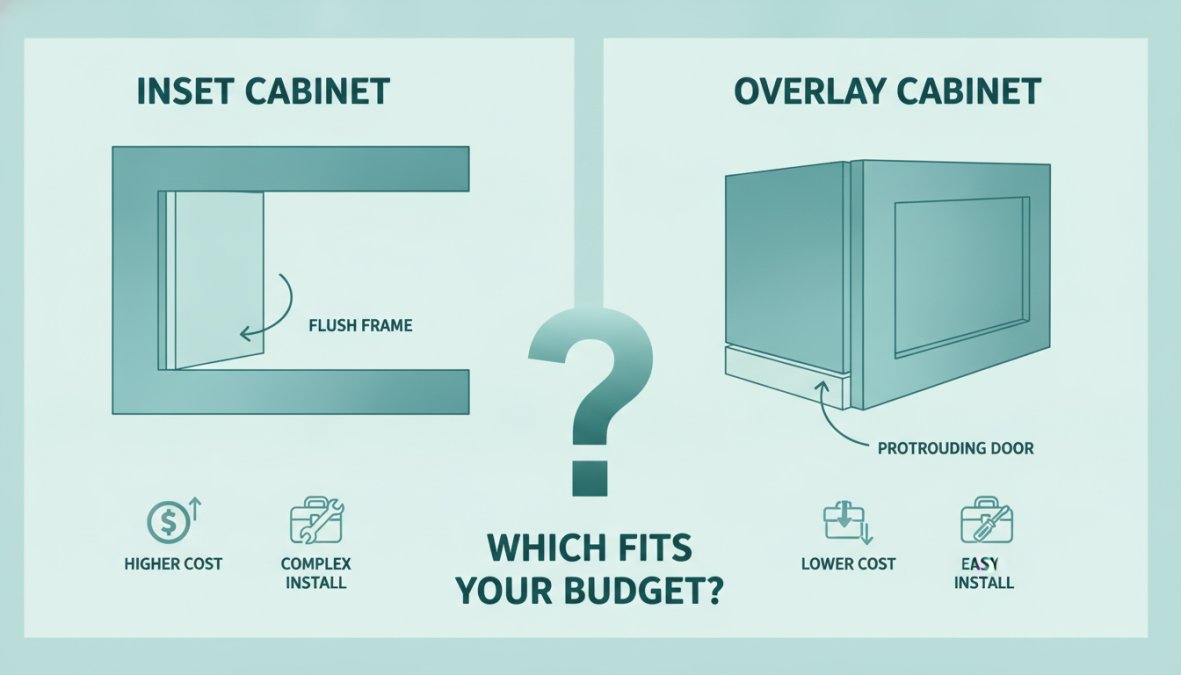
Inset cabinetry requires tighter manufacturing tolerances, the cabinet box must be precisely square or the door won't close flush. This precision adds cost. Overlay doors are more forgiving; slight variations don't affect fit.
Inset cabinets also have slightly less usable interior space because the frame takes up room. Inset cabinetry typically costs 20-40% more than comparable overlay options, though affordable online options narrow this gap by cutting retail markup.
Online Cabinet Retailers: Where to Shop for Affordable Options
Direct-to-Consumer vs. Traditional Retail
Direct-to-consumer (DTC) cabinet retailers sell exclusively online, eliminating showroom costs and sales commissions, typically offering lower prices than traditional showrooms. You lose the ability to see and touch cabinets before ordering, but many DTC retailers provide free design services, 3D renderings, and layout assistance.
Traditional retailers operate physical showrooms where you can examine cabinets and work with designers, but this service costs money, reflected in higher prices.
What to Expect from Free Design Services
Many online retailers offer complimentary design consultations including kitchen measurements and layout analysis, 3D renderings showing cabinet placement and finish colors, door style and hardware recommendations, and space optimization suggestions. Professional design review reduces installation errors by approximately 40%, saving time and frustration during setup.
Custom Inset Cabinets Cost: Understanding Pricing Factors
Customization Options That Impact Price
Custom sizing is the primary cost driver. Standard cabinet widths (12", 15", 18", 24", 30", 36") cost less than non-standard dimensions. Custom colors, especially paint colors beyond standard offerings, add cost. Wood species selection affects pricing, birch and oak are less expensive than cherry or walnut. Soft-close hinges add 8-12% per cabinet but improve perceived quality.
| Customization Factor | Impact on Cost | Best Practice |
|---|---|---|
| Standard sizing | Lowest cost | Use standard widths when possible |
| Custom sizing | +15-30% | Order custom only for essential spaces |
| Paint color | +10-20% | Choose from standard color palette |
| Soft-close hardware | +8-12% per cabinet | Add to frequently-used cabinets only |
Tiered Discounts and Wholesale Pricing Models
Many online retailers offer tiered discounts based on order total. Real wholesale pricing is typically 30-50% below retail showroom prices. Verify genuine wholesale pricing by comparing specific cabinet models across multiple retailers.
Climate Sensitivity and Door Expansion: A Hidden Cost Factor
Wood expands and contracts with humidity and temperature changes. In climates with seasonal humidity swings, inset cabinet doors can expand in summer and shrink in winter, causing sticking or visible gaps. This is not a manufacturing defect but a natural property of wood.
Regions with high humidity (coastal areas, the Southeast, the Midwest during summer) experience more pronounced expansion. Solid wood doors are more prone to expansion than engineered wood or plywood with veneer. Painted finishes seal wood better than stained finishes, reducing moisture absorption.
When ordering, mention your climate zone to the retailer's design team. They can recommend materials and finishes that perform well in your environment. If you prefer the warmth and durability of natural wood, Special Order Oak Inset Kitchen Cabinets are an excellent choice for those willing to account for wood's natural movement.
Installation and Setup: DIY vs. Professional
Measuring Your Kitchen Accurately
Accurate measurements are the foundation of successful installation. Most kitchens are not perfectly square; walls bow slightly, floors slope, and corners aren't 90 degrees.
Here's the correct measurement process:
- Measure diagonal distances in both directions. If unequal, the room is out of square.
- Measure wall height at multiple points (left, center, right).
- Measure floor distance from the wall at multiple points.
- Identify obstacles: electrical outlets, plumbing vents, gas lines.
- Measure appliance openings precisely.
- Take photos from multiple angles.
Most online retailers provide detailed measurement guides. If uncertain, professional measurement is worth the cost compared to ordering cabinets that don't fit.
Common Installation Mistakes to Avoid
The most frequent error is installing cabinets level without accounting for an out-of-level floor. If your floor slopes and you install cabinets level, you'll see visible gaps at one end. Solution: install cabinets to match the floor slope.
Over-tightening cabinet screws during assembly can strip threads or crack the cabinet box. Screws should be snug, not cranked down with maximum force.
Hinge adjustment requires patience. Cabinet doors have three adjustment points per hinge: up/down, left/right, and in/out. Professional installation typically costs $50-150 per cabinet. For a 20-cabinet kitchen, that's $1,000-3,000 in labor.
How to Find the Best Affordable Inset Kitchen Cabinets Online
Red Flags and Quality Assurance
Avoid retailers who won't provide detailed product specifications. You should know the cabinet box material, door construction, hinge type, and hardware quality. Check return and warranty policies, legitimate retailers offer 30-day returns and 1-year warranties on defects.
Read customer reviews on independent sites. Look for comments about shipping damage, quality consistency, and customer service responsiveness. Verify that the retailer provides 3D design renderings before you order.
Shipping, Damage Prevention, and Guarantees
Quality retailers use heavy-duty cardboard boxes, internal bracing, and corner protection. They insure shipments and have clear damage claim procedures. Ask about packaging details before ordering. Damage claims should be straightforward: document with photos, contact the retailer, and they replace the cabinet.
Finding affordable inset kitchen cabinets online requires balancing price, quality, customization, and service. Start with accurate kitchen measurements and a clear design vision. The right retailer will help you execute both while providing free design services to catch measurement errors before ordering.
Frequently Asked Questions
What's the real difference between inset and overlay cabinets?
Inset cabinets have doors that sit flush within the frame opening, creating a seamless, built-in appearance. Overlay cabinets have doors that sit on top of the frame, leaving a visible gap. Inset cabinets typically cost 35-45% more due to precision construction required. Both styles are available as affordable inset kitchen cabinets online, but inset requires tighter tolerances during manufacturing and installation.
Are RTA inset cabinets actually doable for a DIY homeowner?
Yes, RTA inset cabinets are designed for self-assembly, but they require patience and precision. Most DIYers can assemble them in 2-4 hours per cabinet with basic tools. The real challenge is installation, achieving the flush, gap-free look demands accurate measurements and careful door adjustment. If you're comfortable with hand tools and detail work, RTA inset cabinets are feasible. Otherwise, hiring a professional installer is worthwhile for the final fit.
How do custom inset cabinets cost compare to stock options?
Custom inset cabinets cost more than stock because they're built to your exact specifications, size, color, wood species, and hardware. Online retailers offering custom inset cabinets at wholesale pricing typically cost less than traditional cabinet shops because they eliminate middlemen. Pricing depends on customization depth, order quantity, and lead time. Contact retailers directly for quotes, as transparent pricing varies significantly between direct-to-consumer and retail models.
What happens if my inset cabinet doors expand or contract due to humidity?
Inset doors are climate-sensitive because they must fit precisely within the frame. Wood naturally expands in humid conditions and contracts in dry conditions. If gaps appear seasonally, it's usually normal and minor. However, significant expansion can cause binding or rubbing. Quality manufacturers use solid wood construction and proper finishing to minimize this. When ordering custom inset cabinets online, ask about humidity tolerance and climate recommendations for your region.


