 833-377-8663

Affordable Kitchen Cabinets: A Complete 2026 Buying Guide

Table of Contents
- What Are Affordable Kitchen Cabinets and RTA Kitchen Cabinets?
- Kitchen Cabinet Refacing vs Replacement: Which Saves More?
- Affordable Kitchen Cabinets: Materials and Construction Quality
- Budget Kitchen Remodel Tips: Maximizing Your Cabinet Investment
- How to Install Kitchen Cabinets: DIY vs. Professional Installation
- Maintenance and Long-Term Care for Affordable Cabinets
- Budgeting for Hidden Costs in Cabinet Projects
- Conclusion
Affordable Kitchen Cabinets: A Complete 2026 Buying Guide
Last Updated: July 5, 2026
When homeowners plan a kitchen renovation, affordable kitchen cabinets often become the centerpiece of their decision-making process. The cabinet choice determines not just the visual appeal of your kitchen, but also its functionality, durability, and long-term value. This guide walks you through everything you need to know about selecting, installing, and maintaining affordable kitchen cabinets that will serve your home for years to come.
What Are Affordable Kitchen Cabinets and RTA Kitchen Cabinets?
Affordable kitchen cabinets are cabinetry options designed to deliver professional quality and durability at accessible price points. Ready-to-assemble (RTA) cabinets represent one of the most popular affordable solutions available today.
RTA cabinets ship flat-packed and require assembly at your home or job site. This direct-to-consumer model eliminates middleman markups, which is why RTA options consistently deliver better value than fully assembled alternatives. The boxes arrive with all components pre-cut and hardware included.
Ready-to-Assemble vs. Fully Assembled Options
The choice between RTA and fully assembled cabinets comes down to timeline, labor availability, and total cost. RTA cabinets typically arrive within 5-8 weeks for standard configurations. Once they arrive, assembly takes 8-20 hours depending on your kitchen's size and your comfort level with tools. Fully assembled cabinets skip the assembly step entirely but arrive at premium pricing, often 40-60% higher than comparable RTA options.
Both RTA and assembled cabinets can feature plywood construction, soft-close hinges, and professional finishes. The real difference lies in what you're paying for. With RTA, you're buying the cabinet box and hardware. With assembled units, you're also paying for warehouse storage, transportation of bulky items, and embedded labor costs.
Kitchen Cabinet Refacing vs Replacement: Which Saves More?
Cabinet refacing replaces only the visible surfaces of your existing cabinet boxes. The face frame, doors, and drawer fronts get new finishes while the underlying structure remains. Replacement means removing the old cabinets entirely and installing new ones from the ground up.
When Refacing Makes Sense
Refacing works best when your existing cabinet boxes are structurally sound but visually dated. If your cabinets have solid wood construction, aren't water-damaged, and are positioned exactly where you want them, refacing can deliver dramatic visual transformation at lower cost than replacement. The refacing process typically takes 1-2 weeks.
However, refacing has real limitations. You can't change the kitchen layout, improve storage capacity, or upgrade internal hardware and features. If your existing boxes have worn hinges, damaged interiors, or inadequate storage, refacing only addresses the cosmetic problem.
When Replacement Is the Better Investment
Replacement makes sense when you want to fundamentally improve your kitchen's function or when existing cabinets are damaged. New affordable kitchen cabinets give you the opportunity to optimize your layout, add specialized storage solutions, upgrade to soft-close hinges throughout, and choose materials that better suit your lifestyle.
Replacement also matters when existing cabinets have particle board construction, water damage, or outdated hardware that refacing can't fix. New cabinets with quality plywood construction will serve you 15-20 years longer than refacing aging particle board boxes.
Affordable Kitchen Cabinets: Materials and Construction Quality
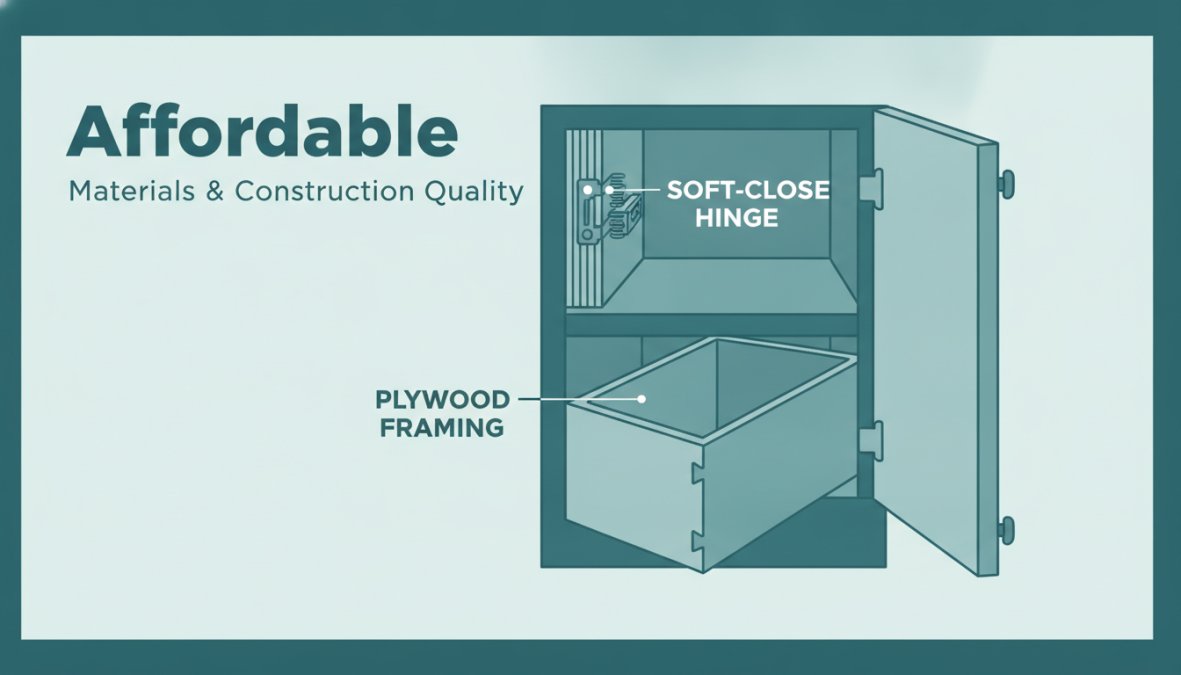
The materials inside your cabinet boxes matter more than most homeowners realize. You can't see the interior construction once doors close, but it determines how long your cabinets will last and how well they handle daily wear.
Plywood vs. Particle Board: Durability Comparison
Plywood construction uses thin layers of wood glued and pressed together. This cross-grain lamination creates inherent strength and resistance to warping. Plywood holds screws securely, resists moisture better than alternatives, and maintains structural integrity over decades.
Particle board uses compressed wood fibers bonded with adhesive. It's lighter and cheaper to manufacture, but absorbs moisture readily, loses screw-holding strength over time, and warps when exposed to humidity, a serious problem in kitchens. Cabinets with particle board interiors typically last 8-12 years before hardware fails and doors begin sagging.
RTA Wholesalers offers affordable kitchen cabinets constructed with plywood throughout, ensuring your investment holds up to decades of use rather than requiring replacement within a decade.
Face Frame and Overlay Options
The face frame is the wooden skeleton that borders your cabinet opening. It anchors hinges, supports doors, and provides structural rigidity. Cabinets with solid wood face frames outperform those with veneer or particle board frames.
Overlay style refers to how cabinet doors sit relative to the face frame. Full overlay doors cover the entire face frame, creating a modern, seamless appearance. Inset doors fit flush within the face frame opening, creating a traditional, furniture-like look. Inset cabinets require more precision in manufacturing but deliver a premium appearance that never goes out of style. If you're drawn to the timeless elegance of inset cabinetry, options like Custom Order Inset and Special Order Oak Inset Kitchen Cabinets allow you to customize both the style and finish to match your design vision.
Budget Kitchen Remodel Tips: Maximizing Your Cabinet Investment
Your cabinet budget represents 40-50% of a typical kitchen remodel cost. Strategic choices in this category directly impact your overall project success.
Choosing Finishes and Hardware Wisely
Finishes fall into three categories: stain, paint, and veneer. For affordable kitchen cabinets, painted finishes typically offer the best value. Paint hides wood imperfections, provides durable protection, and allows color changes without refinishing. White and gray painted cabinets dominate current design trends and resist showing wear better than lighter stains. If you want a specific color that matches your kitchen's aesthetic, Custom Color Inset options let you select from unlimited Sherwin Williams paint colors to achieve exactly the look you envision.
Hardware, hinges, handles, and drawer slides, determines daily functionality more than any other component. Soft-close hinges cost more upfront but eliminate slamming doors and extend hinge lifespan by preventing impact damage. Full-extension drawer slides let you access the entire drawer depth, solving a major storage frustration in budget kitchens.
Planning Your Kitchen Layout for Efficiency
Cabinet layout directly impacts cooking workflow and daily frustration levels. The classic work triangle connects sink, stove, and refrigerator. Efficient kitchens keep this triangle compact, ideally 15-26 feet of total perimeter distance.
Storage zones matter more than total cabinet count. Group frequently used items near prep areas. Keep baking supplies near the oven. Position dishes near the dishwasher. Vertical storage solves space limitations in smaller kitchens. Tall cabinets that reach ceiling height add 30-40% more storage than standard 36-inch base and wall cabinet combinations.
Before finalizing your cabinet layout, spend a week observing your actual cooking patterns. Notice which items you use daily versus weekly. Your affordable kitchen cabinets should solve real problems, not just look good in a showroom.
How to Install Kitchen Cabinets: DIY vs. Professional Installation
Cabinet installation determines whether your new cabinets function flawlessly or develop alignment problems that plague you for years.
Measuring and Preparation Essentials
Accurate measurements are non-negotiable. Measure wall lengths at three heights, top, middle, and bottom, because most walls aren't perfectly straight. Check for obstacles like outlets, windows, and door frames that affect cabinet placement.
Wall condition matters more than most people realize. Cabinets anchor to wall studs, which should be located and marked before installation begins. Use a stud finder to locate framing, then mark stud locations clearly. Uneven walls require shims, thin wedges that level cabinets despite wall irregularities.
Remove existing cabinets carefully if replacing them. Turn off electricity to any outlets in cabinet walls. Disconnect plumbing if sinks are involved.
Common Installation Mistakes to Avoid
The most common mistake is installing cabinets without shimming them level. Cabinets that aren't perfectly level cause doors to swing open or closed on their own and create gaps between cabinets.
Another frequent error is anchoring cabinets to drywall instead of studs. Drywall can't support cabinet weight long-term. Cabinets must anchor directly to wall framing with appropriate fasteners. Use at least four fasteners per cabinet section, preferably more for larger units.
Maintenance and Long-Term Care for Affordable Cabinets
Proper maintenance extends cabinet lifespan by 5-10 years and keeps them looking new throughout their service life.
Weekly cleaning with mild soap and water removes dust and cooking splatter. Avoid harsh chemicals or abrasive scrubbers that damage finishes. Dry cabinets immediately after cleaning to prevent water spots and moisture damage.
Hinges and drawer slides benefit from occasional lubrication. A light silicone spray applied annually keeps hardware moving smoothly. Water is the primary enemy of affordable kitchen cabinets. Immediately wipe spills, especially near sink areas. Ensure that plumbing connections are tight and check periodically for leaks.
Hardware tightening should happen annually. Hinges and handles loosen gradually with use. A quick pass with the appropriate screwdriver keeps everything secure and prevents doors from sagging.
Budgeting for Hidden Costs in Cabinet Projects
The cabinet cost itself represents only part of your total project investment. Understanding hidden costs prevents budget surprises mid-project.
Installation labor costs vary by region and complexity. Simple cabinet installations in straightforward kitchens cost less than complex layouts requiring extensive wall modifications. Budget 20-40% additional for professional installation if you're not handling assembly yourself.
Countertop installation depends on your cabinet configuration. If you're replacing cabinets, existing countertops may not fit new cabinet layouts. Countertop removal, modification, and reinstallation adds significant cost.
Hardware upgrades, soft-close hinges, full-extension slides, and quality handles, typically add 10-15% to cabinet costs but prevent frustration for years. Disposal of old cabinets requires planning. Some contractors include removal in their fees. Others charge separately.
| Budget Category | Typical Range | Notes |
|---|---|---|
| Cabinet Materials | Base cost | Varies by size, materials, finishes |
| Installation Labor | 20-40% of cabinet cost | Professional installation highly recommended |
| Hardware Upgrades | 10-15% additional | Soft-close hinges, full-extension slides |
| Countertops | Variable | May need replacement or modification |
| Backsplash | Variable | Often installed after cabinets |
| Disposal/Removal | 5-10% of cabinet cost | Varies by local rates |
Finding affordable kitchen cabinets that combine quality, durability, and attractive design requires understanding the options available and matching them to your specific needs. Whether you choose ready-to-assemble RTA solutions or fully assembled alternatives, the key is selecting cabinetry built with plywood construction, quality hardware, and finishes designed to last. RTA Wholesalers specializes in providing inset cabinets in custom sizes and custom colors at wholesale pricing, with assembled cabinets available in just 5 weeks across multiple wood species, stain colors, and unlimited Sherwin Williams paint color choices. Our free kitchen design service helps ensure your cabinet project achieves both the aesthetic and functional results you envision.
Frequently Asked Questions
What is the cheapest way to get new affordable kitchen cabinets?
Ready-to-assemble (RTA) cabinets offer the most cost-effective route. These flat-pack options reduce labor costs and shipping fees compared to fully assembled cabinetry. Buying directly from a cabinet distributor at wholesale pricing further reduces expenses. Custom color inset cabinets available in various sizes provide quality without premium pricing, and choosing standard finishes over custom paint or stain colors helps keep budgets in check.
Are RTA kitchen cabinets worth the money?
Yes, when quality construction is prioritized. Look for RTA cabinets with plywood construction, dovetail drawers, and soft-close hinges, these features ensure durability despite the lower price point. Ready-to-assemble options from reputable manufacturers deliver professional results comparable to higher-priced alternatives. The key is selecting cabinets from established distributors who maintain strict quality standards rather than choosing the absolute lowest-cost option.
What are the most durable affordable kitchen cabinet materials?
Plywood construction outperforms particle board in affordability and durability. Face frame cabinets with solid wood edges provide better longevity than frameless options at similar price points. Look for cabinets featuring soft-close hinges and quality hardware, which reduce wear over time. Shaker style and full overlay designs also tend to age better than trendy styles, making them smart budget choices for long-term value.
How do I measure my kitchen for affordable cabinet replacement?
Measure wall length, height from floor to ceiling, and depth from wall to countertop edge. Account for windows, doors, and appliance openings. Take measurements at multiple points along each wall, kitchens are rarely perfectly square. Document electrical outlets and plumbing locations. A free kitchen design consultation service can help verify measurements and optimize your cabinet layout, ensuring you order the correct quantities and configurations for your space.


