 833-377-8663

Are RTA Cabinets Good Quality? A 2026 Buying Guide

Table of Contents
- Are RTA Cabinets Good Quality? The Short Answer
- RTA Cabinet Materials: What Actually Matters
- RTA vs Assembled Cabinets Quality: What's the Real Difference?
- RTA Cabinet Durability: How Long Will They Last?
- How to Choose High-Quality RTA Cabinets
- Common Quality Red Flags to Avoid
- RTA Cabinet Quality Varies Widely, Here's How to Win
- Conclusion
Are RTA Cabinets Good Quality? A 2026 Buying Guide
Last Updated: July 24, 2026
When it comes to kitchen renovations, the question "are rta cabinets good quality" stops many homeowners in their tracks. Ready-to-assemble cabinetry has evolved dramatically over the past decade, but quality varies wildly depending on what you're buying. At RTA Wholesalers, we've helped hundreds of customers navigate this decision, and the answer depends entirely on what you're comparing.
The real issue most guides miss: cheap RTA cabinets and high-quality RTA cabinets are fundamentally different products. This guide shows you exactly what separates cabinet-grade construction from particle board alternatives, how to spot durability red flags before you order, and whether ready-to-assemble is right for your kitchen.
Are RTA Cabinets Good Quality? The Short Answer
Yes, high-quality RTA cabinets are genuinely good, but only if you know what to look for. The problem is that "RTA cabinet" covers everything from solid plywood construction built to last 15+ years to flimsy particle board that sags under weight.
Quality depends almost entirely on materials. A cabinet made from all-plywood construction with dovetail drawers and soft-close hinges will outperform particle board by years. The assembly process itself doesn't determine quality, what's inside the box does.
Cabinet-grade plywood holds up to moisture, weight, and time. Particle board fails faster, especially in kitchens where humidity and daily use take a toll. Before you order, confirm which material you're getting and why it matters for your kitchen environment.
RTA Cabinet Materials: What Actually Matters
Material composition determines lifespan more than any other factor.
All-Plywood vs. Particle Board Construction
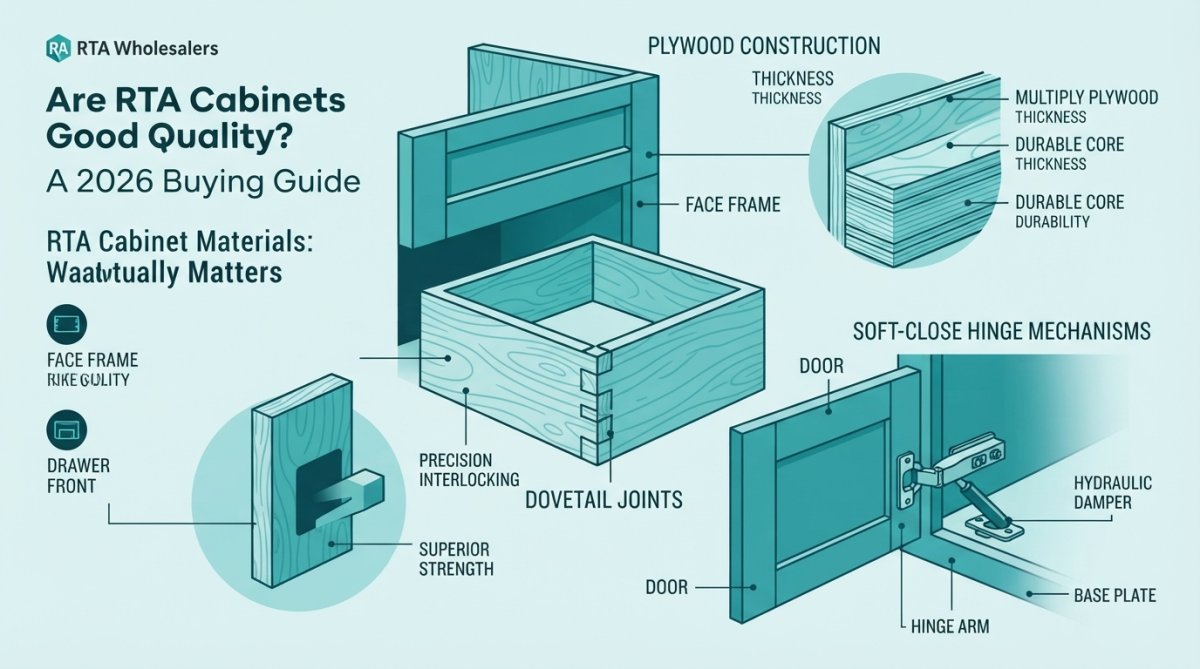
All-plywood RTA cabinets use real wood veneer or solid wood for the cabinet box, sides, and backing. Particle board uses compressed wood fibers and adhesive, cheaper to manufacture but structurally weaker.
A plywood cabinet handles dropped cookware or years of humidity without swelling at seams. Particle board swells when exposed to moisture, warps under heavy loads, and develops soft spots where water penetrates. In kitchens with dishwashers or near sinks, this becomes a problem within 5-7 years.
If you're flipping a house and selling in 18 months, particle board works. If you're building a home you'll live in for a decade, plywood pays for itself in durability. RTA Wholesalers offers custom color inset cabinetry built with materials designed to last, available in multiple wood species that handle moisture and daily use without degradation.
Yes, plywood cabinets weigh more, but that's because they're denser and stronger. Plywood holds wall anchors better and distributes weight more evenly across studs.
Dovetail Drawers and Soft-Close Hardware
Dovetail drawer construction is the hallmark of quality RTA cabinets. Instead of simple butt joints held by staples, dovetail joinery interlocks drawer sides like puzzle pieces. This joint resists racking and lasts longer.
Soft-close hinges and drawer slides use hydraulic dampening to slow closing, preventing slamming and reducing stress on hardware. Over years of daily use, soft-close hardware extends cabinet life by reducing impact wear.
Budget RTA cabinets skip dovetails, using stapled butt joints instead. They install basic hinges without dampening. After 3-4 years, hinges loosen, drawers stick, and the cabinet feels unstable. Once a drawer joint fails, repair is expensive or impossible. Dovetail construction prevents this problem.
RTA vs Assembled Cabinets Quality: What's the Real Difference?
Pre-assembled cabinets made by the same manufacturer using the same materials as their RTA line are identical in quality. The only difference is labor. If you're paying for assembly, you're paying for convenience, not superior materials.
Where pre-assembled cabinets sometimes win: custom sizing and finish options. A local cabinet maker can build to exact specifications. But this costs significantly more and depends entirely on the builder's skill.
The real advantage of RTA cabinets is flexibility. You can order exactly what you need without custom production delays, mix and match sizes and colors, and source from multiple suppliers. This flexibility, combined with transparent material specs, actually makes quality easier to verify with RTA options.
A plywood RTA cabinet outperforms a particle board pre-assembled cabinet every time. Material, not assembly method, drives durability.
RTA Cabinet Durability: How Long Will They Last?
A high-quality RTA cabinet lasts 15-20 years with normal kitchen use. A budget RTA cabinet lasts 5-8 years before requiring repairs or replacement.
This timeline assumes proper installation, reasonable humidity levels, and normal use. Kitchens with constant moisture exposure will degrade any cabinet faster.
Stress Testing and Cabinet Lifespan
Manufacturers of quality RTA cabinets stress-test products before shipping. This means loading drawers to maximum capacity, cycling hinges through thousands of open-close cycles, and exposing samples to humidity chambers that simulate years of kitchen moisture.
A hinge that fails at 5,000 cycles in the lab will fail after about 3-4 years of real kitchen use. A drawer joint that can't handle 100-pound loads will sag under a full set of dishes. Manufacturers that publish stress-test results signal confidence in their products.
Budget manufacturers often skip testing. They build to cost targets, not durability targets. The result is unpredictable failure rates.
Environmental Factors and VOC Emissions
Kitchen humidity is the silent killer of cheap cabinets. Water vapor from cooking and dishwashing migrates into particle board, causing swelling that warps doors and weakens joints.
Quality RTA cabinets use finishes and backing materials that resist moisture penetration. Plywood handles humidity better than particle board, and proper finishing seals wood against water vapor. This is why cabinet-grade construction matters in kitchens.
VOC (volatile organic compound) emissions affect both health and longevity. Low-quality finishes off-gas formaldehyde for months after installation. Quality finishes cure properly and emit minimal VOCs while protecting wood better against moisture and UV damage.
How to Choose High-Quality RTA Cabinets
Start with material specifications, not aesthetics. Before you choose a finish color, confirm what's inside the cabinet box.
Evaluating Cabinet Grade Plywood and Hardware Quality
Ask the manufacturer directly: Is the cabinet box all plywood, or does it use particle board for the back and sides? Quality manufacturers publish material specs because they're proud of them.
For plywood, ask about veneer grade. Cabinet-grade plywood uses A-grade veneers on visible surfaces and B-grade on hidden surfaces. This means consistent appearance and better stability.
Hardware quality matters equally. Soft-close hinges should be name-brand (Blum, Hettich, or similar European manufacturers). Budget hinges fail faster. Drawer slides should be full-extension, meaning the drawer pulls all the way out without tipping.
Examine the back panel. Is it 1/4-inch plywood or thin hardboard? Plywood backs are stronger and resist warping.
Assembly Difficulty and Support Resources
Poor instructions lead to mistakes that compromise durability. Quality manufacturers provide detailed, illustrated assembly manuals with step-by-step photos and tool requirements. Some offer video tutorials.
A single cabinet typically takes 30-60 minutes with quality instructions. Budget cabinets with unclear instructions can take 2+ hours per cabinet, increasing mistakes.
Customer support matters more than most guides acknowledge. If something arrives damaged or an assembly step confuses you, can you reach the manufacturer? Quality RTA suppliers have responsive customer service.
Common Quality Red Flags to Avoid
Particle board throughout. If the entire cabinet is particle board, durability will suffer in primary kitchens.
Stapled joints. Drawers held with staples instead of dovetails will fail. Staples can't handle repeated stress.
Thin backing material. Flimsy hardboard backing instead of plywood indicates cost-cutting that affects the entire cabinet.
No hardware specifications. If the listing doesn't name hinge and slide manufacturers, they're probably budget brands.
Vague material descriptions. "Wood composite" or "engineered wood" without specifics usually means particle board. "Plywood construction" is clear.
Poor reviews mentioning assembly issues. Multiple reviews about unclear instructions indicate manufacturing quality problems.
Extremely low pricing. If comparable cabinets cost significantly more elsewhere, the manufacturer is cutting corners on materials or quality control.
RTA Cabinet Quality Varies Widely, Here's How to Win
The cabinet industry has fragmented into clear tiers.
Budget tier: Particle board construction, basic hardware, minimal assembly support. These work for temporary installations or light use. Expect 5-7 year lifespan.
Mid-range tier: Plywood box with particle board back, quality hardware, decent instructions. These balance cost and durability, lasting 10-12 years with normal use.
Premium tier: All-plywood construction, dovetail drawers, soft-close hardware, excellent instructions and support. These last 15-20 years. RTA Wholesalers offers custom color inset cabinetry in this tier, available in custom sizes and multiple wood species at wholesale pricing. Our assembled cabinets are available in just 5 weeks in a multitude of wood species and stain colors or an unlimited choice of Sherwin Williams paint colors. Our free kitchen design service helps catch mistakes before you order.
Choose based on how long you plan to keep the cabinets and how much you use your kitchen. A rental kitchen justifies budget cabinets. A primary residence justifies mid-range or premium options.
Conclusion
Are RTA cabinets good quality? Yes, when you understand what "good quality" means and verify materials before ordering. High-quality RTA cabinets are built from plywood, feature dovetail drawers and soft-close hardware, and come with clear assembly instructions and responsive support.
The challenge is distinguishing between quality tiers when every cabinet looks similar in photos. Material specifications, hardware details, and customer reviews reveal the truth. Budget time to research before ordering, because cabinet mistakes are expensive to fix.
Frequently Asked Questions
What materials are RTA cabinets typically made from, and does it affect quality?
High-quality RTA cabinets use cabinet-grade all-plywood construction for the box and face frame, while lower-tier options use particle board or MDF. Plywood resists warping, holds fasteners better, and lasts longer. Dovetail drawer construction and solid wood components also signal quality. When evaluating RTA cabinet materials, check the specification sheet, it should explicitly state plywood grade and wood species used.
How long do RTA cabinets last compared to assembled cabinets?
RTA cabinet durability depends entirely on construction quality, not assembly method. Well-made RTA cabinets using all-plywood construction, stress-tested components, and quality hardware can last 15-20+ years in residential kitchens. Cheaper RTA options with particle board may fail within 5-10 years. The difference is materials and manufacturing standards, not whether they arrive flat-packed or pre-assembled.
Are RTA cabinets a good choice for kitchen renovations, or should I buy pre-assembled?
RTA cabinets can be excellent for kitchen renovations when you choose high-quality options. The real advantage is cost-effectiveness and customization, you can often get better materials and custom sizes at wholesale pricing compared to pre-assembled alternatives. However, you'll invest time in assembly. RTA works best if you're comfortable with DIY installation or willing to hire help, and you prioritize material quality over convenience.
What are the key indicators of high-quality RTA cabinets?
Look for: all-plywood construction (not particle board), dovetail drawer joints, soft-close hinges and drawer slides, metal shelf clips, detailed installation manuals, and responsive customer support. Stress-tested components and pre-finished surfaces with quality stain or paint (like Sherwin Williams colors) also indicate durability. Request specifications before ordering, legitimate manufacturers provide detailed material lists and construction details.
Is it difficult to assemble RTA cabinets, and how long does it take?
Assembly difficulty varies by design. Frameless cabinets and cam-lock systems are generally faster and easier than face-frame options. Most DIY homeowners can assemble a kitchen's worth of cabinets in 2-4 days with basic tools. Quality installation manuals with clear diagrams help significantly. If you're uncomfortable with assembly, hiring professional installation is a reasonable option, many RTA retailers can connect you with installers or provide labor-only estimates.
RTA Wholesalers simplifies this process by offering inset cabinets in custom sizes and custom colors at wholesale pricing, with a free kitchen design service to catch errors before production. Their assembled cabinets ship in just 5 weeks in multiple wood species, stain colors, or unlimited Sherwin Williams paint color options. Get started with RTA Wholesalers and ensure your kitchen renovation uses materials built to last.


