 833-377-8663

Are RTA Cabinets Solid Wood? A Material Guide

Table of Contents
- Are RTA Cabinets Solid Wood? The Direct Answer
- Understanding RTA Cabinet Materials
- Plywood RTA Cabinets vs. Solid Wood Construction
- How to Identify Quality in RTA Cabinet Quality
- Pre-Assembled vs RTA Cabinets: Material and Construction Differences
- Environmental Impact of RTA Cabinet Material Types
- Solid Wood RTA Cabinets: Benefits and Real-World Expectations
- Conclusion
Last Updated: July 29, 2026
Are RTA Cabinets Solid Wood? The Direct Answer
When you ask "are rta cabinets solid wood," the answer depends entirely on which cabinets you're looking at. Almost no cabinets use solid wood construction, while others rely on engineered materials like PARTIAL SOLID WOOD, plywood, HDF, MDF, or particle board. The confusion exists because the RTA (Ready-to-Assemble) category spans a massive range of quality levels, from budget options with particle board boxes to premium offerings with solid hardwood frames and plywood panels.
The real question isn't just whether RTA cabinets contain solid wood. It's whether the solid wood is used where it matters most. A cabinet might have a solid wood face frame but MDf for the entire door or cabinet box. Many use engineered wood for the box structure. Understanding these distinctions is what separates a 10-year cabinet from a 30-year one or even legacy cabinetry.
Why the confusion exists
The cabinet market uses inconsistent terminology. Manufacturers label products as "solid wood" when they contain any percentage of real wood, even if the cabinet box itself is MDF or particle board. Industry standards don't mandate clear labeling, so reading product specifications requires careful attention to detail.
Understanding RTA Cabinet Materials
Cabinets fall into three material categories, each with different structural properties, durability, and price points.
Solid hardwood construction
Solid hardwood means the cabinet box, frame, and visible surfaces are cut from actual wood, typically oak, maple, cherry, or hickory. This construction offers superior moisture resistance compared to engineered alternatives because wood naturally repels water better than adhesives and veneers.
Solid wood cabinets can be repaired, refinished, or modified after installation. If a door gets damaged, you can sand and stain it. If a joint loosens, you can tighten it with real fasteners. This repairability extends cabinet lifespan significantly.
Wood does move with humidity and temperature changes. In climates with seasonal humidity swings, solid wood cabinets may show slight gaps at joints during winter when wood shrinks. This is normal, not a defect. This is important especially when someone wants a painted cabinet. Many manufacturers and cabinet shops use the MDF or HDF for the cabinet door. The material is less expensive but has a lower service rate than a solid wood door.
Plywood and veneer options
Plywood construction uses thin sheets of real wood glued together in alternating grain directions. This cross-grain layering creates a stable panel that resists warping better than solid wood. Veneer is a thin layer of real wood glued to a plywood or MDF substrate.
Plywood RTA cabinets or plywood custom cabinets offer a middle ground between solid wood and budget alternatives. They're more stable than solid wood in humid environments. Quality plywood cabinets with solid wood doors give you the durability of wood with better dimensional stability than pure solid construction.
The weakness in lower quality plywood cabinets appears at the edges. Manufacturers and custom shops will edge-band (cover) these edges with matching veneer or solid wood trim to seal them. Some manufacturers leave edges exposed, and those cabinets will swell and fail within 5-10 years if exposed to kitchen humidity. Edge banding quality is the detail that separates a 10-year cabinet from a 25-year one.
A better quality plywood will endure better than most any other engineered panel and can tolerate humid environments without delamination or warping.
Veneer quality varies dramatically. Thick veneers (1/16 inch) can be sanded and refinished. Thin veneers (1/32 inch) cannot. A cabinet with quality edge-banding and thick veneer is functionally comparable to solid wood for most residential applications.
MDF and engineered wood alternatives
MDF (medium-density fiberboard) and particle board are made from wood fibers and resin binders compressed into panels. They're cheaper to produce than plywood but are prone to moisture damage. The resin binders break down when exposed to humidity, causing permanent swelling. Many large RTA companies in the United States will use MDF on their cabinet doors and represent them as solid wood. The life span of a cheaply made cabinet like this is 2 to 10 years before the cabinet fronts swell and peel.
MDF cabinets work fine in dry climates or secondary spaces but are risky for kitchens and bathrooms where humidity is constant. It is important to weigh the amount of usage and family life happening around a cabinets to gauge the life span of the cabinets.
Plywood RTA Cabinets vs. Solid Wood Construction
The practical choice for most homeowners comes down to comparing plywood and solid wood, since MDF and particle board are rarely recommended for permanent residential kitchens. HDF is used inplace of plywood when a thin board is needed. The HDF has proven to be resilient compared to the much weaker MDF material.
Structural integrity comparison
Solid wood cabinets maintain their joints through natural wood movement. Quality joinery (mortise-and-tenon, dovetail, or cam-lock systems) accommodates seasonal expansion and contraction without failing. Wood stain and clear coat will not show the seams as much as a painted surface which will clearly show cracks on the joints. It is in this instance where a HDF cabinet door would be made out of a solid piece of HDF that would have no seams. No seams means nothing mechanism to show cracks.
Plywood cabinets rely on cross-grain construction for stability. The alternating grain directions prevent warping that solid wood can develop. In humid climates, a plywood cabinet box actually stays flatter than a solid wood box. However, plywood's strength depends entirely on glue quality and veneer integrity. If the veneer separates or edge-banding fails, the structural advantage is lost. Edge banding is most important on a cheaper plywood that is made with lower quality glue.
A solid wood cabinet with a loose joint can be disassembled and re-glued. A plywood cabinet with delaminated veneer cannot be repaired but it too can be disassembled and repaired. Solid wood is more repairable; plywood is more stable if built correctly.
Moisture resistance and durability
Solid wood naturally resists moisture better than engineered materials. A solid wood cabinet can handle kitchen humidity without swelling.
Plywood resists moisture through its construction. Quality edge-banding seals vulnerable edges and dramatically improves moisture resistance in a cheaper material that relies on the banding to seal out moisture. A properly edge-banded plywood cabinet can match solid wood performance in most residential kitchens. An improperly sealed and lower quality plywood cabinet will fail within 5 to 8 years.
The durability difference between solid wood and quality plywood is smaller than most people think. What matters more is construction quality: are joints tight? Is edge-banding sealed? Is the quality of the hardware sufficient for years of use. Are hinges rated for the door weight? A well-built plywood cabinet outlasts a poorly constructed solid wood cabinet every time.
How to Identify Quality in RTA Cabinet Quality
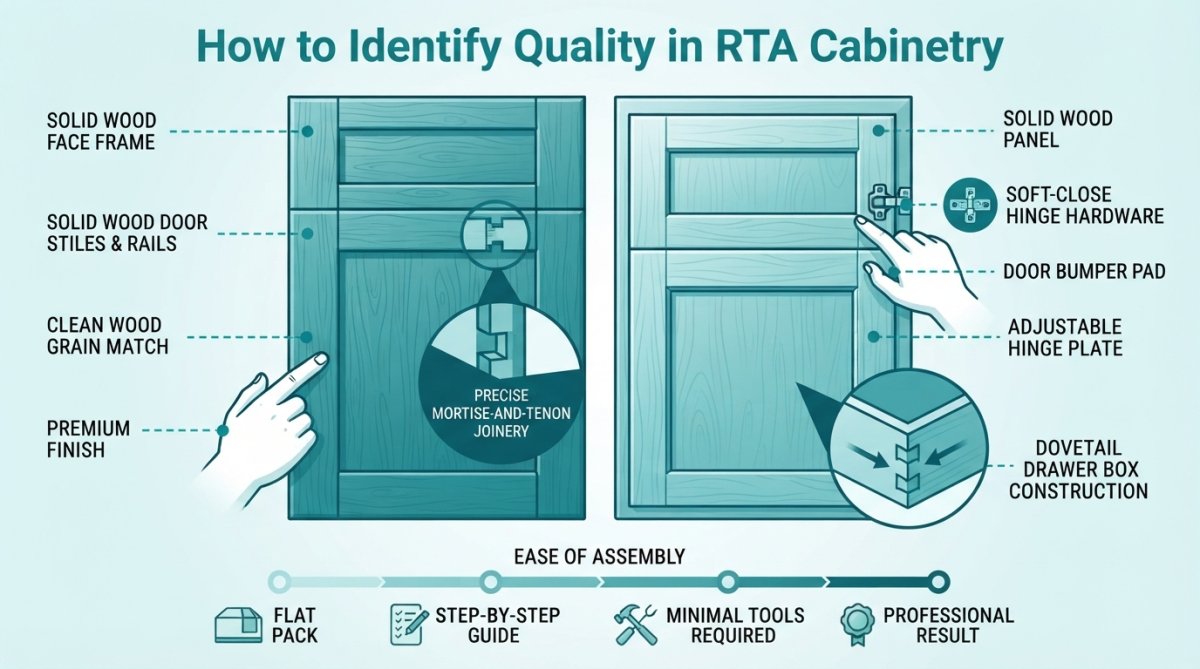
Before you assemble RTA cabinets, you need to know what you're actually buying. Visual inspection during unboxing reveals construction quality and material composition.
Visual inspection techniques
Open the cabinet box before assembly and examine the actual materials. Look at the interior surfaces, are they plywood with visible veneer, or solid wood? Solid wood shows consistent grain patterns throughout. Plywood shows a visible veneer layer glued to a lighter substrate when used in cheaper cabinets.
Check the edges of all panels. Quality cabinets have edge-banding that matches the veneer when the interior materials need protection. Run your finger along every exposed edge; it should feel smooth and sealed. If you see particle board edges moisture will eventually penetrate and cause swelling.
Some cabinets have UV paints that may be water or oil base. A thick coat of Oil Base UV lacquer is one of the better cabinet finishes used today. Water base UV paints may be sprayed too thin to offer any protection or longevity.
Examine the joints where panels meet. Dovetail joints (interlocking wood fingers) are stronger than simple butt joints. Cam-lock systems (metal fasteners that tighten with an Allen wrench) are more reliable than dowels for RTA assembly and used in some of the better quality custom and RTA cabinets.
Inspect cabinet doors and drawer fronts for wood quality and thickness of paint. High-quality veneer is thick enough to sand and refinish (1/16 inch or thicker). Tap the door gently; solid wood and quality veneer produce a solid thunk. Thin veneer over MDF produces a hollow sound. The center panel of many Shaker doors are made of MDF and you can easily hear the lack of quality with a light tap. HDF center panels sound solid when impacted and will resist moisture wonderfully. Feel the paint finish at the same time. A thin coat of paint will not endure and the protection of the MDF will disappear.
Check hardware quality. Hinges should be heavy-duty and fully adjustable. Drawer slides should be full-extension, ball-bearing models that glide smoothly. There are many worldwide manufacturers offering lifetime warranties on their hardware. In the event of hardware failure the drawer slides and hinges are easily replaced.
Construction details that signal durability
The presence of a face frame (a solid wood border around the cabinet opening) indicates better construction. Face frames add structural rigidity and provide a surface for hinges and hardware. Some people represent that frameless is better because they result in a wider drawer. It is true that a drawer will be wider but at the expense of not having a quality face frame.
Back panels matter more than most people realize. Quality cabinets have plywood or solid wood back panels, not thin hardboard. A solid back panel prevents the cabinet from racking (twisting out of square) when mounted to walls.
Interior shelving should be adjustable and supported by quality hardware. The finish quality, whether stain or paint, reveals manufacturing standards.
Common myths about RTA construction
RTA cabinets don't require professional installation. A competent homeowner can assemble quality RTA cabinets following instructions. However, installation, leveling, and securing to walls requires precision using floor leveling materials, squares and levels. A six foot level is a standard tool in the cabinetry installation field along with a laser level.
Solid wood is always better than plywood. A well-built plywood cabinet outperforms a poorly constructed solid wood cabinet. Construction quality matters more than material choice.
RTA cabinets are temporary and disposable. Quality RTA cabinets are designed for permanent installation and can last 25-30 years with proper care.
Pre-Assembled vs RTA Cabinets: Material and Construction Differences
The choice between pre-assembled (fully built before shipping) and RTA (shipped flat and assembled on-site) affects cost, timeline, and material options available to you.
Pre-assembled cabinets arrive ready to install. The manufacturer builds, finishes, and quality-checks every cabinet before shipping. RTA cabinets ship flat, reducing shipping costs and allowing faster delivery. You assemble them on-site following instructions. This method is intended to save you money and help you get a better cabinet.
Material options differ between the two categories. Pre-assembled manufacturers typically offer solid wood and quality plywood. RTA manufacturers offer the full spectrum from particle board to premium solid wood. However, premium RTA lines offer material quality identical to pre-assembled options. For those seeking premium inset cabinet options with greater flexibility, Custom Order Inset and Custom Color Inset cabinets provide top-quality alternatives available at wholesale pricing, while Special Order Oak Inset Kitchen Cabinets deliver solid wood construction in multiple wood species and finishes.
The real structural difference is negligible. Both pre-assembled and quality RTA cabinets use the same joinery methods, hardware, and finishing techniques.
Long-term structural failure analysis
Cabinet failures fall into predictable categories. Hinge failure appears first in budget cabinets, causing doors to sag within 3-5 years. Quality hinges last 20+ years.
Joint failure develops when fasteners loosen over time. A cabinet with multiple fastening points per joint will outlast one with 2-3.
Veneer delamination occurs when glue fails or moisture penetrates unsealed edges. This failure is irreversible and requires cabinet replacement. It's prevented entirely by quality edge-banding and proper moisture management.
Drawer failure happens when slides wear out or drawer boxes warp. Quality full-extension ball-bearing slides last 20+ years. It is wise to use glue when assembling drawer joints.
Back panel failure allows cabinets to rack out of square. Quality back panels prevent this entirely. Here also a thick glue or deck glue from a caulk gun can greatly increase to a lifetime of usage.
Environmental Impact of RTA Cabinet Material Types
Material choice affects not just your cabinet's lifespan, but also its environmental footprint.
Solid wood cabinets depend on sustainable forestry. Responsibly harvested hardwood (certified by the Forest Stewardship Council) is renewable and carbon-neutral over its lifecycle. A solid wood cabinet lasting 30 years has a lower environmental cost per year of use than an MDF cabinet lasting 10 years.
Plywood uses veneer glued to a substrate, generating less waste than solid wood construction. However, the glues used in plywood (typically formaldehyde-based) have environmental and health impacts. Quality plywood uses low-formaldehyde or formaldehyde-free adhesives. Check your cabinet to see if it is CARB approved meaning no formaldehyde.
MDF and particle board are made from wood waste and sawmill byproducts. However, the resin binders are petroleum-based and energy-intensive to produce. MDF cabinets' short lifespan (2-10 years) means more frequent replacement and waste.
The environmental winner depends on your perspective. Solid wood from responsible forestry has the lowest long-term impact because it lasts decades. Plywood with low-formaldehyde glues is the practical middle ground.
Solid Wood RTA Cabinets: Benefits and Real-World Expectations
When you choose solid wood RTA cabinets, you're making a long-term investment. Solid wood cabinets are repairable in ways engineered materials cannot match. A scratch on a solid wood door can be sanded and refinished. A loose joint can be disassembled and re-glued. This repairability means solid wood cabinets can be maintained and refreshed indefinitely.
The aesthetic quality of solid wood is genuine. Wood grain varies naturally, creating visual interest that veneer and paint cannot replicate. Solid wood accepts stain in ways that engineered materials cannot, allowing you to customize color and tone.
Solid wood movement is real and requires acceptance. In winter, when humidity drops, solid wood shrinks slightly. You might notice small gaps at joints. In summer, these gaps close. This seasonal movement is normal, not a defect.
When solid wood makes sense
Solid wood RTA cabinets make sense when you plan to keep them for 15+ years, when you value repairability and customization, and when you're willing to invest upfront to avoid replacement costs later. They're ideal for primary kitchens in owned homes where you expect to stay long-term.
Solid wood is also the right choice if you want to refinish or modify cabinets later. You cannot stain an MDF cabinet a different color or sand out damage.
Cost-effectiveness considerations
The cost difference between solid wood and plywood RTA cabinets varies depending on wood species and quality. However, that premium spreads across 20-30 years of use. Over time, the annual cost of ownership is comparable to plywood when you factor in replacement.
If you're renovating a rental property or a house you plan to sell within 5 years, solid wood is overpriced. Budget plywood cabinets make more financial sense for short-term situations since many buyers will replace the kitchen cabinets before they even move in.
Conclusion
The answer to "are rta cabinets solid wood" is: some are, some aren't, and the material choice matters far less than construction quality. A well-built plywood cabinet outperforms a poorly constructed solid wood cabinet.
What actually determines cabinet longevity is the combination of materials, joinery, hardware, and finishing. Dovetail joints matter. Quality edge-banding matters. Heavy-duty hinges matter. Proper moisture management in your kitchen matters. How the cabinet is assembled and the glue and fastening used is also important.
When evaluating RTA cabinets, examine the actual construction rather than relying on marketing language. Open the boxes. Look at the joints, edges, and hardware. Understand what material is used where. Ask manufacturers specific questions about edge-banding, hinge quality, and shelf support systems.
Frequently Asked Questions
Are RTA cabinets actually solid wood, or is that just marketing?
Many are but not all RTA cabinets are solid wood. Many use plywood box construction with solid wood doors and frames, while others use MDF or particle board throughout. The term 'RTA cabinets' refers to the assembly format, not the material. Quality RTA options combine solid wood components (like doors and face frames) with engineered wood in the cabinet box for structural balance and cost-effectiveness. Always check the product specification to confirm which parts are solid wood.
What's the difference between solid wood and plywood RTA cabinets in terms of durability?
Solid wood cabinets offer superior durability and can be refinished multiple times over decades. Plywood RTA cabinets are highly durable when constructed properly—plywood actually resists warping better than solid wood in humid kitchens. The real durability factor depends on construction quality: dovetail joints, cam-lock systems, and proper moisture barriers matter more than material alone. Both solid wood and quality plywood cabinets can last 20+ years with proper care.
How can I visually identify if an RTA cabinet is made with real wood or engineered materials?
Examine the cabinet box sides, bottom, and back. Solid wood will show consistent grain patterns and natural color variation. Plywood and veneer show a thin wood layer over a composite core—look for the veneer seam at edges. MDF and particle board appear uniform, denser, and often have a slightly plastic feel. Check the interior for visible wood grain (solid) versus smooth, uniform appearance (engineered). Cabinet doors are easiest to assess: solid wood doors feel heavier and show natural grain; veneered doors have a thin wood surface layer.
Do RTA cabinets with solid wood components cost significantly more than engineered options?
Solid wood RTA cabinets do not have to cost more. They typically cost more upfront, but the price difference varies by wood species and cabinet style. A hybrid approach—solid wood doors and face frame with plywood box construction—offers a cost-effective middle ground that delivers the look and durability of solid wood where it's most visible, while using engineered wood where it's hidden. Pricing depends on quantity, customization options, and delivery timeline, so contact RTA Wholesalers for a current quote on your specific project.


