 833-377-8663

Are RTA Cabinets Water Resistant? A Complete Guide

Table of Contents
- Are RTA Cabinets Water Resistant? The Short Answer
- Understanding RTA Cabinet Materials and Water Resistance
- How Cabinet Finishes Impact Water Resistance
- Best Cabinet Materials for Bathrooms and Wet Areas
- How to Protect Cabinets from Water Damage
- Repairing Water-Damaged RTA Cabinets
- Regional Climate Considerations for Cabinet Durability
- Pros and Cons of RTA Cabinets for Water-Prone Environments
Are RTA Cabinets Water Resistant? A Complete Guide
Last Updated: July 27, 2026
Are RTA Cabinets Water Resistant? The Short Answer
The question of whether RTA cabinets are water resistant deserves a straightforward answer: it depends entirely on the materials and finishes used. Most standard RTA cabinets offer limited water resistance without proper protection. The core materials, typically HDF, particleboard, or plywood, absorb moisture readily, meaning water damage isn't a matter of if, but when, unless you take deliberate steps to seal and protect them.
Are RTA cabinets water resistant enough for everyday kitchen use in normal conditions? Yes, with the right finish. Are they waterproof enough for bathrooms or flood-prone areas without reinforcement? No. The distinction is critical because it shapes every decision you make during selection, installation, and maintenance.
The real value isn't in finding a cabinet that resists water on its own, but in understanding which materials perform better, which finishes provide genuine protection, and which maintenance practices actually prevent the swelling and deterioration that destroys RTA cabinets in wet environments.
Understanding RTA Cabinet Materials and Water Resistance
Your cabinet's water resistance starts with what it's made from. Different substrates handle moisture exposure in dramatically different ways, and understanding these differences is the foundation for making an informed choice.
HDF and Particleboard: Common but Vulnerable
HDF (high-density fiberboard) and particleboard are the most common materials in budget-friendly RTA cabinets. Both are engineered from wood fibers and adhesives compressed under heat and pressure. They're affordable and stable, which is why they dominate the RTA market.
The problem: they're moisture sponges. When water contacts exposed edges or unfinished surfaces, these materials absorb it like paper towels. The fibers swell, the adhesives weaken, and within weeks you'll see visible warping, soft spots, or delamination. HDF performs slightly better than particleboard because its higher density creates a tighter structure, but neither material is adequate for wet areas without aggressive sealing and finish protection.
Plywood vs MDF Cabinets: Water Resistance Comparison
Plywood offers a meaningful step up from particleboard or HDF. It's made from thin layers of solid wood veneer glued together, creating a cross-grain structure that resists warping and absorbs moisture more slowly than engineered materials.
MDF (medium-density fiberboard) sits between particleboard and plywood in performance. It's denser and more stable than particleboard, with a smoother surface that takes finishes well, but it still absorbs moisture readily when exposed.
For kitchens with normal humidity, plywood or MDF with a quality polyurethane finish performs adequately. For bathrooms or areas with standing water risk, plywood is the minimum acceptable choice, and edge sealing becomes non-negotiable. RTA Wholesalers offers custom color inset cabinetry in multiple wood species and materials, allowing you to choose substrates that match your moisture exposure level.
Solid Wood Options
Solid wood cabinets represent the best water resistance among traditional materials. Hardwoods like oak, maple, and cherry resist moisture absorption far better than engineered materials because they're dense and naturally stable. They swell less, dry faster, and can recover from minor water exposure if dried promptly.
The trade-off is cost and availability. Solid wood RTA cabinets are less common because they're heavier and more expensive to ship. But in flood-prone areas or high-moisture bathrooms, they're the only RTA option that performs reliably without extensive reinforcement. A properly finished solid wood cabinet in a bathroom will outlast a particleboard cabinet in a kitchen.
How Cabinet Finishes Impact Water Resistance
Material choice matters, but finish choice often matters more. A high-quality polyurethane or lacquer finish on particleboard can outperform an unfinished plywood cabinet.
Polyurethane and Lacquer Finishes
Polyurethane finishes create a plastic-like barrier that blocks water penetration. They're durable, resistant to both moisture and chemicals, and maintain their appearance through years of kitchen use. Lacquer finishes are thinner but harden quickly and create a smooth, professional appearance.
Cabinets with a two-part polyurethane finish can withstand occasional splashing and humidity spikes without swelling. The same cabinets without finish will begin showing damage within weeks. Edge banding and sealant application determine how effective any finish is, a cabinet with polyurethane on the face but exposed edges will fail because water penetrates through the unprotected edges first.
Paint vs Stain for Moisture Protection
Paint finishes provide superior moisture protection compared to stain because they create an opaque, continuous barrier. Water can't penetrate paint the way it can seep under stain finishes.
Stain finishes are more transparent, allowing the wood grain to show through, but they also leave the wood more exposed to moisture. Stain alone is inadequate protection and must be topped with polyurethane or lacquer to provide real water resistance.
For bathrooms and wet areas, paint finishes are the clear choice. They're more forgiving of moisture exposure, easier to touch up, and create a more waterproof seal. RTA Wholesalers offers custom color inset cabinets with unlimited Sherwin Williams paint color options, giving you both aesthetic flexibility and superior moisture protection.
Best Cabinet Materials for Bathrooms and Wet Areas
If you're installing cabinets in a bathroom, under a sink, or in any area with regular moisture exposure, material selection is make-or-break.
Solid wood with a polyurethane or paint finish is the gold standard. If solid wood is outside your budget, plywood with a two-part polyurethane finish is the minimum acceptable choice. MDF or HDF without aggressive sealing will fail in bathroom environments within 12-24 months depending on ventilation and humidity levels.
The cabinet construction method also matters. Inset cabinets (where the door sits flush with the frame) provide better water protection than overlay cabinets because water is less likely to run down the sides and into gaps. RTA Wholesalers specializes in inset cabinet options, which offer superior moisture management in addition to their cleaner aesthetic.
Ventilation is equally important as material choice. A bathroom with poor ventilation will destroy even solid wood cabinets eventually. Install an exhaust fan rated for your bathroom size and run it during and for 20 minutes after showers.
How to Protect Cabinets from Water Damage
Even if you choose the best materials and finishes, active protection during and after installation determines whether RTA cabinets are water resistant in practice.
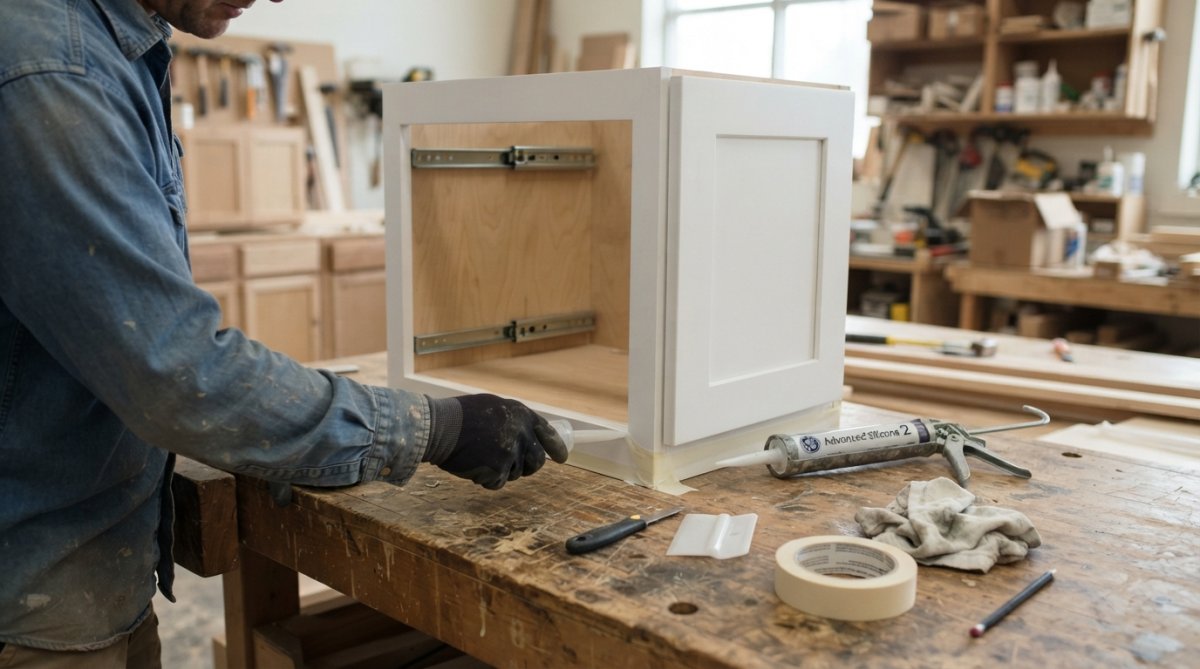
Sealant Application and Edge Banding
Edge banding is adhesive-backed veneer that covers the exposed edges of particleboard, MDF, or plywood. It's your primary defense against water penetration. Without edge banding, water enters the cabinet through the edge grain and spreads throughout the interior.
During assembly, inspect every edge. Edges that are already banded should be checked for gaps or lifting. Any gap larger than a credit card thickness needs to be sealed with polyurethane caulk before installation.
Exposed edges that aren't banded, typically the back edges of cabinets installed against walls, should be sealed with polyurethane caulk or marine-grade sealant. For sink base cabinets specifically, apply sealant to the interior bottom where water inevitably pools using a waterproof sealant rated for food contact areas.
Maintenance and Long-Term Care
Water resistance isn't a one-time installation step, it's an ongoing maintenance commitment. Wipe up spills immediately, water sitting on a cabinet surface for hours will begin penetrating the finish.
Check under sinks monthly for leaks. Drain lines fail silently, and catching leaks early prevents catastrophic failure. Inspect edge banding and sealant annually for gaps, peeling, or cracks. Small gaps can be sealed with additional polyurethane caulk.
Monitor humidity levels in bathrooms using an inexpensive hygrometer. If humidity consistently exceeds 60%, increase ventilation or add a dehumidifier. Refinish or reseal cabinets every 3-5 years in high-moisture areas.
Installation and Ventilation Considerations
Ensure cabinets are level before fastening them to the wall. Unlevel cabinets create gaps where water pools. Leave a small gap between the cabinet back and the wall, about 1/4 inch, to allow air circulation that prevents moisture from being trapped.
For under-sink installations, install a liner or waterproof membrane on the cabinet floor before the sink is set. This catches water from slow leaks that would otherwise soak into the substrate. Install an exhaust fan in any room with cabinets and moisture exposure, sized appropriately and vented to the outside.
Repairing Water-Damaged RTA Cabinets
Minor swelling in particleboard or MDF can sometimes be addressed by removing the cabinet from service, drying it thoroughly in a warm space with a dehumidifier, and allowing the material to shrink back. This works only if swelling is caught early, within days of water exposure.
Soft spots or sponginess indicate structural failure and the cabinet should be replaced. Delamination can be repaired by removing the damaged section, cleaning the substrate, applying new adhesive, and clamping until dry. For solid wood cabinets, water damage is often repairable, sand the affected area, let it dry completely, and refinish.
The lesson: catch water damage early. A damp cabinet that's dried within days can be saved. A cabinet that's been wet for weeks is usually beyond repair.
Regional Climate Considerations for Cabinet Durability
Where you live shapes how much water resistance matters. High-humidity climates (Southeast, Pacific Northwest) require aggressive cabinet protection. Solid wood or plywood with polyurethane finishes is the minimum acceptable choice. Particleboard cabinets will fail within 2-3 years without exceptional maintenance.
Moderate-humidity climates (most of the Midwest and mid-Atlantic) allow more flexibility. Plywood or quality MDF with good finishes performs adequately. Arid climates experience extreme humidity swings that stress finishes and joints, solid wood handles these swings better than engineered materials.
Coastal regions add salt spray exposure, which accelerates finish degradation. Paint finishes hold up better than stain in coastal areas. Understanding your regional climate helps you choose materials that will actually perform in your environment.
Pros and Cons of RTA Cabinets for Water-Prone Environments
RTA cabinets offer real advantages in affordability, selection, and customization, but also come with limitations in water-prone environments.
Pros:
RTA cabinets are significantly more affordable than semi-custom or fully custom cabinetry, allowing you to invest in better materials and finishes without exceeding budget. Selection is unmatched, you're not limited to whatever your local cabinet shop has in stock. RTA Wholesalers offers custom color inset cabinetry in most any size, allowing you to specify exactly what you need for your space.
Assembly timeline is predictable. Our assembled cabinets are available in just 5 weeks, which means you can plan your project timeline with confidence. Customization extends to finishes, you can specify Sherwin Williams paint colors or custom stain options, giving you control over water resistance through finish selection.
Cons:
Quality varies significantly across RTA manufacturers. Budget options cut corners on edge banding, finish quality, and substrate selection. Assembly requires attention to detail, improper assembly creates gaps and misaligned joints that compromise water resistance.
Warranty coverage is often limited for water damage, as most manufacturers exclude it as a maintenance issue. Repair and replacement parts can be harder to source years later if a door or panel fails.
Understanding whether RTA cabinets are water resistant ultimately comes down to making informed choices about materials, finishes, installation, and maintenance. Budget particleboard cabinets with minimal sealing will fail in any moisture-prone environment. Solid wood or plywood cabinets with polyurethane finishes and proper edge sealing perform reliably even in bathrooms.
At RTA Wholesalers, we understand that one-size-fits-all cabinet solutions don't work for diverse projects and climates. That's why we offer inset cabinets that are top quality and available in custom sizes and custom colors at great wholesale pricing. Our assembled cabinets are available in just 5 weeks in a multitude of wood species and stain colors or an unlimited choice of Sherwin Williams paint colors, giving you the flexibility to choose the right materials and finishes for your specific moisture exposure. Start with RTA Wholesalers and build cabinets that are genuinely suited to your environment.
Frequently Asked Questions
What materials are RTA cabinets typically made from, and which offer the best water resistance?
RTA cabinets are commonly constructed from HDF, particleboard, plywood, or solid wood. Plywood and solid wood offer superior water resistance compared to HDF and particleboard, which absorb moisture and swell when exposed to humidity. The finish applied to these materials, such as polyurethane or quality paint, significantly enhances water resistance regardless of the base material. For water-prone areas, prioritize cabinets with sealed edges and protective coatings.
Are RTA cabinets suitable for high-humidity environments like bathrooms?
Standard RTA cabinets made from particleboard or HDF are not ideal for bathrooms without additional protection. However, RTA cabinets constructed from plywood or solid wood with polyurethane or paint finishes can perform well in bathrooms when properly sealed and maintained. Proper ventilation, moisture control, and regular maintenance are essential. Edge banding and sealants on all exposed surfaces help prevent water penetration and cabinet swelling in humid conditions.
How can I make my RTA cabinets more water resistant after installation?
After installation, apply quality sealants to all joints, seams, and exposed edges where moisture can penetrate. Ensure edge banding is intact and sealed. Apply polyurethane topcoats or waterproof paint to cabinet surfaces. Maintain proper kitchen ventilation to reduce humidity levels. Install a backsplash behind sink areas and use cabinet liners to catch spills. Regular inspection for signs of swelling or water damage allows early intervention before permanent damage occurs.
What is the difference between water-resistant and waterproof cabinets?
Water-resistant cabinets can withstand occasional moisture exposure and humidity without immediate damage, but prolonged water contact will eventually cause swelling and deterioration. Waterproof cabinets are sealed so thoroughly that water cannot penetrate the material at all. Most RTA cabinets are water-resistant rather than waterproof. Achieving true waterproof status requires professional-grade sealants, multiple protective coatings, and flawless application to all surfaces and edges.


