 833-377-8663

Best Cabinets for Kitchen Flips: A Buyer's Guide

Table of Contents
- Best Cabinets for Kitchen Flips: Options That Drive ROI
- Stock vs. Semi-Custom vs. Custom Cabinets for Flips
- RTA Kitchen Cabinets for Flipping: Assembly, Lead Times, and Installation Labor
- Material Quality: Plywood, Particle Board, and Durability for Rental Units
- Kitchen Cabinet Painting vs. Replacing for ROI
- Kitchen Flip Budget Breakdown: Cabinet Costs and Value
- White Shaker and Modern Slab-Front Styles: The Industry Standard
- Top Cabinet Brands and Options for Kitchen Flips
Best Cabinets for Kitchen Flips: A Buyer's Guide
Last Updated: July 3, 2026
When evaluating cabinets for kitchen flips, the math is simple: your choice determines whether you hit your profit margin. Cabinets consume 25-40% of a kitchen remodel budget, yet they're often the first thing buyers notice. Get them right, and you've created an anchor for the entire flip. Get them wrong, and you're leaving money on the table.
Why Cabinet Choice Matters for Fix-and-Flip Success
Your cabinet decision shapes three critical outcomes: project timeline, buyer perception, and durability. Many flippers chase the cheapest option and move on, but that strategy collapses when delayed delivery pushes your timeline by six weeks, suddenly, your "savings" evaporate into carrying costs.
The real question isn't "What's the cheapest option?" It's "What delivers the highest perceived value while staying within my timeline and budget?" Research from the National Association of Home Builders shows that kitchen renovations consistently rank as the highest-ROI home improvement project, but only when executed with quality materials. A kitchen with cheap particle-board cabinets reads as "rushed" to buyers, regardless of how nice the countertops are.
Stock vs. Semi-Custom vs. Custom Cabinets for Flips
Understanding these three categories is essential because each serves a different flip profile.
Stock Cabinets: Speed and Budget
Stock cabinets are pre-manufactured in standard sizes with fixed door styles and finishes. They're the fastest option to source, often available immediately at big box retailers. For flippers on tight timelines, stock cabinets eliminate the wait.
The trade-off is limited customization. You're choosing from a pre-set catalog of sizes and finishes. Hampton Bay and similar lines start at accessible price points, making them attractive for budget-conscious flips. They work best when your target buyer is price-sensitive and the kitchen layout is straightforward. Stock cabinets often use particle board boxes with veneer doors, which hold up adequately for owner-occupied homes but show wear faster in rental units.
Semi-Custom: The Middle Ground
Semi-custom cabinets offer more flexibility than stock without the lead time and cost of full custom. You choose from a broader range of door styles, finishes, and sizes, with options to modify dimensions within certain parameters.
Brands like Fabuwood and American Woodmark deliver professional-grade construction, solid wood frames, dovetail drawers, and quality hardware at mid-range pricing. Lead times typically run 6-12 weeks. For most flips, semi-custom hits the sweet spot, you get enough customization to match your kitchen's dimensions and the buyer's style preferences without paying for endless custom options.
Custom Cabinets: Premium Appeal
Full custom cabinetry is built to your exact specifications. The trade-off is cost and timeline. Custom cabinets run 12-16 weeks or longer, and pricing is significantly higher than semi-custom. Custom cabinetry makes sense in high-end flips where the target buyer expects luxury finishes or when your kitchen has unusual dimensions. But for most flips, custom cabinetry is overkill, the additional cost doesn't generate proportional ROI in resale price.
RTA Kitchen Cabinets for Flipping: Assembly, Lead Times, and Installation Labor
Ready-to-assemble cabinetry has evolved significantly. What was once dismissed as a budget option is now a legitimate choice for flippers who understand the trade-offs between assembly time and cost savings.
Ready-to-Assemble vs. Pre-Assembled Cabinets
RTA cabinets arrive flat-packed and require on-site assembly. Pre-assembled cabinets ship fully built and ready to install. RTA cabinets compress shipping costs and lead times, they're lighter, more compact, and cheaper to transport. For flippers ordering in bulk or managing multi-unit projects, RTA pricing is significantly lower. The trade-off is assembly labor.
RTA Wholesalers specializes in this space, offering inset and overlay cabinet options in multiple wood species and custom colors. Their ready-to-assemble approach reduces lead times while maintaining quality construction with plywood boxes, solid wood frames, and quality hardware.
Pre-assembled cabinets eliminate assembly risk. If you're managing three units simultaneously, RTA assembly might take 60 total hours. At $50/hour labor, that's $3,000 in assembly costs. If pre-assembled cabinets cost $2,500 more per kitchen, you're looking at $7,500 extra for three units. In that scenario, RTA makes financial sense.
Supply Chain Lead Times for Flippers
Stock cabinets are available immediately. Semi-custom typically runs 8-12 weeks. RTA cabinets from quality suppliers like RTA Wholesalers can ship in 5 weeks or less, which is faster than traditional semi-custom.
Every week your project sits waiting for cabinets is a week you're carrying the property, paying utilities, property taxes, and financing costs. A six-week delay can easily cost $3,000-$5,000 in carrying costs. When evaluating cabinet options, always factor in the true cost of delay.
Installation Labor Cost Analysis
Cabinet installation is where many flippers underestimate their true costs. It's not just hanging boxes, it's leveling, shimming, scribing, connecting, and finishing. Skilled installation takes time.
Stock cabinets with simple layouts typically take 16-24 hours for a standard 10-by-12-foot kitchen. Semi-custom might run 24-32 hours. RTA cabinets, if your crew is experienced with assembly, can compress this to 20-28 hours total.
At $50-$75/hour for skilled labor, you're looking at $800-$2,400 in installation labor per kitchen. Quality cabinets with accurate dimensions reduce rework significantly.
| Cabinet Type | Lead Time | Assembly Time | Installation Time | Total Labor Hours |
|---|---|---|---|---|
| Stock | Immediate | None | 16-24 | 16-24 |
| Semi-Custom | 8-12 weeks | None | 24-32 | 24-32 |
| RTA (Quality) | 5 weeks | 8-12 | 16-20 | 24-32 |
| Custom | 12-16 weeks | None | 24-32 | 24-32 |
Material Quality: Plywood, Particle Board, and Durability for Rental Units
Material quality determines durability, and durability determines whether buyers perceive value or see a project that will need work in five years.
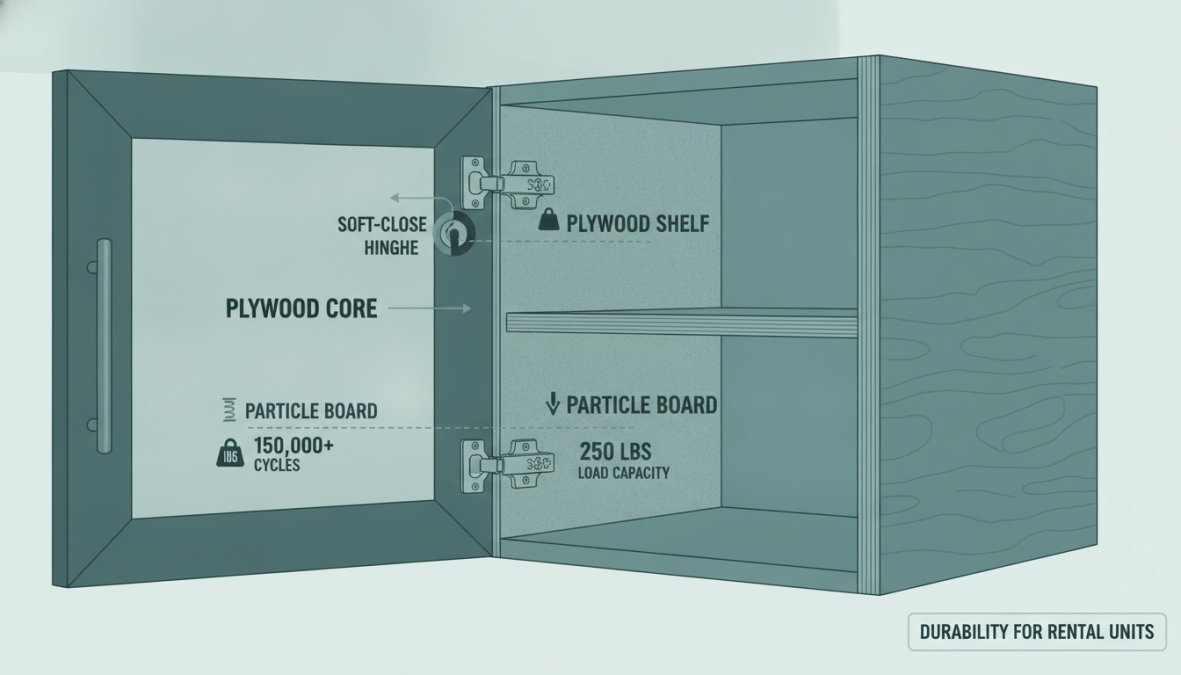
Cabinet Grade Construction
Cabinet boxes come in three primary constructions: solid plywood, engineered plywood with veneer, and particle board.
Solid plywood cabinets use 3/4-inch plywood for the box structure. This is the gold standard. Plywood resists moisture, warping, and damage from daily use. It holds fasteners reliably and lasts decades.
Engineered plywood uses veneer over a plywood or MDF core. This reduces cost while maintaining reasonable durability. This is the standard for mid-range semi-custom cabinets and is adequate for owner-occupied homes.
Particle board is the budget option. It's compressed wood fibers held together with adhesive. Particle board swells when exposed to moisture, can't support heavy loads, and deteriorates faster than plywood. For flips in markets where durability matters to the buyer, particle board is a false economy.
Hardware and Finish Durability
Cabinet hardware, hinges, drawer slides, handles, determines how the cabinet feels and how long it lasts. Budget cabinets use cheap stamped-steel hinges and basic slides. Quality cabinets use soft-close hinges and smooth-operating drawer slides.
Soft-close hinges cost more but reduce noise, prevent slamming, and extend hardware life. When a buyer opens a cabinet and feels the smooth, controlled close, they perceive quality. Drawer slides matter equally. Quality slides use ball bearings and glide smoothly even when fully loaded.
Maintenance and Warranty for Rental and Flip Units
Cabinet warranties vary significantly by brand. Budget cabinets often come with limited warranties (1-2 years). Quality cabinets offer longer warranties (sometimes 10+ years). A manufacturer offering a 10-year warranty is betting the cabinet will last that long. Quality cabinets with solid construction and durable finishes require minimal maintenance, reducing your liability and improving margins.
Kitchen Cabinet Painting vs. Replacing for ROI
Sometimes the best cabinet choice is to keep the existing cabinets and paint them. Painting existing cabinets costs $1,500-$3,500 per kitchen. Replacing cabinets costs $5,000-$15,000 or more. Painting makes sense when the underlying cabinet structure is solid but the finish is dated. A fresh coat of paint in a modern color completely transforms the kitchen's perception.
Painting also makes sense on a tight timeline. Painting takes 2-3 weeks. Replacing cabinets takes 8-16 weeks plus installation.
Replacement makes sense when the existing cabinets are particle board, damaged, or structurally compromised. It also makes sense when the kitchen layout is inefficient and new cabinets allow you to reconfigure the space.
Kitchen Flip Budget Breakdown: Cabinet Costs and Value
Understanding where cabinets fit in your overall kitchen budget helps you allocate resources strategically.
Allocating Your Kitchen Budget
A typical kitchen remodel allocates budget roughly as follows: cabinets (30-40%), countertops (15-20%), flooring (10-15%), appliances (15-20%), labor and miscellaneous (10-20%). Cabinets consume the largest share.
If your total kitchen budget is $30,000, you're allocating $9,000-$12,000 to cabinets. If your budget is $50,000, you're allocating $15,000-$20,000. The allocation depends on your target buyer. In a market where buyers prioritize modern appliances, you might allocate more to appliances and less to cabinets.
Resale Value and ROI Considerations
Kitchen renovations return 50-80% of their cost in increased home value, depending on the market and quality level. A $12,000 cabinet investment might generate $6,000-$9,600 in added resale value. The key to maximizing ROI is choosing cabinets that appeal to your target buyer without over-investing in features they don't value.
White Shaker and Modern Slab-Front Styles: The Industry Standard
Cabinet door style shapes the kitchen's entire aesthetic. White shaker cabinets are the industry standard for good reason. Shaker styling, a simple frame-and-panel door with no ornamentation, appeals across demographics and design trends. White finishes feel fresh, clean, and modern while remaining timeless.
This makes white shaker the safe choice for flips. Modern slab-front cabinets, flat, minimalist doors with no frame-and-panel detail, are the contemporary alternative. They feel sleek and modern, appealing to buyers who want a current aesthetic. The safest approach for most flips is white shaker cabinets in a quality construction level that matches your target market. If you're looking for flexibility in finishes, Custom Color Inset options allow you to match virtually any design direction while maintaining the timeless appeal of inset cabinetry.
Top Cabinet Brands and Options for Kitchen Flips
Budget-Friendly Cabinetry: Hampton Bay and Stock Options
Hampton Bay cabinets from The Home Depot are the accessible entry point. Stock options start at budget-friendly price points and are available immediately. Hampton Bay cabinets use particle board construction with veneer doors. They're functional and adequate for owner-occupied homes with normal use, but stock cabinets rarely offer the best value compared to semi-custom options.
Mid-Range Quality: Fabuwood and American Woodmark
Fabuwood and American Woodmark operate in the semi-custom space, offering professional-grade construction at mid-range pricing. Both brands deliver solid wood frames, quality hardware, and durable finishes. Fabuwood is known for excellent value-to-quality ratio. Lead times typically run 8-12 weeks.
Premium RTA and Semi-Custom Solutions
Premium RTA providers offer high-quality ready-to-assemble cabinets that compete with semi-custom brands on construction quality while maintaining faster lead times and lower costs.
RTA Wholesalers offers inset cabinetry in custom sizes and custom colors at wholesale pricing. Their assembled cabinets are available in multiple wood species and stain colors, plus unlimited Sherwin Williams paint color options. The 5-week lead time is significantly faster than traditional semi-custom, and their free kitchen design service adds value for flippers planning custom layouts. For investors seeking premium inset options, Custom Order Inset cabinetry provides the flexibility to match any design aesthetic while maintaining consistent quality across multiple units.
Multi-Unit Flips: Wholesale and Bulk Options
If you're managing multiple units simultaneously, wholesale pricing becomes critical. For investors managing 3+ units, wholesale suppliers offer significant cost advantages through volume pricing and dedicated account management. RTA Wholesalers' wholesale pricing on inset cabinetry is designed for this scenario, allowing you to maintain consistency across units while accessing wholesale costs.
Choosing the best cabinets for kitchen flips requires balancing timeline, budget, and target buyer expectations. Semi-custom and quality RTA options deliver the best ROI for most flips, they signal quality to buyers without over-investing in features that don't generate proportional returns.
RTA Wholesalers specializes in this space, offering inset cabinetry in custom sizes and custom colors at wholesale pricing. Their assembled cabinets ship in five weeks, compressing your timeline while maintaining quality construction. With options ranging from multiple wood species and stain colors to unlimited Sherwin Williams paint selections, you can match the cabinet quality to your target market. Their free kitchen design service adds value for flippers planning custom layouts.
Frequently Asked Questions
What type of cabinets are best for house flipping?
For most kitchen flips, semi-custom or quality RTA cabinets offer the best balance of cost, durability, and resale appeal. White shaker and modern slab-front styles consistently deliver strong ROI. Stock cabinets work for tight budgets, but semi-custom options with solid wood fronts and plywood boxes provide better long-term durability and buyer perception, critical for investment properties.
Are RTA cabinets good for kitchen flips?
Yes, when sourced from reputable manufacturers. Ready-to-assemble cabinets offer significant cost savings and fast supply chain lead times, typically 5 weeks or less. The key is selecting RTA options with quality plywood construction, dovetail drawers, and soft-close hinges. Assembly and installation labor costs must be factored into your budget, but quality RTA cabinets deliver professional results at wholesale pricing suitable for fix-and-flip economics.
Should I paint or replace cabinets for a kitchen flip?
Replace cabinets if the existing ones are particle board, damaged, or outdated in style, replacement drives stronger ROI and appeals to modern buyers. Paint existing cabinets only if they have solid construction, quality hardware, and neutral bone structure. Painting is faster and cheaper upfront, but replacement with fresh semi-custom or RTA cabinets typically justifies the investment through resale value and buyer confidence.
How much should I budget for cabinets in a kitchen flip?
Cabinets typically represent 30-40% of a kitchen remodel budget. For budget-conscious flips, allocate funds toward quality plywood-box construction with attractive door styles and finishes. Focus spending on high-visibility items: cabinet hardware, soft-close hinges, and a cohesive color palette. Wholesale cabinetry sources and RTA options help maximize your budget while maintaining professional appearance and durability for rental or resale units.


