 833-377-8663

Best Ease of Installation for Reliable Cabinet Shipping

Table of Contents
- How Cabinet Shipping Reliability Directly Affects Installation Ease
- Kitchen Cabinet Shipping Damage Prevention: Crating, Palletizing, and Freight Protocols
- Cabinet Installation Tools List: What You Need for RTA Assembly and Mounting
- RTA Cabinet Assembly Tips for Faster, Smoother Installation
- Ease-of-Installation Scoring Matrix: Comparing Cabinet Construction and Shipping Features
- Understanding Cabinet Construction Materials for Easier Installation
- Why RTA Wholesalers Delivers the Best Ease of Installation for Reliable Cabinet Shipping
- Frequently Asked Questions
Last Updated: September 16, 2026
How Cabinet Shipping Reliability Directly Affects Installation Ease
Cabinet shipping is the practice of packing, palletizing, and freight-delivering ready-to-assemble cabinetry so that every part arrives square, undamaged, and ready for assembly. When shipping goes wrong, installation ease disappears before you ever pick up a screwdriver.
Here's the part most guides skip: the best ease of installation for reliable cabinet shipping isn't a hinge or a cam lock. It's what happens in the warehouse before the truck ever leaves. A warped side panel or a crushed face frame turns a straightforward weekend assembly into a claim, a reorder, and a stalled project. At RTA Wholesalers, we've watched enough contractor timelines slip to know the pattern: installers blame their own technique when the real culprit is a pallet that shifted in transit.
Below, we'll break down crating standards, a tool list, assembly shortcuts, and a scoring matrix you can use to judge any cabinet order before it ships.
OSHA materials handling and forklift guidance
Kitchen Cabinet Shipping Damage Prevention: Crating, Palletizing, and Freight Protocols
Kitchen cabinet shipping damage prevention comes down to three layers: protective crating, disciplined palletizing, and freight protocols that match the load. Miss one and the other two won't save you. The section below gives you the inspection and claims workflow most guides skip entirely.
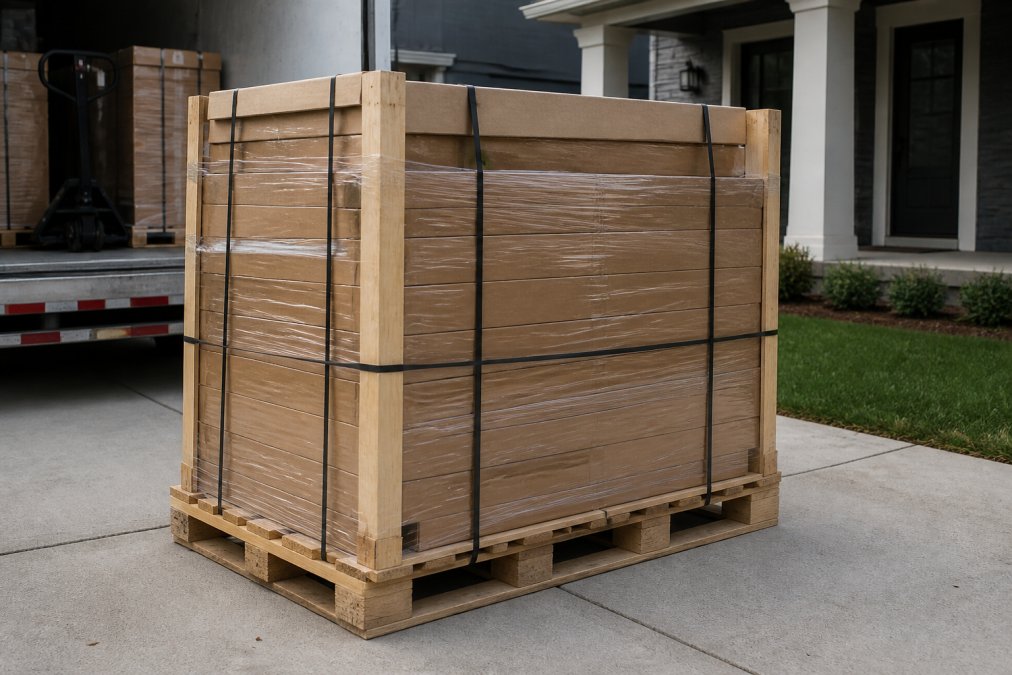
Protective Crating and Palletizing Standards
Corner protection matters more than most buyers realize. Cabinet doors and face frames take the hardest hits at the corners, so edge crating and corner boards absorb impact that would otherwise dent a door front. Look for double-wall corrugated cartons on door fronts and a rigid corner board on every exposed edge.
Palletizing is where weight distribution gets decided. Heavy base cabinet boxes belong at the bottom, wall cabinets and trim on top, and every layer strapped so nothing shifts when the truck brakes. Skin panels and long trim pieces ship flat rather than upright, because a 96-inch panel standing on edge is a lever waiting to bend. A properly built pallet uses a plywood or OSB deck, vertical corner posts, and at least two horizontal straps per layer.
Freight class matters here. Cabinets typically move under LTL (less-than-truckload) service, and the bill of lading should list the correct freight class and the piece count. If your delivery requires a liftgate because you don't have a loading dock, confirm that on the order before the truck rolls, because a missed liftgate is a re-delivery fee and a lost day.
Post-Shipping Inventory Management and Damage Claims
This is the checklist that separates a smooth install from a stalled one. Run it in order, at the curb, before the driver leaves.
- Photograph the pallet before you touch it. Shoot all four sides and the top. This is your baseline if a claim becomes necessary.
- Inspect the shrink wrap and strapping. Torn wrap, crushed corners, or a shifted load are red flags. Note them on the delivery receipt.
- Count the pieces against the bill of lading. The piece count on the paperwork should match what's on the pallet.
- Open at least one carton per layer. You don't need to unpack everything at the curb, but you need to see whether the load shifted.
- Note exceptions in writing on the bill of lading. Write "subject to inspection" if you can't open boxes at the curb. A clean signature is treated as proof of clean delivery.
- File the claim within the carrier's window. Most LTL carriers require concealed-damage claims within a short window after delivery, so photograph and report the same day you find the damage.
Count parts against the packing list before assembly starts. A missing hinge pack is a five-minute phone call on day one and a two-week delay on day ten. Sort hardware into labeled bins by cabinet run so you're not digging through a box mid-install.
Cabinet Installation Tools List: What You Need for RTA Assembly and Mounting
The cabinet installation tools list for RTA work is shorter than most people expect, but every item on it earns its place. You need hand tools, fasteners, and measuring gear. Nothing exotic. What most guides don't tell you is which tools actually move the needle on installation ease, and which ones you can skip.
Essential Hand Tools and Fasteners
- Cordless drill with a clutch setting
- Impact driver for driving screws without stripping heads
- Rubber mallet for tapping panels into place
- Screwdriver set, including a stubby for tight corners
- Cam-lock fasteners (usually included with the cabinet box)
- Wood glue for drawer box assembly
- Stud finder and a level
- Clamps for holding cabinet boxes together while fasteners seat
A common mistake is overtightening cam locks.
Measuring and Leveling Tools for Precision
A laser distance measurer saves more time than any other tool on this list.
Tool-to-Ease Scoring: What Actually Reduces Install Time
| Tool | Impact on Install Ease | Worth Buying? |
|---|---|---|
| Laser distance measurer | High, eliminates re-measuring | Yes, if doing a full kitchen |
| 4-foot level | High, base leveling depends on it | Yes |
| Impact driver | Medium, speeds screw driving | Yes, if you don't own one |
| Clamps | Medium, holds boxes during fastening | Yes, a pair is enough |
| Stubby screwdriver | Low, only for tight corners | Borrow if you can |
| Stud finder | High, wall cabinet safety | Yes |
RTA Cabinet Assembly Tips for Faster, Smoother Installation
RTA cabinet assembly tips that actually save time focus on two things: understanding pre-machined parts and getting leveling right the first time.
Cam-Lock Fasteners and Dovetail Joints: Working with Pre-Machined Parts
Cam-lock fasteners join the cabinet carcass with a rotating cam that pulls a bolt tight against the panel.
Base Cabinet Leveling and Wall Cabinet Mounting Techniques
Base cabinet leveling starts at the highest point of the floor, not the lowest.
Ease-of-Installation Scoring Matrix: Comparing Cabinet Construction and Shipping Features
| Factor | What to Check | Weight | Score 1 | Score 5 |
|---|---|---|---|---|
| Construction material | Plywood vs. particle board | High | Particle board | Full-plywood construction |
| Hardware included | Hinges, slides, cam locks | High | Sold separately | All assembly hardware included |
| Pre-machined joints | Cam locks, dovetails | Medium | Field-cut required | Factory pre-drilled |
| Crating quality | Corner boards, strapping | High | Loose boxes | Crates and pallet straps |
| Hardware adjustability | Hinge alignment range | Medium | Fixed | 6-way adjustable soft-close |
| Delivery method | Curbside vs. inside | Low | Curbside only | Scheduled freight window |
Understanding Cabinet Construction Materials for Easier Installation
EPA formaldehyde and composite wood standards
Why RTA Wholesalers Delivers the Best Ease of Installation for Reliable Cabinet Shipping
California Air Resources Board composite wood regulation
Frequently Asked Questions
What features make RTA cabinets easier to install?
Pre-machined cam-lock fasteners, dovetail drawer joints, and included hardware reduce assembly time significantly. Soft-close hinges that are six-way adjustable let you align doors without removing them. Full-plywood construction holds screws better than particle board, so mounting rails and shims stay secure. Look for cabinets with clear assembly instructions and labeled parts. These features cut the learning curve for DIY installers and speed up professional crews on multi-unit projects.
How can you tell if a cabinet supplier offers reliable shipping?
Ask about protective crating, palletizing standards, and freight delivery methods. A supplier that uses custom-sized pallets, corner protection, and stretch wrap minimizes shipping damage. Curbside shipping with liftgate service is standard for large orders. Request lead times and delivery windows in writing. Check whether the supplier provides a damage claim process and replacement policy. Transparent communication about freight logistics signals a supplier that understands cabinet shipping risks.
How do you inspect cabinets for shipping damage upon arrival?
Inspect all boxes before signing the delivery receipt. Look for crushed corners, punctures, and water stains on packaging. Open at least one box per pallet to check for internal damage. Photograph any visible issues and note them on the freight bill. Count all pieces against the packing list within 48 hours. Report discrepancies immediately. This post-shipping inventory management protects your claim rights and prevents mid-installation surprises.
What tools are essential for installing ready-to-assemble cabinets?
A drill with driver bits, a laser distance measurer, and a 4-foot level are the core tools. Add a stud finder, rubber mallet, and shims for leveling base cabinets. For wall cabinet mounting, you need a cordless impact driver and mounting rails. A screwdriver set handles cam-lock fasteners and hinge adjustments. Keep a tape measure and pencil handy for marking. These tools cover assembly, alignment, and mounting for most RTA cabinet installations.
The challenge with cabinet shipping isn't finding a supplier. It's finding one whose packing standards match the quality of the cabinet inside the box. RTA Wholesalers pairs plywood construction and included hardware with crating built for freight handling, plus inset and overlay options in custom sizes and colors. Get started with RTA Wholesalers and let the free design service confirm your dimensions before the pallet ships.


