 833-377-8663

Best Kitchen Cabinet Materials for Durability: 2026 Guide

Table of Contents
- Quick Comparison: Cabinet Materials at a Glance
- Plywood vs Particle Board Cabinets: What Holds Up
- Solid Wood, MDF, and Laminate: Strength by Material
- Durable Kitchen Cabinet Finishes That Resist Wear
- Moisture, Climate, and Hardware: What Competitors Skip
- How to Choose Kitchen Cabinet Materials for Your Project
- Conclusion
- Frequently Asked Questions
Last Updated: October 1, 2026
Quick Comparison: Cabinet Materials at a Glance
Choosing the best kitchen cabinet materials for durability starts with one question: what is the cabinet box made of? At RTA Wholesalers, we build our cabinet boxes from plywood, not particle board. Cabinet materials fall into a few core categories: solid wood, plywood, MDF, particle board, and laminate finishes.
| Material | Moisture Resistance | Screw Holding | Typical Use | Durability Rating |
|---|---|---|---|---|
| Plywood | High | Strong | Cabinet boxes, shelves | Excellent |
| Particle board | Low | Weak | Budget box construction | Fair |
| MDF | Low to moderate | Moderate | Painted doors, panels | Good |
| Solid wood | Moderate | Strong | Face frames, doors | Excellent |
| Laminate (TFL/HPL) | High | N/A (surface) | Door and box surfaces | Very good |
Plywood vs Particle Board Cabinets: What Holds Up
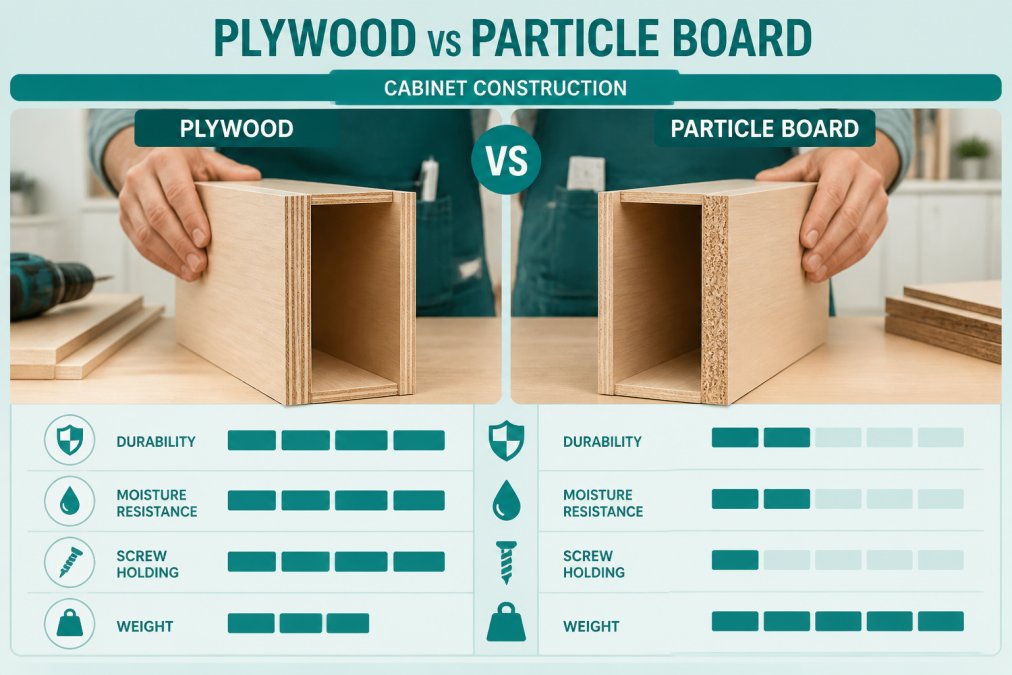
Plywood wins the durability contest, and it isn't close. It's built from thin layers of wood veneer glued in alternating directions, giving it dimensional stability and real screw-holding strength. Particle board is wood chips pressed with resin, and it swells when water reaches the core.
Solid Wood, MDF, and Laminate: Strength by Material
Solid wood is the strongest option for doors and face frames, and the only material you can sand and refinish after years of wear. Hardwoods like oak and birch resist dents and hold hardware screws far better than softwoods. The trade-off is cost and movement: solid wood expands and contracts with humidity, so it needs a stable finish and reasonable indoor conditions.
Species Matters More Than "Solid Wood"
"Solid wood" is not one material. On the Janka hardness scale, the standard measure of resistance to denting, red oak scores around 1290, hard maple around 1450, and hickory around 1820. At the softer end, pine sits near 380-600 and alder around 590. A pine door in a busy family kitchen will show dents a hickory or maple door shrugs off.
MDF: Where It Wins and Where It Fails
MDF is uniform and smooth, making it ideal for painted doors and panels. It machines cleanly, takes paint beautifully, and because it has no grain, it won't telegraph grain through a painted finish the way solid wood can. That's why most factory-painted shaker doors use MDF center panels.
Laminate and Melamine: Surface vs. Core
The most common misunderstanding about laminate is that it's a material. It isn't, it's a surface applied to a core. Thermally fused laminate (TFL) and high-pressure laminate (HPL) add scratch, heat, and impact resistance over whatever core sits underneath. A laminate-faced particle board box still fails like particle board when water reaches the core. A laminate-faced plywood box performs like plywood.
Hardware Compatibility by Material
Hardware load is where material choice shows up ten years in. Soft-close hinges, drawer glides, and pull-out systems all transfer load into the cabinet box through screws and cam fittings.
- Solid wood face frames hold hinge screws best and can be re-drilled if a screw strips.
- Plywood boxes hold drawer glides and pull-out hardware well, and a stripped screw hole can usually be filled and re-set.
- MDF holds screws on the face but strips more easily on the edge; heavy hardware usually needs machine-thread inserts or through-bolts.
- Particle board has the weakest screw-holding and tends to wallow out under repeated load.
- Laminate surfaces don't change the core's screw-holding, only the surface.
Repairability by Material
Durability isn't only about how long a material lasts, it's about whether you can bring it back after damage.
- Solid wood: most repairable. Scratches sand out, minor dents can be steamed out, and a worn finish can be scuff-sanded and recoated.
- Plywood: surface damage can be sanded and resealed; delaminated plies must be cut out and patched, but the surrounding box usually survives.
- MDF: cosmetic damage on painted doors can be filled and repainted, but swollen edges can't be compressed back, structural swelling means replacement.
- Particle board: effectively non-repairable once it swells.
- Laminate and melamine: scratch-resistant, but a deep chip can't be sanded out, color-matched repair wax or a replacement panel is the fix.
Durable Kitchen Cabinet Finishes That Resist Wear
The finish decides how long your cabinets look new, even when the box underneath is solid. A durable kitchen cabinet finish seals the wood against moisture, resists scratches and heat, and holds its color over time. Proper application of these protective layers ensures longevity, though the structural integrity of the final assembly often depends on using the correct cabinet installation tools.
- Polyurethane: tough, water-resistant, and available in satin or gloss. Good for high-traffic kitchens.
- Lacquer: dries fast and looks refined. Our oak doors use a clear UV lacquer that lets the natural grain show.
- Varnish: slower to apply, but flexible and long-lasting on solid wood.
- Thermally fused laminate: a factory-bonded surface that shrugs off scratches and wipes clean.
- Painted finishes: the easiest way to refresh a kitchen, provided the prep is right.
Moisture, Climate, and Hardware: What Competitors Skip
Moisture is the number one killer of cabinetry, and the factor most material guides skip. Kitchens in humid summers and dry winters put cabinets through repeated cycles of swelling and shrinking, stressing joints and finishes. Plywood handles that cycle far better than particle board because its cross-layered construction resists warping.
Climate-Specific Durability: Why Region Matters More Than Brand
Most guides treat "moisture resistance" as a single checkbox, but durability depends heavily on where the kitchen sits. Three patterns matter:
Sample Door Slim Shaker Natural Color →
- Gulf Coast and Southeast humidity. Indoor relative humidity often sits above 60% for months. Solid wood doors and face frames move the most here, a raised-panel door can expand and contract enough to show finish cracks at the joints over a few seasons. Plywood boxes tolerate this well because cross-grain layers restrain movement. Particle board is the worst choice: it absorbs ambient moisture through unsealed edges and slowly loses screw-holding strength even without a visible leak.
- Desert Southwest and high-altitude dry climates. Indoor humidity can drop below 20% in winter. Solid wood shrinks, opening miters and revealing unfinished edges. MDF and plywood are more dimensionally stable, but MDF edges must be sealed or they'll wick incidental moisture. A humidifier or whole-house humidistat in the 35-50% range is the best protection for solid wood here.
- Four-season climates with wide swings. The repeated wet-dry cycle is harder on cabinets than steady humidity. This is where plywood's cross-lamination earns its keep, and where stapled particle board joints loosen first.
Hardware-Material Compatibility Over 10+ Years
Hardware compatibility is the other blind spot. Soft-close hinges and heavy pull-outs put real load on the box, and the material behind the screw determines whether that load stays tight a decade from now.
- Plywood and solid wood hold standard #6 and #8 hinge screws and euro-style cam fittings well. A 3/4" plywood side panel can be re-drilled and re-set if a screw strips, which is why it's the standard for pull-out trash units, mixer lifts, and heavy drawer banks.
- MDF holds screws acceptably on the face but strips more easily on the edge, especially after a screw has been removed once. Heavy hardware usually needs through-bolts or machine-thread inserts rather than wood screws.
- Particle board has the weakest screw-holding of the common box materials. A pull-out trash unit hangs its full weight on the box sides every time it opens, and on particle board that load wallows out the screw holes within a few years.
- Laminate and melamine surfaces don't change the core's screw-holding, a laminate-faced particle board box still fails like particle board.
If your project sits in a humid climate, spec plywood boxes, sealed edges, and soft-close hardware together. Upgrading the box but leaving cheap hinges is the most common mistake we see on remodels.
Repairability: What You Can Fix and What You Can't
Durability isn't only about how long a material lasts, it's about whether you can bring it back after damage.
- Solid wood is the most repairable. Scratches sand out, dents can sometimes be steamed out, and a worn finish can be scuff-sanded and recoated. Water rings usually lift with light sanding.
- Plywood boxes can be sanded and resealed if damage is surface-level. If water has delaminated a ply, that section must be cut out and patched, but the surrounding box usually survives.
- MDF is difficult to repair once water reaches the core. Swollen fibers don't compress back, and sanding a swollen edge just exposes more raw fiber. Painted MDF doors can be filled and repainted for cosmetic damage, but structural swelling means replacement.
- Particle board is effectively non-repairable once it swells.
- Laminate and melamine surfaces resist scratches well, but a deep chip can't be sanded out. Color-matched repair wax or a replacement panel is the usual fix.
Indoor Air Quality and Formaldehyde
Homeowners increasingly weigh indoor air quality alongside durability. Composite panels, plywood, MDF, and particle board, use adhesives that can emit formaldehyde, and emission limits are regulated. California's CARB Phase 2 and the federal TSCA Title VI rule both cap formaldehyde emissions from composite wood products sold in the U.S (the EPA). Ask for panels labeled CARB Phase 2 or TSCA Title VI compliant, and consider no-added-formaldehyde (NAF) or ultra-low-emitting-formaldehyde (ULEF) cores for nurseries, bedrooms adjacent to kitchens, and anyone with chemical sensitivity.
How to Choose Kitchen Cabinet Materials for Your Project
Match the material to the room, the budget, and how long the cabinets need to last. There's no single right answer, but there is a right sequence.
- Start with the box. Plywood for anything you want to last; particle board only for short-term, dry installs.
- Choose the door material. Solid wood for longevity and refinishing; MDF for painted looks; laminate for low-maintenance surfaces.
- Pick a finish for the room. Lacquer or polyurethane in busy kitchens; laminate where kids and spills are constant.
- Check moisture exposure. Sinks, dishwashers, and humid climates demand sealed plywood and moisture-resistant finishes.
- Confirm hardware support. Heavy pull-outs and soft-close hinges need a solid box and face frame behind them.
- Verify compliance. Look for California CARB2 compliant materials, which meet strict formaldehyde emission standards.
Conclusion
Picking cabinet materials is really a decision about how long you want the kitchen to last. Plywood boxes, solid wood face frames, dovetail drawer joints, and a finish built for your climate will outlast any budget shortcut every time. If you want durable cabinets without the markup, RTA Wholesalers offers ready-to-assemble cabinetry with inset and overlay options, custom sizes and colors, and a free design service to keep your project on track.
Frequently Asked Questions
What is the most durable material for kitchen cabinets?
Plywood cabinet boxes paired with solid wood face frames and doors hold up best over time. Plywood resists moisture, warping, and impact better than particle board because its layered construction stays stable. Solid wood doors, dovetail drawer joints, and soft-close hardware add years of service. RTA Wholesalers builds its cabinets with 3/4-inch plywood boxes, solid wood face frames, and dovetail drawer boxes, which is the combination to look for when durability is the priority.
Is plywood or particle board better for kitchen cabinets?
Plywood wins for durability. Its cross-layered construction resists moisture, warping, and screw pull-out far better than particle board, which swells and crumbles once water reaches the core. Particle board costs less and works for dry, low-traffic areas, but in a kitchen where spills and humidity are constant, plywood cabinet boxes last longer and hold hardware more securely. Look for 1/2-inch to 3/4-inch plywood with a finished interior.
What is the best cabinet material for high-moisture environments?
Plywood and solid hardwood outperform MDF and particle board in humid or high-moisture kitchens. Plywood's layered core resists swelling, and solid wood face frames and doors handle humidity swings without delaminating. Pair them with moisture-resistant finishes like polyurethane or UV lacquer, and seal any exposed edges. Avoid particle board entirely in bathrooms, laundry rooms, and kitchens near dishwashers or sinks, where standing water is common.
Do solid wood cabinets last longer than engineered wood?
Solid wood doors and face frames typically outlast engineered options, but the cabinet box matters just as much. A solid oak door on a particle board box still fails when the box swells. The strongest builds combine solid wood fronts with plywood boxes, dovetail drawer joints, and quality hardware. That mix delivers the longevity of solid wood with the dimensional stability engineered cores provide, which is why it shows up in most long-lasting custom and semi-custom cabinetry.
How much do durable kitchen cabinets cost?
Durable cabinets cost more upfront but reduce replacement and repair costs over a 15 to 20 year lifespan. RTA Wholesalers offers plywood-construction cabinets with solid wood face frames and dovetail drawers at wholesale pricing, with base cabinets starting around $251.86 and tall pantry cabinets around $1,121.26. Ready-to-assemble designs cut labor costs, and free design help ensures you order the right sizes the first time, avoiding costly reorders.


