 833-377-8663

Cost of Custom vs Stock Cabinets: 2026 Price Guide

Table of Contents
- What Counts as Stock, Semi-Custom and Custom Cabinetry
- Cost of Custom vs Stock Cabinets: Price Per Linear Foot
- Inset vs Overlay Cabinet Cost: What Actually Changes the Price
- Material Quality and Construction: Plywood vs Particle Board
- Kitchen Cabinet Installation Timeline and Hidden Labor Costs
- RTA Cabinet Benefits for Contractors, Flippers and DIY Remodels
- Resale Value, Repairability and the Long-Term Math
- Frequently Asked Questions
Last Updated: September 25, 2026
What Counts as Stock, Semi-Custom and Custom Cabinetry
Stock cabinets are factory-made boxes sold in fixed widths, while custom cabinetry is built to your exact design specifications. Semi-custom sits between the two: standard boxes with adjustable sizing and finish choices.
That distinction drives nearly every dollar difference in the cost of custom vs stock cabinets. Stock sizes come in 3-inch increments, so a 33-inch gap gets a 30-inch cabinet and filler strips. Custom sizing closes that gap to the quarter inch.
RTA Wholesalers builds both ends of that spectrum, which is why we can walk you through the trade-offs honestly.
| Type | Sizing | Lead Time | Best For |
|---|---|---|---|
| Stock | Fixed 3-inch increments | In stock | Fast flips, rentals |
| Semi-custom | Standard boxes, more finishes | 1-3 weeks | Most remodels |
| Custom | Any size to 1/4 inch | Longer production | Odd layouts, inset looks |
Cost of Custom vs Stock Cabinets: Price Per Linear Foot
The cost of custom vs stock cabinets usually comes down to a per-linear-foot comparison. Stock runs cheapest because factories mass-produce the same boxes; custom costs more because every cabinet is built to order. A linear foot is 12 inches of continuous cabinet run measured along the wall, and it is the only unit that lets you compare a 10-foot kitchen to a 14-foot kitchen without re-quoting every box.
Here is how the three tiers typically stack up per linear foot for base cabinets with a door and a drawer:
| Tier | Typical Range Per Linear Foot | What Drives the Number |
|---|---|---|
| Stock | Lowest of the three | Fixed 3-inch widths, limited door styles, flat-pack or in-stock assembled |
| Semi-custom | Mid-range | Standard boxes with more finishes, adjustable shelves, some sizing tweaks |
| Custom | Highest | Built to 1/4-inch tolerances, one-off milling, specialty finishes, inset construction |
Those ranges are broad on purpose. The per-foot number moves with box depth, drawer count, door style, and whether the run includes a sink base or a corner.
What Actually Moves the Per-Foot Number
Five cost components separate the tiers, and each one compounds across the run:
- Box construction: A 5/8-inch 7-ply plywood box costs more to produce than a particle board box, but it holds screws and resists moisture. This is the single biggest material swing.
- Door and drawer fronts: Solid wood or plywood-core fronts cost more than thermofoil or MDF. Painted finishes add a step; stained finishes add a different step.
- Sizing tolerance: Stock cabinets come in 3-inch increments. Custom cabinets close that gap to the quarter inch, which means one-off milling and tighter quality control.
- Hardware: Soft-close hinges and full-extension glides are standard on better lines and an upgrade on cheaper ones. DTC hardware with a lifetime warranty is a common benchmark.
- Finish: A stock line may offer 5 to 10 finishes. A custom line may offer 1,500+ paint colors. Color count is a proxy for how much finishing capacity the factory has.
The Filler Strip Trap
Here is the practical rule: the more your kitchen deviates from standard dimensions, the less stock saves you. Filler strips and skin panels eat into the gap fast.
Real Package Pricing: Two 10x10 Kitchens Compared
A complete 10x10 kitchen package is the clearest way to see the difference. RTA Wholesalers publishes two Snow White Inset Shaker packages that show how wall height changes the total.
How to Build Your Own Per-Foot Estimate
Take the package price, divide by the linear feet of cabinet run in the package, and you get a working per-foot number you can scale. A 10x10 package is roughly 20 linear feet of combined base and wall run, so the math is straightforward. Then add the line items competitors leave out:
- Filler strips and scribe molding
- End panels and skin panels for exposed sides
- Crown molding and light rail
- Toe kick and base molding
- Assembly labor if the cabinets ship flat
Inset vs Overlay Cabinet Cost: What Actually Changes the Price
Inset cabinets cost more than overlay because the door sits flush inside the face frame. That flush fit demands tighter tolerances, so every door is milled to fit one specific opening.
Material Quality and Construction: Plywood vs Particle Board
Plywood versus particle board is the single biggest durability question in cabinetry. Plywood cores are layered and hold screws; particle board is pressed sawdust that crumbles once moisture gets in.
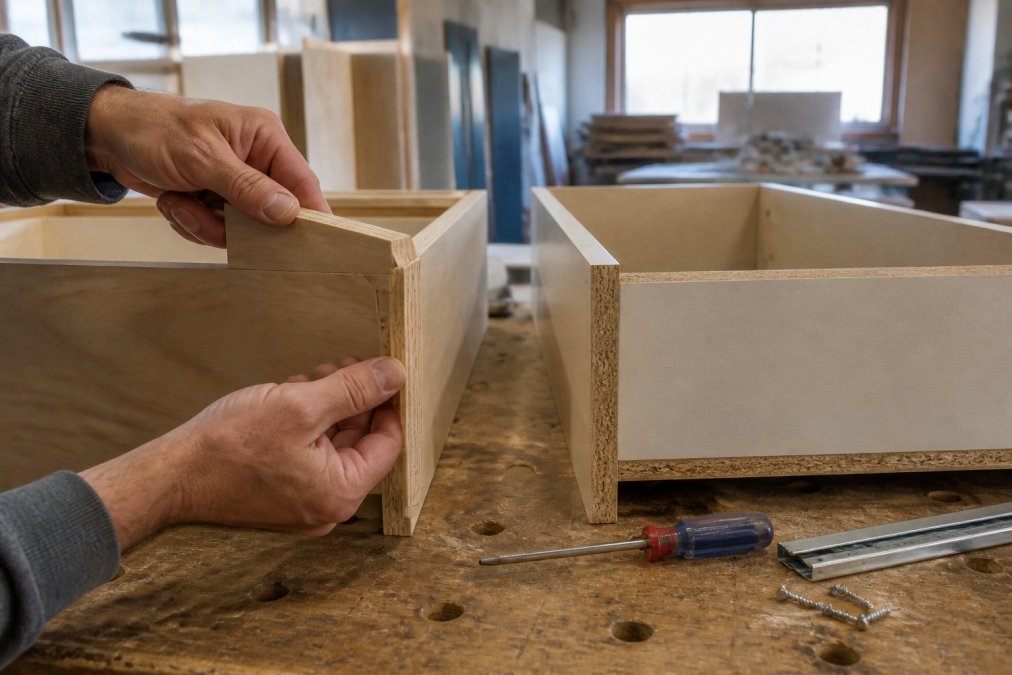
Never judge a cabinet by its door alone. A solid oak door on a particle board box is a warranty claim waiting to happen. Ask what the box is made of before you compare prices.
Kitchen Cabinet Installation Timeline and Hidden Labor Costs
A kitchen cabinet installation timeline depends on whether your cabinets arrive assembled or flat. Stock and RTA ship flat or assembled; full custom arrives assembled after a long production window.
- Assembly: RTA saves on the cabinet but adds 1-3 hours per box in labor
- Old cabinet removal: often quoted separately, and disposal costs extra
- Wall repair and paint: rarely included, almost always needed
- Countertop templating: waits on cabinet install, adding days to the schedule
- Plumbing and electrical: moving a sink or adding an outlet means a licensed trade
RTA Cabinet Benefits for Contractors, Flippers and DIY Remodels
RTA cabinet benefits come down to three things: lower cost per box, faster replacement on damaged pieces, and flat-pack shipping that survives the trip. Contractors who run multiple jobs value all three.
Resale Value, Repairability and the Long-Term Math
Resale value and repairability are the two angles most cabinet comparisons skip. Both matter more than the sticker price over a 10-year hold, and both can be modeled with real numbers instead of adjectives.
Resale Value: What Buyers Actually Pay For
Buyers notice cabinet quality during a showing, even if they cannot name it. Solid wood fronts and soft-close drawers read as "well built." Sagging particle board shelves read as "deferred maintenance."
Repairability: The Cost Nobody Quotes
Repairability is the quieter factor, and it is where the long-term math actually lives. Three repair scenarios separate the tiers:
- Scratched or dented solid wood door: Can be sanded, stained, and refinished. A local finisher can usually match it. Cost is a fraction of a replacement door.
- Peeling thermofoil door: Cannot be repaired at all, only replaced. The replacement often will not match the faded run, so a single peel can trigger a partial re-front.
- Failed hinge or glide: Replaceable on any tier, but only if the hardware brand is still in production and the mounting pattern has not changed. This is why hardware brand matters more than most buyers realize.
The 10-Year Cost of Ownership
Run the math over a 10-year hold and the tiers separate in a way the sticker price hides:
| Cost Category | Stock | Custom / Semi-Custom |
|---|---|---|
| Upfront cabinet cost | Lowest | Highest |
| Refinishing or re-fronting | Likely once in 10 years | Unlikely if finish holds |
| Hardware replacement | Possible, brand-dependent | Covered by warranty on better lines |
| Full replacement risk | Higher if boxes sag or swell | Lower with plywood boxes |
| Resale categorization | Often "dated" at 15 years | Often "updated" longer |
Frequently Asked Questions
What is the average price difference between stock and custom cabinets?
The gap is usually two to three times the sticker price. Factory-made stock or ready-to-assemble cabinet boxes run far less per linear foot than bespoke cabinetry built to your exact design specifications, because you are buying predetermined measurements rather than one-off millwork. The difference widens further once you add custom finishes, non-standard depths and the design time that comes with a fully bespoke order. For a typical kitchen remodel, that spread can cover the counters, sink and labor on its own.
Are RTA cabinets a cost-effective alternative to custom cabinetry?
They can be, especially when you need standard sizing with a high-end look. RTA cabinet benefits include lower per-cabinet cost, flat-pack shipping, and assembly you can do yourself with basic tools. A complete 10' x 10' Snow White Inset Shaker kitchen package is priced at $4,535.79, which gives you inset construction and soft-close hardware without a bespoke price tag. The trade-off is that you assemble and install the boxes yourself, and exposed sides need skin panels.
How long does it take to get custom cabinets versus stock?
This is where the kitchen cabinet installation timeline splits sharply. Custom-order inset cabinets typically require 8 to 11 weeks for production before shipping even begins, and those orders are non-returnable and non-changeable once submitted. Stock and ready-to-assemble lines ship from existing inventory, so the wait is measured in days, not months. If your project scope is tight or you are flipping a property, that production window is often the deciding factor.
Do custom cabinets increase home resale value?
They can help a kitchen show well, but the return is rarely dollar-for-dollar. Buyers notice fit and finish, door style and storage solutions more than whether a cabinet was built to the quarter inch. A well-installed semi-custom or RTA kitchen with plywood boxes, dovetail drawers and soft-close glides reads as quality to most buyers. Spending the difference on counters, lighting or layout usually moves resale value further than upgrading the cabinet boxes alone.


