 833-377-8663

Most Durable Finishes for Wholesale Kitchen Cabinets

Table of Contents
- Types of Cabinet Finishes Compared for Wholesale Buyers
- Conversion Varnish vs Lacquer for Cabinets: Which Wins on Durability
- Durability Rankings for Durable Cabinet Finishes
- Best Cabinet Finish for High Traffic Kitchens
- How Cabinet Materials Affect Finish Longevity
- How to Maintain Kitchen Cabinet Finishes
- Climate, Repairability, and VOC Trade-Offs for Wholesale Orders
- Frequently Asked Questions
Last Updated: September 12, 2026
Types of Cabinet Finishes Compared for Wholesale Buyers
In a showroom, the finish sells the cabinet. In a wholesale order, durable cabinet finishes determine whether that cabinet still looks good after five years of daily use.
Finish chemistry falls into two broad families, and that split matters more than brand names or sheen levels when buying in volume.
Catalyzed lacquer adds a catalyst before application, hardening the film far beyond standard lacquer. Conversion varnish is a two-part acid-catalyzed coating that cross-links into one of the hardest films used on wood cabinetry.
Catalyzed Lacquer and UV Lacquer
Catalyzed lacquer cures harder and resists moisture and household chemicals better than the nitrocellulose lacquer on older furniture. UV lacquer cures the same chemistry under ultraviolet light, producing a factory-applied topcoat that arrives fully cured with consistent film thickness across every door in the run.
That consistency is what DIY refinishing can't match: a garage brush or spray finish varies by humidity, technique, and last-pass thickness, while a UV-cured finish doesn't.
Conversion Varnish, Polyurethane, and Varnish
Conversion varnish sits at the top of the hardness scale. Polyurethane is more flexible and easier to repair, so it holds up on surfaces that flex or take impact. Traditional varnish is slower to cure and softer than either, but forgiving to touch up.
For wholesale buyers, the practical question isn't which is "best" in the abstract, but which survives the specific abuse your project will see.
Conversion Varnish vs Lacquer for Cabinets: Which Wins on Durability
Conversion varnish wins on raw durability, forming a harder, more chemically resistant film than catalyzed lacquer, which is why it shows up on commercial casework and high-end millwork. Lacquer wins on repairability: a lacquer film can often be touched up or blended in place, while a conversion varnish repair usually means refinishing the whole door.
| Finish | Hardness | Moisture Resistance | Repairability | Best For |
|---|---|---|---|---|
| Conversion varnish | Highest | Excellent | Difficult | Commercial kitchens, heavy wear |
| Catalyzed lacquer | High | Very good | Moderate | Residential kitchens, high traffic |
| UV lacquer | High | Very good | Moderate | Factory-built cabinet runs |
| Polyurethane | Medium-high | Good | Easy | Impact-prone surfaces |
| Traditional varnish | Medium | Fair | Easy | Low-traffic, touch-up-friendly work |
What most guides miss: a factory-applied UV lacquer often outperforms a site-applied conversion varnish because the cure is controlled and complete. Application quality matters as much as chemistry.
Durability Rankings for Durable Cabinet Finishes
Ranked by long-term performance in real kitchens, from most durable down:
- Conversion varnish, hardest film, best chemical and heat resistance
- Catalyzed lacquer, nearly as hard, easier to repair
- UV lacquer, factory-cured consistency, excellent moisture resistance
- Polyurethane, flexible and repairable, slightly softer
- Traditional varnish, the most forgiving to touch up, the least resistant
These rankings assume a properly prepared substrate. A great finish over a poor substrate still fails. The finish is a protective shell, not a fix for unstable material underneath.
Moisture, Chemical, and Heat Resistance by Finish Type
Moisture resistance matters most around sinks, dishwashers, and coffee stations, where steam and splashes hit the same spot daily. Chemical resistance matters near cleaning products and cooking oils, and heat resistance above ranges and venting appliances.
Conversion varnish handles all three best. Catalyzed and UV lacquer handle moisture and everyday chemicals well and tolerate brief heat. Polyurethane resists moisture but softens faster under sustained heat. Traditional varnish is weakest on all three, fine in a low-traffic room, a mistake in a busy family kitchen.
Best Cabinet Finish for High Traffic Kitchens
The best cabinet finish for high traffic kitchens is a factory-applied catalyzed or UV lacquer, with conversion varnish as the upgrade for the hardest-use spaces. High traffic means repeated contact: hands, hips, chairs, mops, and cleaning sprays hitting the same doors daily.
For a wholesale buyer, "high traffic" is a procurement spec, not a marketing phrase. A restaurant, a rental turnover, and a busy family kitchen all count as high traffic and fail finishes in different ways. The finish that survives all three is the one whose film hardness, adhesion, and edge sealing were verified before the cabinets left the factory, not after the first callback.
How to Vet a Factory-Applied Finish Before You Order in Volume
Most articles on cabinet finishes are written for someone refinishing a single kitchen. Wholesale buyers face a different question: how do you confirm a factory finish will hold up across an entire run of doors, drawers, and boxes before committing to hundreds of units? A few concrete checks separate a commercial-grade finish from a residential one dressed up in the same chemistry name. Rigorous testing protocols reveal that the same resilience required for heavy-use cabinetry is often mirrored in the standards applied to durable home finishes found in other high-traffic interior environments.
- Ask for the finish system, not just the finish name. "Catalyzed lacquer" covers a wide range of formulations. A supplier should name the specific product line and the number of coats applied to the face, edges, and back of each door.
- Confirm the cure method. A UV-cured finish is fully reacted before the cabinet ships; an air-cured or force-cured finish depends on the factory's control of temperature, humidity, and dwell time.
- Check edge and end-grain sealing as a separate spec. Ask how edges are sealed, how many passes they receive, and whether end grain gets a sanding sealer before topcoat.
- Ask about the back of the door. A face-only finish is a common cost-cutting move. An unfinished back absorbs moisture from the cabinet interior and can cause the door to cup, stressing the face finish at the hinges.
- Request a sample door from the actual production run. Not a showroom sample, a production sample shows the real film thickness, sheen consistency, and edge treatment your order will receive.
- Confirm the substrate spec. A great finish over a swelling particle board core still fails. Ask for the box material, the face frame material, and the plywood grade if plywood is used.
That last point is where wholesale buyers get burned: a cabinet with a great face finish but a poorly sealed edge fails at the edge, not the face. When you order, ask how edges and exposed sides are handled, skin panels exist for exactly this reason.
Three Failure Modes to Specify Against
High-traffic kitchens fail finishes in three predictable ways, each mapping to a spec you can write into your order:
- Edge swell and peeling. Moisture reaches exposed edges and end grain, the substrate swells, and the finish lifts. Specify sealed edges and skin panels on every exposed side.
- Hinge-zone scuffing and cracking. Doors drift out of alignment, rub the frame, and wear through the finish. Specify adjustable hinges and confirm they are torqued and aligned at the factory.
- Chemical dulling near work zones. Cleaning sprays, degreasers, and cooking oils sit on the same doors daily. Conversion varnish and catalyzed lacquer resist this best; traditional varnish and softer films dull and haze.
Matching the Finish to the Project Type
A single durability ranking does not answer the procurement question, because project types weight the trade-offs differently:
- Commercial and food-service kitchens see constant chemical and heat exposure. Conversion varnish is the defensible spec; repairability is secondary because the finish rarely fails in a spot-repairable way.
- Multi-family and rental turnovers see heavy contact but need fast, low-cost repair between tenants. A catalyzed or UV lacquer that can be spot-blended usually beats a harder film requiring full door replacement.
- High-end residential balances appearance and durability. A factory-applied UV lacquer delivers consistent sheen and film thickness across a large run, hard to match with site-applied finishes.
- Flip and spec projects prioritize upfront consistency over maximum hardness. A factory finish that arrives fully cured removes the schedule risk of on-site finishing.
The finish that wins on a spec sheet is not always the finish that wins on a callback log. For most wholesale orders, the practical answer is a factory-applied UV lacquer or catalyzed lacquer with verified edge sealing, backed by a substrate stable enough to keep the film from cracking underneath.
How Cabinet Materials Affect Finish Longevity
The substrate under the finish decides how long that finish lasts. MDF and particle board are dimensionally stable and take a smooth, even finish well, but swell permanently if moisture reaches the core. Hardwood and plywood move with humidity but recover, and hold fasteners and hardware better over time. Cross-grained construction and plywood boxes resist warping better than solid wood panels in humid rooms, keeping the finish from cracking as the material moves underneath.
This is why a cabinet box built from 5/8-inch Birch plywood with a solid hardwood face frame, like the construction RTA Wholesalers uses across its inset lines, tends to hold its finish longer than a box made from lower-grade material. The finish can only be as stable as what it's bonded to.
U.S. EPA guidance on formaldehyde and composite wood products
How to Maintain Kitchen Cabinet Finishes
Maintenance is simpler than most people expect: wipe doors with a soft, damp cloth and mild soap solution, then dry immediately. Avoid abrasive pads, ammonia-heavy cleaners, and anything that leaves standing water on the surface.
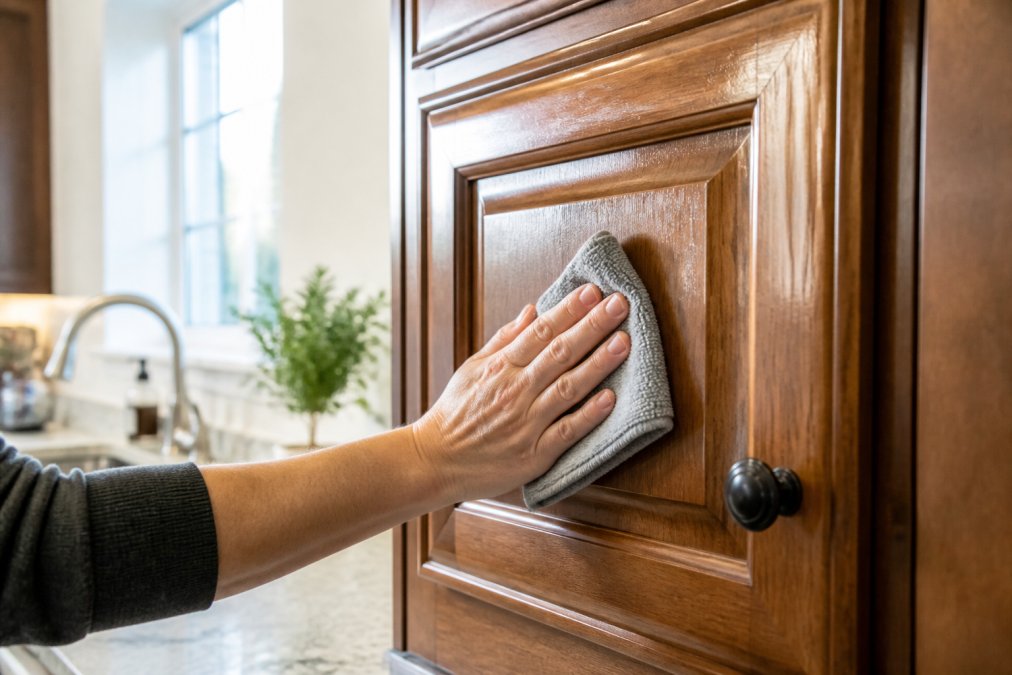
A few habits keep a factory finish looking new for years:
- Wipe spills promptly instead of letting them sit
- Keep a towel or mat under the coffee maker and near the sink
- Use a soft cloth, never a scouring pad
- Avoid solvent-based cleaners on painted or lacquered surfaces
- Re-tighten and adjust hinges so doors don't rub and scuff
The scuffing most people blame on the finish is usually door-to-frame contact from hinges that drifted out of adjustment. Fix the alignment and the finish stops wearing.
Climate, Repairability, and VOC Trade-Offs for Wholesale Orders
Most finish guides stop at the chemistry. Wholesale buyers have to go three steps further: how the finish behaves in the installation climate, whether it can be repaired without a full strip-and-refinish, and whether it meets the project's air-quality rules. All three affect the total cost of a wholesale order.
Climate-Specific Finish Performance
Wood moves with humidity, and the finish has to move with it. The same finish that performs flawlessly in one region can crack or peel in another, and the failure is usually blamed on the finish when the real cause is a mismatch between film flexibility and the local moisture cycle.
- Humid and coastal regions. Moisture resistance and edge sealing matter more than raw hardness. A hard, brittle film over a seasonally swelling substrate can crack at the edges. Catalyzed lacquer and UV lacquer handle sustained humidity well when edges and end grain are properly sealed.
- Arid and high-desert regions. Wood shrinks in winter, and a brittle film can crack as the substrate pulls away. A slightly more flexible film, polyurethane or a formulated lacquer, tolerates that movement better than the hardest conversion varnish.
- Four-season regions with wide swings. The finish must survive humid summers and dry winters. Substrate stability matters as much as chemistry: a plywood box with a hardwood face frame moves less than a solid wood panel, keeping the finish from being stressed.
- High-altitude regions. UV exposure is stronger, and finishes that are not UV-stabilized can yellow or chalk faster on doors receiving direct sunlight.
The practical takeaway: tell your supplier where the cabinets are going, not just what they are made of. A finish spec that ignores the installation climate is a callback waiting to happen.
Repairability of Factory-Applied Finishes
A harder finish resists damage better but is harder to fix when damaged. What's rarely discussed is how repairability works on a factory-applied finish specifically, because the repair has to match a cured, controlled film rather than a site-applied one.
- Spot-repairable finishes. Catalyzed lacquer and UV lacquer can often be touched up or blended in place, because the film can be reactivated or feathered at the repair site. This matters for rental turnovers and multi-family projects, where a scuffed door can be repaired between tenants instead of replaced.
- Difficult-to-repair finishes. Conversion varnish forms a highly cross-linked film that resists chemical and heat damage but does not blend easily. A repair usually means refinishing the whole door face, and matching sheen across a partial repair is difficult.
- The color-match problem. A stained factory finish is harder to spot-repair than a painted one, because the repair must match both the stain and the topcoat sheen. Single-color painted finishes are more forgiving.
- The spare-door strategy. The most reliable repair path for a wholesale order is to include spare doors and drawer fronts in the original run, finished in the same batch. A factory-matched spare eliminates the color and sheen mismatch that makes field repairs visible.
For wholesale buyers, repairability is a line item, not an afterthought. A finish that can be spot-repaired lowers long-term cost of ownership even if it is slightly softer on day one.
VOC and Air-Quality Compliance
VOC content is the third trade-off, and increasingly a specification rather than a preference. Solvent-based and oil-based finishes generally carry higher VOC content than water-based options, and some projects, particularly multi-family and commercial work, specify low-VOC materials as a condition of the build.
Two things matter for a wholesale order:
- Where the finish cures. A factory-applied finish cures in a controlled environment before the cabinet ships, so off-gassing happens at the factory rather than in the finished kitchen, a meaningful advantage over site-applied finishes, which release VOCs into the occupied space during and after installation.
- What the project requires. Some jurisdictions and project specifications set limits on the VOC content of finishes used in the building. A supplier should be able to document the VOC content of the finish system used on your order.
California Air Resources Board composite wood and finish regulations
U.S. EPA guidance on formaldehyde and composite wood products
The Three Questions to Ask Before You Commit
For wholesale orders, confirm three things before you commit: the finish type and cure method, the substrate it is applied to, and how exposed edges are sealed. Add a fourth for projects with air-quality specs: the documented VOC content of the finish system. Get those right and the durability question answers itself.
For buyers who want options rather than a single spec, RTA Wholesalers offers both inset and overlay cabinetry, custom sizes, and custom colors across its lines, including Custom Order Inset and Custom Color Inset options, plus Special Order Oak Inset Kitchen Cabinets If you're weighing a stained finish against a painted one, the White Oak Inset Cabinet Color Sample lets you see the actual grain, tone, and sheen before your order goes into production.
Frequently Asked Questions
What is the most durable finish for kitchen cabinets?
Catalyzed lacquer and conversion varnish top the list for durable cabinet finishes. Both are factory-applied and chemically cured, forming a hard topcoat that resists moisture, heat, and household chemicals better than site-applied paint or standard varnish. Catalyzed lacquer offers excellent clarity on stained wood, while conversion varnish delivers the highest chemical and moisture resistance. For wholesale orders, both finishes arrive fully cured, so cabinets handle daily kitchen use from day one.
Is conversion varnish better than lacquer for cabinets?
Conversion varnish and lacquer each have strengths. Conversion varnish forms a harder, more chemically resistant film, making it the better choice for high-traffic kitchens and areas exposed to grease, cleaners, and moisture. Catalyzed lacquer cures faster, shows wood grain more clearly, and is easier to repair on site. For wholesale kitchen cabinets, conversion varnish suits heavy commercial use, while catalyzed lacquer balances durability with a natural look for residential projects.
What finish do professional cabinet makers use for high-traffic areas?
Professional cabinet makers typically choose conversion varnish or catalyzed lacquer for high-traffic kitchens. Both are spray-applied in a controlled shop environment and cure to a hard protective shell that resists scuffs, stains, and moisture. Factory-applied finishes outperform brush-on polyurethane because the curing process is controlled and the finish adheres evenly. Many wholesale cabinet lines use UV-cured lacquer, which offers similar durability with faster production times.
How do you maintain the finish on wholesale shaker cabinets?
Wipe wholesale shaker cabinets with a soft damp cloth and mild dish soap, then dry immediately. Avoid abrasive cleaners, scouring pads, and ammonia-based products that dull the topcoat. For greasy areas, use a 50/50 mix of water and white vinegar. Touch up minor scratches with a matching stain marker or lacquer repair stick. Keep cabinets away from direct heat sources and prolonged standing water to preserve finish longevity.
Does cabinet material affect how long the finish lasts?
Yes. The cabinet substrate plays a major role in finish longevity. Solid hardwood face frames and plywood boxes hold finish better than particle board or MDF, which can swell if moisture reaches the core. Plywood resists warping and provides a stable surface for the topcoat. When ordering wholesale kitchen cabinets, confirm the box material is plywood and the face frame is solid wood for the best finish adhesion and wear resistance.


