 833-377-8663

Durable RTA Cabinets for Residential Projects: A 2026 Guide

Table of Contents
- What Are RTA Cabinets and Why Durability Matters for Residential Projects
- Plywood vs Particle Board RTA Cabinets: Material Durability Comparison
- How to Assemble RTA Cabinets Properly for Maximum Durability
- Best RTA Cabinet Brands for Contractors and Homeowners
- Identifying High-Quality Durable RTA Cabinets: Key Features to Check
- RTA Cabinets vs. Pre-Assembled and Custom-Built Options
- Installation Failure Analysis: What Goes Wrong and How to Prevent It
- Maintaining Your Durable RTA Cabinets for Long-Term Performance
Durable RTA Cabinets for Residential Projects: A 2026 Guide
Last Updated: July 11, 2026
What Are RTA Cabinets and Why Durability Matters for Residential Projects
Ready-to-assemble cabinets have become the standard choice for residential renovations. These flat-pack solutions arrive disassembled, ship efficiently, and assemble on-site. The real question isn't convenience, it's whether they'll hold up under daily use for years to come.
The difference between cabinets that last and those that fail comes down to material selection, construction methods, and assembly precision. A poorly constructed RTA cabinet might wobble after six months. A well-built one will outlast expectations.
The Ready-to-Assemble Advantage
RTA cabinetry has transformed residential renovation timelines. Instead of waiting 12-16 weeks for custom-built cabinets, homeowners can select from hundreds of configurations and have assembled units ready in weeks. The standardized, engineered approach actually improves consistency compared to hand-built custom work.
Why Durability Defines Success in Residential Kitchens and Bathrooms
Kitchen and bathroom cabinets experience constant stress. Doors open and close dozens of times daily. Drawers slide under weight. Moisture from cooking and showers creates environmental pressure. Over five years, a cabinet door might open and close 10,000 times.
Cheap construction fails under this stress. Particle board swells when exposed to humidity. Weak joints separate. Hinges strip out. Durable RTA cabinets maintain structural integrity through years of real-world use and affect resale value, buyers notice cabinet condition immediately.
Plywood vs Particle Board RTA Cabinets: Material Durability Comparison
The cabinet box material determines how well your cabinets resist warping, moisture damage, and structural failure. Two materials dominate the RTA market: plywood and particle board.
Plywood Construction: Strength and Longevity
Plywood consists of thin wood veneers glued together in alternating grain directions. This cross-grain construction creates exceptional strength and stability. Plywood resists warping even when exposed to humidity fluctuations and won't swell and bind doors.
A cabinet box built from plywood will outlast one built from particle board by years, sometimes decades. Plywood cabinets can handle heavier loads without sagging shelves and maintain tight joints long-term. When you calculate cost-per-year-of-service, plywood becomes economical. A plywood cabinet lasting 15 years costs less annually than a particle board cabinet lasting 5 years.
Particle Board and HDF: Cost vs. Structural Integrity
Particle board consists of wood particles bonded with resin and compressed into sheets. It's cheaper to manufacture but has significant durability limitations. Moisture swells particle board, causing cabinet doors to bind and drawers to stick. In bathrooms with regular steam exposure, particle board deteriorates within 3-5 years.
High-Density Fiberboard (HDF) offers a middle ground, denser and more moisture-resistant than standard particle board, but less stable than plywood. For kitchens and bathrooms, HDF is a compromise, better than cheap particle board but not the durability choice. Particle board also fails under load, with shelves sagging faster and hinges stripping sooner.
Veneer and Laminate Finishes: Protection and Aesthetics
Real wood veneer consists of thin slices of solid wood glued to the cabinet surface. Veneer looks authentic but is vulnerable to moisture and mechanical damage. It can peel, crack, or water-stain.
Laminate is a synthetic material bonded to the cabinet surface. It resists moisture better than veneer, doesn't stain easily, and requires minimal maintenance. For residential kitchens, laminate finishes offer better durability than veneer in high-moisture zones. Paint finishes provide another option, durable, customizable, and resistant to moisture when applied properly.
How to Assemble RTA Cabinets Properly for Maximum Durability
Assembly quality directly impacts cabinet longevity. A cabinet assembled incorrectly will fail sooner than one assembled with precision.
Pre-Assembly Inspection and Tools You'll Need
Before opening a single box, inspect all components for damage. Look for cracked panels, bent hardware, or missing pieces. Document any damage with photos and contact the supplier immediately.
Gather the right tools before starting: power drill with bits, adjustable wrench or hex key set, rubber mallet, level, measuring tape, and screwdriver set. Cheap tools lead to stripped fasteners and misaligned joints. Prepare your workspace by clearing a flat, level surface, laying cardboard to protect the finish, and organizing hardware in labeled containers. Read the assembly manual completely before touching a single piece.
Step-by-Step Assembly Process
Begin with the cabinet box. Lay out all panels and identify each piece according to the manual. Check that all edges are square using a carpenter's square.
Install the cam-lock system carefully. These connectors hold the cabinet box together. Align the cam-lock holes precisely and tighten firmly but don't over-torque, which strips the plastic inserts.
Install the back panel next. The back panel provides critical lateral bracing. A cabinet without a properly installed back panel will rack and twist under load. Secure it with all fasteners, not just a few.
Attach the face frame if applicable. The face frame must be perfectly square. Use shims to adjust alignment before fastening permanently.
Install hinges and drawer glides according to specifications. Hinges must be perfectly aligned or doors will sag. Drawer glides must be level or drawers will slide open on their own.
Attach doors and drawers last. Adjust doors to sit perfectly flush with the cabinet box. Gaps should be even all around.
Common Assembly Mistakes That Compromise Cabinet Longevity
The most common mistake is installing the back panel incorrectly or skipping it entirely. The back panel is structural bracing, not cosmetic. Without it, the cabinet box will rack and twist, causing doors to bind and joints to separate.
Loose fasteners cause cascading failures. Check every fastener twice and tighten firmly but carefully. Over-tightening fasteners strips the plastic inserts in cam-lock systems. Misaligning the back panel causes the cabinet box to twist out of square. Rushing the door and drawer adjustment leads to binding and sagging.
Best RTA Cabinet Brands for Contractors and Homeowners
Quality varies dramatically across RTA cabinet brands. Some manufacturers cut corners on materials and construction. Others maintain rigorous standards.
What Sets Quality RTA Brands Apart
Quality RTA brands invest in plywood construction, precision engineering, and rigorous testing. They use soft-close hinges and full-extension drawer glides as standard. They include comprehensive assembly instructions and customer support.
Budget brands cut corners by using particle board instead of plywood and including basic hinges instead of soft-close hardware. Mid-range brands occupy the middle ground, using plywood or quality HDF for cabinet boxes, including decent hardware, and providing clear assembly instructions and responsive customer support. These brands offer the best value for residential projects.
Evaluating Warranty Coverage and Long-Term Support
Warranty coverage indicates manufacturer confidence in durability. Look for warranties that cover structural defects for at least five years and material defects for at least one year. Beyond warranty terms, check whether the manufacturer provides responsive customer support. Read warranty exclusions carefully, as many exclude damage from moisture, installation errors, or normal wear.
Identifying High-Quality Durable RTA Cabinets: Key Features to Check
Before purchasing, inspect cabinet specifications carefully. Certain features indicate quality construction.
Hardware Quality: Hinges, Glides, and Cam-Lock Systems
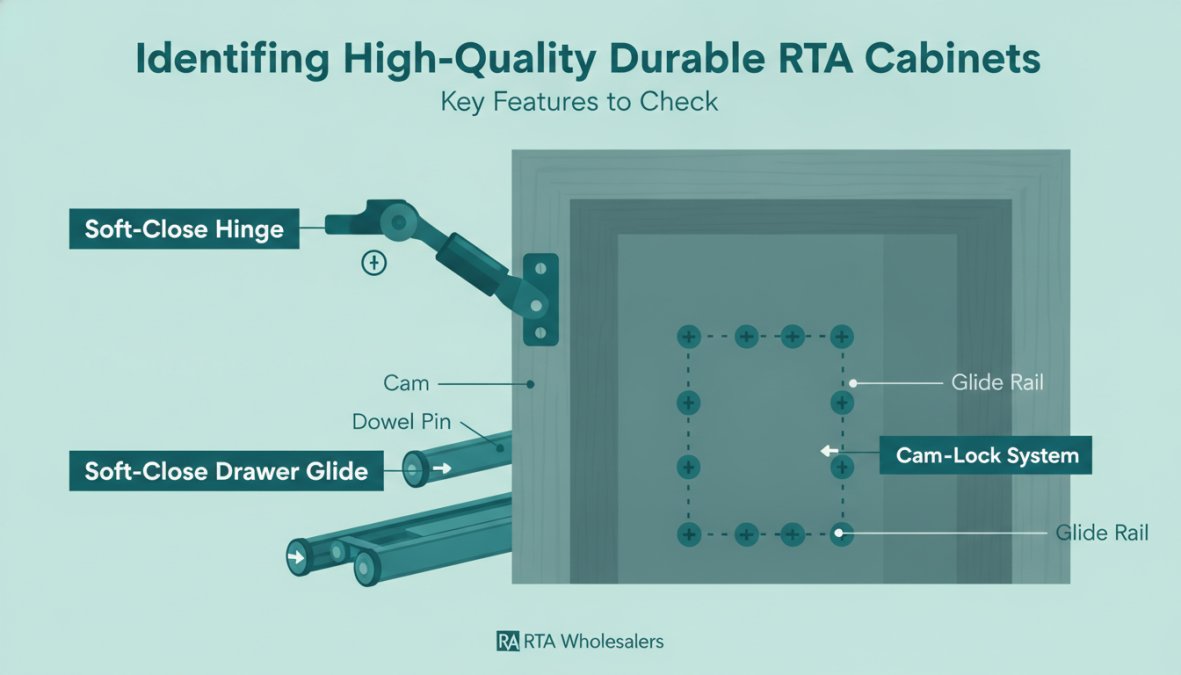
Soft-close hinges are the quality standard. They close doors gently without slamming, reducing stress on the hinge mechanism. Quality hinges use ball bearings and precision engineering and maintain smooth operation for 10,000+ cycles, while budget hinges degrade after 2,000-3,000 cycles.
Full-extension drawer glides allow the drawer to open completely without tilting. Quality glides use ball bearings that operate smoothly under load. Cam-lock systems hold the cabinet box together. Quality cam-locks use reinforced plastic inserts and precise engineering.
Cabinet Box Construction and Joint Strength
Inspect how cabinet panels are connected. Quality construction uses multiple connection points with reinforced joinery. Check for dovetail joints on drawer boxes, they're stronger than simple butt joints. Examine the cabinet box for internal bracing. Quality cabinets include center supports on wide cabinets to prevent sagging.
Moisture Resistance for Kitchens and Bathrooms
For kitchen and bathroom cabinets, moisture resistance is non-negotiable. Plywood is inherently more moisture-resistant than particle board. Check whether cabinet boxes are sealed or treated. Verify that the back panel is solid, not perforated, to protect the cabinet interior from moisture. If you're looking for specific finishes and configurations, options like Custom Order Inset and [Special Order Oak Inset Kitchen Cabinets](https://rtawholesalers.com/collections/white-oak-inset-shaker-kitchen-cabinets-special-order) allow you to tailor cabinets to your exact specifications while maintaining quality construction standards.
RTA Cabinets vs. Pre-Assembled and Custom-Built Options
Homeowners often wonder whether RTA cabinets are the right choice compared to alternatives.
Durability and Longevity Comparison
Pre-assembled cabinets arrive fully assembled. The durability is identical to RTA cabinets, same materials, same construction methods. The difference is assembly location: factory versus on-site.
Custom-built cabinets are constructed by local craftspeople to your exact specifications. Quality varies dramatically based on the builder's skill and materials selection. RTA cabinets offer consistency: every cabinet follows the same tested design and construction method.
Installation Flexibility and Timeline
RTA cabinets offer maximum flexibility. You choose when to assemble and install. Pre-assembled cabinets arrive ready to install, but you lose flexibility. Custom-built cabinets require 12-16 weeks of lead time.
Cost-Effective Solutions Without Compromising Quality
RTA cabinets offer the best value for most residential projects. Pre-assembled cabinets cost 15-25% more than RTA. Custom-built cabinets cost 2-3 times the price of quality RTA cabinets.
| Option | Lead Time | Customization | Installation Effort | Durability | Best For |
|---|---|---|---|---|---|
| RTA Cabinets | 2-4 weeks | Standard configurations | Moderate | Excellent | Most residential projects |
| Pre-Assembled | 3-6 weeks | Limited options | Low | Excellent | Quick renovations, simple layouts |
| Custom-Built | 12-16 weeks | Unlimited | Low | Variable | Unique spaces, specific designs |
Installation Failure Analysis: What Goes Wrong and How to Prevent It
Understanding common installation failures helps you avoid them.
Common Installation Failure Patterns
The most common failure is inadequate support during installation. Cabinets must be properly braced while assembly is underway. Without bracing, the cabinet box can shift or twist, creating stress on fasteners.
Misaligned fasteners cause joint failure. If cam-lock holes don't align perfectly, the fastener won't grip properly. Insufficient fasteners cause sagging. Improper back panel installation causes racking. Moisture damage causes swelling and binding.
Environmental Factors Affecting Cabinet Performance
Humidity levels directly impact cabinet durability. Kitchens with poor ventilation maintain high humidity. In these environments, particle board deteriorates within 3-5 years. Plywood holds up much better but still requires attention to ventilation.
Temperature fluctuations cause wood movement. Over years, this cycling loosens fasteners and stresses joints. Direct water exposure causes rapid deterioration. Prevention requires water-resistant materials and immediate leak detection.
Maintaining Your Durable RTA Cabinets for Long-Term Performance
Cabinet durability extends beyond initial construction. Maintenance practices determine whether your cabinets last 5 years or 15 years.
Regular Care and Cleaning Best Practices
Clean cabinet exteriors monthly using a soft cloth and mild soap. Avoid harsh chemicals that can damage finishes. Wipe up spills immediately to prevent water damage.
Clean cabinet interiors quarterly. Remove items, wipe down shelves, and check for debris. Inspect hinges and drawer glides every six months. Look for dust accumulation or signs of wear. Clean hinges with a dry cloth. Lubricate glides with a silicone-based lubricant.
Check fasteners annually. Tighten any loose fasteners using the appropriate wrench or hex key. Monitor for moisture problems by checking under sinks monthly for leaks.
When to Repair vs. Replace Cabinet Components
Minor issues can often be repaired without replacing the entire cabinet. A loose hinge can be tightened. A stuck drawer glide can be cleaned and lubricated. A water-stained door can be refinished. Replace components when repair is impossible. Replace entire cabinets only when structural damage is severe.
Frequently Asked Questions
Are durable RTA cabinets suitable for primary kitchens in residential projects?
Yes. High-quality durable RTA cabinets constructed with plywood, reinforced cam-lock systems, and soft-close hardware perform reliably in primary kitchens. The key is selecting cabinets with quality materials, proper assembly, and adequate warranty coverage. Many homeowners successfully use durable RTA options for full kitchen renovations rather than temporary solutions.
What materials make RTA cabinets most durable for residential use?
Plywood construction offers superior durability compared to particle board or HDF, providing better structural integrity and moisture resistance. Look for cabinets with solid wood frames, quality veneer or paint finishes, reinforced dovetail joints, and soft-close hinges. Moisture-resistant finishes are especially important for kitchens and bathrooms where humidity fluctuates.
How do you tell if RTA cabinets are high quality before purchasing?
Evaluate the cabinet grade by checking material specifications, hardware quality (soft-close hinges, full-extension drawer glides), joint construction (dovetail vs. simple butt joints), and warranty coverage. Request information about the cabinet box construction, whether it uses plywood or particle board, and confirm moisture resistance ratings. Ask about long-term durability testing and customer reviews.
What are the main pros and cons of RTA cabinets for residential kitchen projects?
Pros include cost-effectiveness, faster delivery timelines, DIY installation flexibility, and availability in multiple wood species and finishes. Cons include assembly requirements, potential quality variation between manufacturers, and installation errors if not done properly. Durability depends heavily on material selection and correct assembly, making it essential to choose quality options and follow instructions carefully.


