 833-377-8663

How Long Do RTA Kitchen Cabinets Last: A Durability Guide

Table of Contents
- How Long Do RTA Kitchen Cabinets Last: Realistic Lifespan Expectations
- RTA Cabinet Materials Comparison: Construction Quality and Durability
- RTA Cabinet Durability: Factors That Affect Lifespan
- How to Maintain RTA Cabinets for Maximum Longevity
- RTA vs. Assembled Cabinets Durability: What's the Real Difference
- Common Failures and Repairability: What Actually Breaks and How to Fix It
- Environmental Impact of RTA Cabinet Materials
- When to Replace vs. Repair: Making the Right Call
Last Updated: July 26, 2026
How Long Do RTA Kitchen Cabinets Last: Realistic Lifespan Expectations
Ready-to-assemble cabinetry lasts 10 to 25 years or longer, depending on materials, installation, and maintenance. Most RTA cabinets fail due to moisture exposure, poor installation, or inadequate maintenance rather than design flaws. Below, we'll explain what determines cabinet longevity and how to extend your investment for decades.
Typical Lifespan Range
RTA kitchen cabinets typically last 10-25 years under normal residential use. Budget-tier RTA options with particle board construction show visible wear after 10-12 years. Mid-range cabinets with plywood box construction and soft-close hinges perform reliably for 15-20 years. Premium RTA cabinets using dovetail drawer boxes and quality veneer finishes last 20-25 years or beyond.
Moisture resistance is the primary differentiator between a 10-year and 25-year cabinet. Kitchens are wet environments, and water exposure is the single biggest threat to cabinet longevity.
What Determines Longevity
Three core factors determine cabinet lifespan: cabinet box material quality, structural integrity of the frame and hinges, and your maintenance commitment. You control the third factor completely. A homeowner who wipes down cabinet interiors monthly and addresses humidity issues will see their cabinets outlast someone who ignores water damage by five years or more.
Plywood construction resists warping and moisture better than particle board. Particle board swells when exposed to water and never fully recovers. Premium hardware extends cabinet life by years compared to budget hinges that wear out quickly.
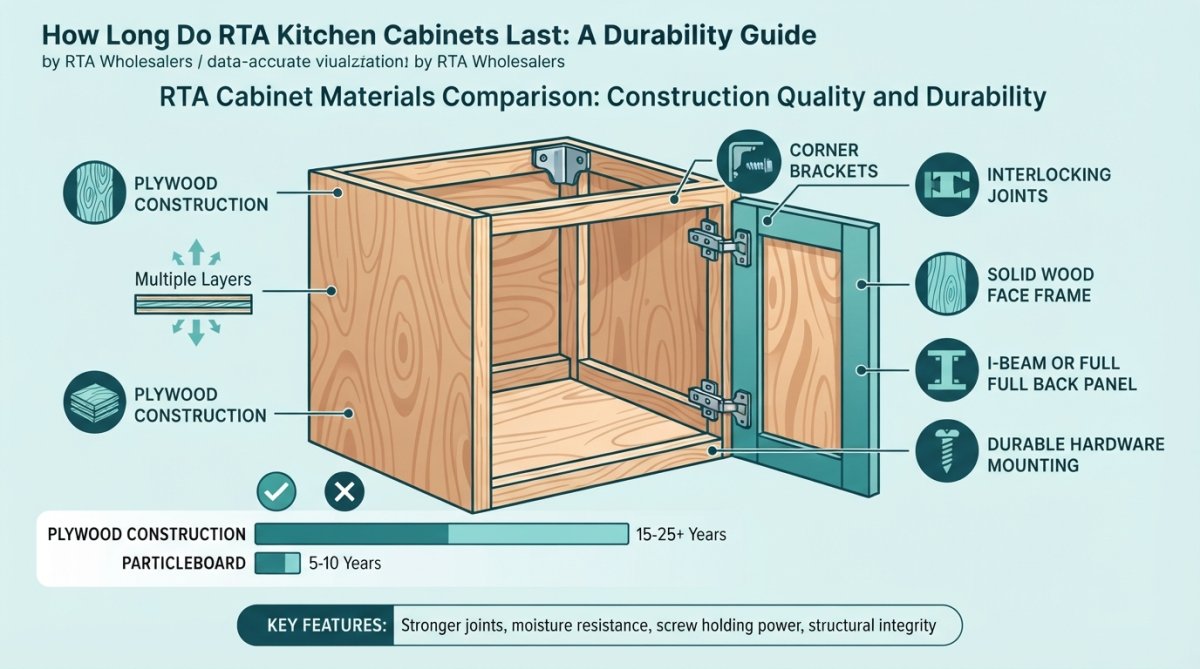
RTA Cabinet Materials Comparison: Construction Quality and Durability
Understanding the materials inside your RTA cabinets is essential before purchase. Two identical-looking cabinets can have vastly different lifespans based on internal construction.
Plywood vs. Particle Board Cabinet Boxes
Plywood is engineered from thin layers of wood veneer glued at alternating angles, making it far more resistant to warping and moisture than particle board. When water exposure occurs, plywood swells minimally and often dries back to its original shape.
Particle board is made from wood chips mixed with adhesive and pressed into sheets. It's cheaper to manufacture but has a critical weakness: water absorption. When particle board absorbs moisture, the adhesive breaks down and the material swells permanently, never returning to its original dimensions.
Plywood costs more but delivers dramatically better longevity, especially in humid climates or kitchens prone to moisture issues.
Veneer, Laminate, and Finish Quality
The visible cabinet surface affects longevity. Veneer is a thin layer of real wood glued to a substrate; laminate is a plastic coating. Both can last 15-20 years if protected from moisture and physical damage. Veneer is more susceptible to peeling if exposed to water or humidity spikes. Laminate is more durable against moisture but can crack under impact.
Paint finishes offer excellent moisture resistance when properly sealed, creating a barrier that protects underlying material from humidity fluctuations. A well-applied paint finish on plywood cabinets is one of the most durable combinations available in RTA cabinetry. Our assembled cabinets are available in just 5 weeks in a multitude of wood species and stain colors or an unlimited choice of Sherwin Williams paint colors.
Stain finishes offer beauty but less protection than paint. Stain penetrates wood but doesn't create a moisture barrier. In high-humidity kitchens, expect to refresh stain every 5-7 years.
Hardware and Structural Components
Hardware reveals true cabinet quality. Soft-close hinges and drawer slides add cost but extend cabinet life by years. Budget hardware wears out under daily use, while premium hardware uses precision-engineered slides with multiple bearing points and hinges designed for thousands of cycles.
Cam-lock systems hold the box together through interlocking dowels and plastic connectors. These work well when assembled correctly but fail if the cabinet is installed crooked or swells from moisture.
Dovetail drawer boxes represent premium RTA construction. Instead of simple butt joints held with cam locks, dovetail joinery interlocks wood pieces mechanically, creating stronger, more moisture-resistant, longer-lasting construction.
RTA Cabinet Durability: Factors That Affect Lifespan
How long RTA kitchen cabinets last depends on environmental factors you control and some you don't. The same cabinet model lasts 12 years in a humid coastal kitchen and 22 years in a dry climate.
Moisture, Humidity, and Climate-Specific Performance
Moisture is the primary enemy of cabinet longevity. Kitchens with humidity above 60% degrade particle board cabinets within 5 years. Plywood cabinets handle higher humidity better but still suffer with poor ventilation. A kitchen with an active range hood, proper ventilation, and humidity controlled below 50% will see cabinets last 20+ years.
Coastal environments present particular challenges. Salt air accelerates metal hardware corrosion and causes wood to swell and shrink with seasonal humidity swings. Coastal cabinets need superior moisture protection: painted finishes over plywood, stainless steel hardware, and aggressive moisture management.
Dry climates present the opposite problem. Low humidity can cause wood to shrink and crack, though cabinet box structural integrity remains sound.
Installation Quality and Assembly Standards
How your RTA cabinets are assembled directly impacts longevity. A cabinet installed crooked or with loose cam locks will rack under its own weight. A cabinet assembled square and level with properly tightened cam locks performs reliably for years.
Professional installation ensures cabinets are level, plumb, and properly secured to wall studs, with hinges and drawer slides adjusted for smooth operation. Cabinets screwed together at the face frames share stress loads and last longer than independent cabinets.
Load-Bearing Capacity and Daily Use Stress
RTA cabinets have load limits. A cabinet designed for 50 pounds per shelf fails faster if consistently loaded with 75 pounds. Distributing weight evenly and respecting load ratings extends cabinet life.
Daily use stress accumulates over time. A cabinet opened and closed 20 times daily experiences 7,300 cycles per year. Over 20 years, that's 146,000 cycles. Budget hardware rated for 50,000 cycles fails around year 7. Premium hardware rated for 500,000 cycles operates smoothly at year 20.
How to Maintain RTA Cabinets for Maximum Longevity
You cannot control materials or construction after purchase, but you have complete control over maintenance. A properly maintained cabinet lasts decades; the same cabinet neglected fails in years.
Cleaning and Regular Care Routines
Clean cabinet interiors monthly. Dust accumulates and traps moisture. A dry cloth or vacuum removes dust before it causes damage. Pay special attention to areas around the sink and stove where humidity and heat concentrate.
Address spills immediately. Water left on cabinet surfaces or inside cabinets causes eventual damage. A sponge and dry cloth take 30 seconds; leaving a spill overnight costs months of cabinet life.
Use appropriate cleaners. Mild dish soap and water works for most surfaces. For painted cabinets, a slightly damp cloth suffices. Avoid excessive water; wring out your cloth so it's damp, not wet.
Addressing Common Wear and Tear Issues
Hinges sag over time, this is normal and fixable. Adjust hinges every 6-12 months to keep doors aligned. Most RTA cabinet hinges have adjustment screws that take 30 seconds to tighten, preventing progressive failure from misaligned doors.
Drawer slides accumulate debris. Crumbs, dust, and food particles jam slides. Clean slides quarterly with a dry brush or vacuum. If a drawer is difficult to open, clean the slides before assuming they're broken.
Soft-close mechanisms weaken over time. If a door closes too quickly or slams, the soft-close cartridge may need adjustment or replacement. Most soft-close hinges adjust with a wrench.
Preventive Maintenance for Hinges, Slides, and Hardware
Inspect hinges and slides annually for rust, corrosion, or visible damage. Stainless steel hardware resists corrosion better than standard steel, especially in humid or coastal environments.
Tighten all fasteners annually. Constant opening and closing loosens screws and bolts. A quick pass with a screwdriver prevents hardware from becoming dangerously loose.
Lubricate drawer slides annually with dry lubricant like PTFE spray. Do not use oil or grease, which attract dust and create mess. Dry lubricant reduces friction and keeps slides operating smoothly.
RTA vs. Assembled Cabinets Durability: What's the Real Difference
The durability comparison between RTA and pre-assembled cabinets is not straightforward. Both can last 20+ years or fail in 10 years depending on materials and maintenance. Real differences lie in construction methods and repairability.
Construction Methods and Structural Integrity
Pre-assembled cabinets are built in factories with precision machinery and quality control. RTA cabinets rely on your assembly. Correct assembly yields equivalent structural integrity; missed cam locks or uneven tightening compromise the cabinet from day one.
Pre-assembled cabinets use more fasteners and adhesive, making them inherently stronger. However, premium RTA cabinets with dovetail construction and quality hardware match pre-assembled cabinet durability. The difference is budget versus premium within each category, not RTA versus pre-assembled.
Warranty Coverage and Long-Term Support
Pre-assembled cabinets typically offer 5-10 year warranties on structural components. RTA cabinets often have 1-3 year warranties, reflecting expectations of potential assembly issues.
Warranty coverage matters less than repairability. If a hinge fails on an RTA cabinet, you can order a replacement and install it yourself in 10 minutes. RTA cabinets are often easier to repair because they're designed for disassembly.
At RTA Wholesalers, we provide replacement hardware, documentation, and design guidance years after purchase. Our free kitchen design service catches potential issues before you order, and our Custom Order Inset and Custom Color Inset cabinets ensure your cabinets fit your space perfectly and are specified correctly from the start.
Common Failures and Repairability: What Actually Breaks and How to Fix It
Understanding what typically fails in RTA cabinets helps you prevent problems and address them quickly. Most failures are fixable with basic tools and replacement parts.
Real-World Failure Points in RTA Cabinets
Hinges fail most frequently. The hinge pin wears out, the spring mechanism weakens, or mounting holes strip. A sagging door is the first sign. Hinge failure is progressive; the door sags more each month until it won't close properly. Replacement hinges are affordable and take 10 minutes to install.
Drawer slides jam when debris accumulates or when the cabinet racks (twists out of square). This failure is usually preventable through regular cleaning. If the slide is truly damaged, replacement is straightforward.
Soft-close mechanisms fail when the hydraulic cartridge wears out. The door closes too quickly instead of slowly. Replacement cartridges are affordable and take 5 minutes to swap.
Cam locks fail when the cabinet swells due to moisture. The lock is designed for specific thickness; if wood swells, the lock no longer engages fully. Replacing cam locks requires disassembly but is manageable for someone with basic tool skills.
Cabinet box damage from water exposure is the most serious failure. If the box has swelled, warped, or delaminated, repair is often not cost-effective. Prevention through moisture control is far easier than repair.
DIY Repair Strategies for Extended Cabinet Life
Replace hinges before complete failure. When you notice sagging, order replacement hinges immediately. Installing new hinges while old ones still function prevents cascading failures.
Clean drawer slides instead of replacing them. Nine times out of ten, a "broken" slide just needs cleaning. Vacuum out debris, wipe with a dry cloth, and test. If the slide still binds, apply dry lubricant and try again.
Adjust soft-close mechanisms before replacing them. Most soft-close hinges have adjustment screws controlling closing speed. Adjustment costs nothing and often solves the problem.
Seal moisture damage immediately. If you notice water staining or swelling on a cabinet exterior, dry the area thoroughly and apply a waterproof sealant or paint. Catching moisture damage early prevents it from spreading into the cabinet box.
Replace damaged veneer or laminate rather than the entire cabinet. If a door face is scratched or peeling, the door can be refinished or re-veneered, far cheaper than replacing the entire cabinet.
Environmental Impact of RTA Cabinet Materials
RTA cabinets have a lower environmental footprint than pre-assembled cabinets. The flat-pack design reduces shipping volume, meaning fewer truck trips and lower fuel consumption. A shipment of 50 RTA cabinets takes the space of 5-10 pre-assembled cabinets, reducing transportation emissions significantly.
Plywood and particle board are both made from waste wood products, making them more sustainable than solid wood alternatives. Water-based paints like Sherwin Williams products have lower environmental impact than oil-based alternatives.
The real environmental question is longevity. A cabinet lasting 25 years has half the environmental impact of one lasting 12 years, regardless of material choice. Maintaining your cabinets and extending their life is the most environmentally responsible choice.
When to Replace vs. Repair: Making the Right Call
Deciding whether to repair or replace a cabinet is a practical calculation. If repair costs less than 30% of replacement cost and extends life by 5+ years, repair makes sense.
Hinge failure: always repair. Replacement hinges are affordable and take 10 minutes. Replacing the entire cabinet is significantly more expensive.
Drawer slide failure: repair first. Clean and lubricate before replacing. If cleaning doesn't work, replacement slides are affordable. Full cabinet replacement is much more expensive.
Soft-close mechanism failure: repair. Replacement cartridges are affordable. Full cabinet replacement is much more expensive.
Cabinet box damage from water: evaluate carefully. If swelling is minor and the cabinet is otherwise sound, drying and sealing may restore function. If the box is severely warped or delaminated, replacement is likely necessary.
Finish damage (scratches, peeling veneer): repair or refinish. Refinishing a cabinet door is much cheaper than replacing the entire cabinet.
The general rule: if the cabinet box is structurally sound, repair is almost always cheaper than replacement. Only when the box itself is damaged beyond repair should you consider full replacement.
Choosing RTA cabinets means accepting responsibility for assembly and maintenance, but it also gives you the ability to repair and customize your cabinets over decades. Cabinets that last longest are not always the most expensive; they're the ones assembled correctly, protected from moisture, and maintained consistently. At RTA Wholesalers, we provide the materials and guidance to help your cabinets last. Our free kitchen design service ensures your cabinets fit perfectly and are specified correctly from the start. Build cabinets that last 20+ years by starting with the right materials and maintenance plan.
| Cabinet Material | Expected Lifespan | Best For | Maintenance Intensity |
|---|---|---|---|
| Particle Board | 10-12 years | Budget renovations, dry climates | Low (but vulnerable to moisture) |
| Plywood | 15-20 years | Standard kitchens, humid climates | Moderate (regular moisture control) |
| Premium Plywood + Soft-Close | 20-25+ years | Long-term durability, active kitchens | Moderate (annual hinge/slide maintenance) |
| Dovetail Construction | 20-25+ years | Maximum durability, high-use kitchens | Moderate (premium hardware lasts longer) |
Frequently Asked Questions
How long do RTA kitchen cabinets last compared to custom cabinets?
RTA cabinets last as long as custom cabinets when built with equivalent materials. A premium RTA cabinet with plywood construction and quality hardware lasts 20-25 years, matching custom cabinets built with the same materials. The difference is materials and construction quality within each category, not RTA versus custom.
Can RTA cabinets be repaired after water damage?
Minor water damage can be addressed through drying and sealing. If a cabinet exterior gets wet but the interior box stays dry, damage is usually cosmetic. Dry the area thoroughly, sand if necessary, and apply a waterproof sealant or paint. If water penetrates the cabinet box and causes swelling, damage is often permanent. Prevention through moisture control is far easier than repair.
What's the most common reason RTA cabinets fail prematurely?
Moisture exposure is the primary cause of premature failure. Kitchens with humidity above 60% or poor ventilation see particle board cabinets deteriorate within 5 years. Poor assembly is the second most common cause, followed by neglected maintenance. Hinges that sag for months without adjustment eventually fail completely. Regular maintenance prevents most early failures.
Should I choose plywood or particle board for my RTA cabinets?
Plywood is superior for durability and moisture resistance. If your kitchen has humidity issues, poor ventilation, or is in a coastal climate, plywood is essential. If your kitchen is dry with good ventilation, particle board cabinets can last 12-15 years. Plywood extends cabinet life by 5-10 years, making it a better long-term investment.
How often should I maintain my RTA cabinets?
Monthly: clean cabinet interiors with a dry cloth. Quarterly: clean drawer slides. Annually: inspect and tighten all hardware, adjust hinges, and lubricate slides. These simple tasks take 1-2 hours per year and extend cabinet life by years. Maintenance is the difference between a cabinet lasting 15 years and one lasting 25 years.
Frequently Asked Questions
How long do RTA kitchen cabinets last on average?
RTA kitchen cabinets typically last 10-15 years with proper care, though quality varies significantly based on materials and construction. Plywood-based cabinets with solid joinery tend to perform better than particle board alternatives. Factors like humidity control, proper installation, and regular maintenance directly impact how long your RTA cabinets last and can extend their functional lifespan considerably.
What factors most affect RTA cabinet durability?
RTA cabinet durability depends on material quality (plywood vs. particle board), moisture resistance, installation precision, and hardware quality. Climate-specific performance matters too, high humidity environments accelerate deterioration. Load-bearing capacity and how frequently cabinets are used also influence longevity. Soft-close hinges and quality drawer slides reduce wear compared to basic hardware, and proper ventilation prevents moisture damage.
How do I maintain RTA cabinets to make them last longer?
Regular maintenance extends RTA cabinet life significantly. Clean surfaces with mild soap and avoid excess moisture. Check hinges and drawer slides quarterly, tightening loose fasteners and lubricating moving parts. Wipe spills immediately to prevent water damage. Ensure proper kitchen ventilation to control humidity. Inspect cam-lock systems and dovetail drawer boxes for wear. Address minor issues early, replacing a hinge is cheaper than replacing a damaged cabinet box.
Are RTA cabinets less durable than pre-assembled or custom cabinets?
Not necessarily. RTA cabinet durability depends on material quality and construction, not assembly method. High-quality RTA cabinets with plywood construction, dovetail drawers, and quality hardware can match pre-assembled cabinet longevity. The key difference is that assembled cabinets may use premium materials or superior joinery techniques. Budget RTA options with particle board typically don't last as long as mid-range or premium alternatives, whether RTA or pre-assembled.
[EXTERNAL_LINK: Understanding Wood Composites in Cabinetry | woodmagazine.com]
[EXTERNAL_LINK: Kitchen Cabinet Durability and Maintenance Guidelines | consumerreports.org]
[EXTERNAL_LINK: Moisture Control in Kitchen Environments | epa.gov]


