 833-377-8663

How to Choose Kitchen Cabinet Hardware: A Complete Guide

Table of Contents
- How to Choose Kitchen Cabinet Hardware: Key Factors
- How to Measure for Cabinet Hardware
- Knobs vs Pulls for Kitchen Cabinets
- Standard Cabinet Pull Sizes and Spacing
- Mixing Metal Cabinet Hardware: Creating Cohesion
- Finishes, Durability, and Maintenance
- Hardware Selection for Accessibility and Universal Design
- Common Mistakes When Choosing Cabinet Hardware
How to Choose Kitchen Cabinet Hardware: A Complete Guide
Last Updated: June 28, 2026
Selecting the right kitchen cabinet hardware affects both function and aesthetics. This guide breaks down the essential factors you need to consider when selecting hardware that complements your cabinet style, fits your budget, and works for your daily kitchen workflow.
How to Choose Kitchen Cabinet Hardware: Key Factors
Understanding your kitchen's overall design style is the foundation for selecting hardware that won't feel out of place. Modern kitchens call for sleek, minimalist pulls with clean lines, while traditional spaces benefit from ornate knobs with decorative details. Transitional designs blend contemporary and classic elements with simple but characterful hardware.
The material and finish of your hardware should coordinate with your kitchen's other metals. If you have stainless steel appliances, brushed nickel or chrome hardware typically complements them well. For warm-toned wood cabinets, consider bronze or gold-finished pulls. Identify your kitchen's metal "temperature" (warm or cool) and stay consistent throughout.
Functionality matters as much as appearance. Hardware needs to withstand daily use without loosening or losing its finish. Commercial-grade hardware from reputable manufacturers typically lasts longer than budget options.
Understanding Your Kitchen's Design Style
Your cabinet hardware should feel like a natural extension of your kitchen's personality. A modern farmhouse kitchen with white shaker cabinets might use simple cup pulls in matte black or oil-rubbed bronze. A contemporary kitchen with flat-panel cabinets could feature minimal bar pulls in brushed stainless steel. Traditional kitchens with raised-panel cabinetry often showcase more decorative hardware with ornamental backplates.
The relationship between your hardware and cabinet style creates visual harmony. Inset cabinets, which sit flush within the face frame, often pair beautifully with hardware that has subtle detail and dimension, and if you're building custom cabinetry, options like Custom Order Inset or Special Order Oak Inset Kitchen Cabinets allow you to select hardware that perfectly complements your cabinet design from the start. Glass-front cabinets might feature more decorative hardware since it's visible, while solid cabinet doors allow for bolder choices. Large cabinets can handle substantial pulls, while smaller cabinets look better with more delicate hardware.
Considering Functionality and Workflow
Kitchen workflow efficiency depends partly on hardware accessibility and ease of use. Pulls are generally easier to grab quickly than knobs, especially when your hands are wet or full. Think about who uses your kitchen, elderly family members or those with arthritis benefit from larger, easier-to-grip hardware, while children need hardware they can manipulate without excessive force.
The depth of your cabinets and door swing pattern affect hardware placement and accessibility. Base cabinets with pullout shelves benefit from pulls positioned low enough to grab comfortably. Wall cabinets require hardware at a height where you can reach without straining.
How to Measure for Cabinet Hardware
Finding the exact center-to-center measurement is the most critical step in hardware selection. This measurement, the distance between the two screw holes on the back of your hardware, determines whether your hardware will align properly with pre-drilled holes in your cabinets. Standard measurements range from 2 inches for small knobs to 10 inches for large bar pulls on base cabinets.
Finding Center-to-Center Measurements
Start by measuring the width of your cabinet door or drawer front. Most hardware manufacturers provide guidelines for positioning hardware based on cabinet size. For a standard 24-inch cabinet door, hardware is typically centered horizontally and positioned about 2-3 inches from the top (for wall cabinets) or bottom (for base cabinets).
Use a tape measure to find the exact center point of your cabinet door. Mark this point lightly with a pencil. From this center point, measure outward to determine where your screw holes should be. If you're installing 3-inch center-to-center hardware, mark points 1.5 inches on either side of center. Write down all your measurements before ordering hardware to prevent costly mistakes.
Accounting for Cabinet Depth and Door Thickness
Cabinet depth affects how hardware looks and functions. Deeper cabinets can accommodate longer, more substantial pulls without looking disproportionate. Shallow cabinets look better with smaller, more refined hardware.
Door thickness also matters for hardware selection. Standard cabinet doors are typically 3/4 inch thick, but custom-built doors might be thicker. Thicker doors require hardware with longer screws to ensure proper mounting. When measuring, account for any decorative backplates and ensure adequate clearance between the backplate and adjacent cabinet doors.
Knobs vs Pulls for Kitchen Cabinets
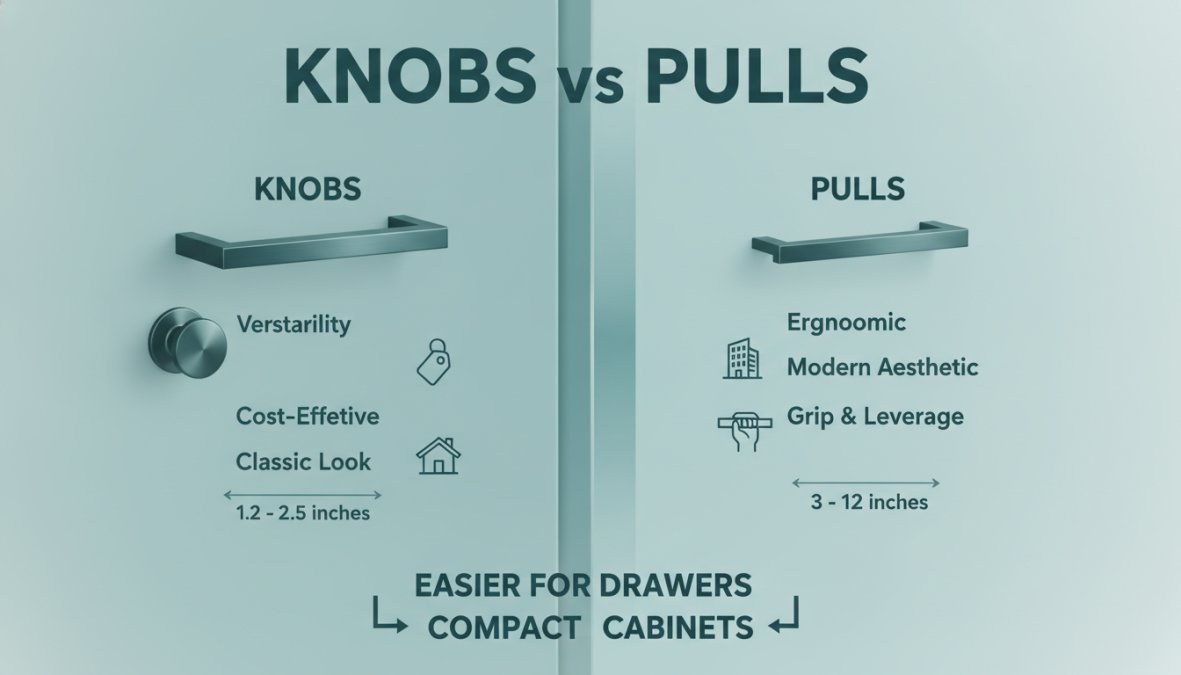
The choice between knobs and pulls comes down to ergonomics, aesthetic preference, and cabinet size. Knobs are single-point fasteners that work well on smaller cabinets and pantry doors. Pulls, which span 3-10 inches, distribute the force of opening across a larger area and feel more comfortable for frequent use. Most modern kitchens use a combination: pulls on drawers and large cabinet doors, knobs on smaller doors.
When Knobs Work Best
Knobs are ideal for pantry doors, glass-front cabinets, and smaller upper cabinets where you're not reaching frequently. They require less space to operate and feel more delicate and refined. Traditional and transitional kitchens often feature knobs as the primary hardware choice. Cup knobs offer better ergonomics than flat knobs while maintaining a classic appearance.
When Pulls Are the Better Choice
Pulls should be your primary choice for base cabinets, deep drawers, and any cabinet you access multiple times daily. The lever action of a pull is easier on joints and requires less finger strength than twisting a knob. For kitchens serving multiple family members with varying abilities, pulls are the more inclusive choice. Bar pulls create a contemporary look while providing excellent grip.
Standard Cabinet Pull Sizes and Spacing
Cabinet hardware comes in standardized sizes that correspond to common cabinet dimensions. The most common center-to-center measurements are 3 inches, 4 inches, 5 inches, and 10 inches. Smaller cabinets typically use 3-inch or 4-inch hardware, while larger base cabinets use 5-inch or 10-inch pulls.
| Cabinet Type | Typical Width | Recommended Pull Size (C-to-C) |
|---|---|---|
| Small upper cabinet | 12-15 inches | 3 inches |
| Standard upper cabinet | 18-24 inches | 3-4 inches |
| Large upper cabinet | 30-36 inches | 4-5 inches |
| Base drawer | 18-24 inches | 4-5 inches |
| Base drawer | 30-36 inches | 5-10 inches |
| Pantry door | 24 inches | 4-5 inches |
Common Pull Lengths and Widths
Pull length refers to the overall dimension of the hardware from end to end. A 4-inch pull has a 4-inch center-to-center measurement, but the overall length might be 4.5 inches or longer depending on the design. Always check the manufacturer's specifications for both center-to-center measurement and overall length. Width matters for bar pulls and cup pulls with decorative backplates, a pull that's too wide looks clunky, while one that's too narrow looks undersized.
Spacing Guidelines for Different Cabinet Types
For wall cabinets, position hardware 2-3 inches from the top of the door. For base cabinets and drawers, position hardware 2-3 inches from the bottom, which aligns with natural reaching height when standing at counter level. Horizontal spacing should center the hardware on your cabinet door.
Mixing Metal Cabinet Hardware: Creating Cohesion
Mixing metal finishes in your kitchen is acceptable when done intentionally. The key is limiting your palette to two complementary metals and ensuring they appear in balanced quantities. Warm metals (bronze, brass, copper, gold) pair well together, as do cool metals (chrome, stainless steel, nickel, pewter). Mixing warm and cool metals requires more restraint.
Pairing Metals Effectively
Brushed finishes, whether nickel, bronze, or stainless, feel more contemporary and hide fingerprints better than polished finishes. Oil-rubbed bronze pairs beautifully with warm wood tones and traditional cabinetry. Brushed nickel works well with both contemporary and transitional designs. Matte black hardware has become increasingly popular for contemporary and industrial-style kitchens. When mixing hardware on different cabinet types, ensure both pieces share the same finish.
Balancing Hardware with Appliances and Fixtures
Your cabinet hardware should coordinate with your kitchen's other metal elements: appliances, faucet, light fixtures, and sink. If your appliances are stainless steel, your cabinet hardware doesn't need to match exactly; brushed nickel or chrome hardware coordinates well. If you have a bronze or gold faucet, consider incorporating those tones into your cabinet hardware.
Finishes, Durability, and Maintenance
The finish on your hardware affects both appearance and longevity. High-traffic kitchens benefit from finishes that resist tarnishing and wear. Polished finishes show fingerprints and water spots more readily than brushed or matte finishes. If you have hard water or frequently wet hands, brushed finishes require less maintenance.
Stainless steel hardware resists corrosion and fingerprints better than other materials, making it ideal for kitchens with high moisture or frequent use. Quality hardware from reputable manufacturers uses thicker coatings and better base materials, resulting in longer-lasting finishes.
Popular Finishes and Their Longevity
Brushed nickel is durable, resists fingerprints, and works with multiple design styles, typically maintaining its appearance for 10+ years with normal use. Brushed stainless steel offers similar durability with slightly better corrosion resistance, ideal for kitchens near salt water or in humid climates. Oil-rubbed bronze develops a natural patina that many homeowners find attractive and doesn't chip or peel like some coatings. Matte black hardware is trendy but requires careful selection; quality matte black hardware lasts as long as brushed finishes.
Sustainability and Material Longevity
Consider the lifespan of your hardware when evaluating sustainability. A cheap pull that needs replacement every 5 years generates more waste than quality hardware lasting 20+ years. Brass hardware offers excellent longevity, and stainless steel is infinitely recyclable, representing a more sustainable choice than some alternative finishes.
Hardware Selection for Accessibility and Universal Design
Kitchen hardware should be usable by people of all ages and abilities. Lever-style pulls are more accessible than knobs, which require twisting and gripping strength. Larger hardware accommodates users with limited hand dexterity. Hardware positioned at 36-48 inches from the floor is reachable by most users, including those in wheelchairs.
Ergonomic Considerations for All Users
Older adults and those with arthritis benefit from hardware that requires minimal force to operate. Lever-style hardware (bail pulls, cup pulls with handles) are easier to grip than round knobs. Hardware with textured surfaces provides better grip than smooth, polished finishes. Positioning pulls on base cabinets at 36-42 inches from the floor accommodates most users, while lower cabinets with hardware at 30-36 inches accommodate wheelchair users or children.
Soft-Close and Smart Storage Technology
Soft-close hinges and drawer slides have become standard in quality cabinetry. These mechanisms prevent slamming and reduce noise while quality pulls and hinges withstand thousands of open-close cycles without loosening or wearing.
Common Mistakes When Choosing Cabinet Hardware
One frequent error is selecting hardware based solely on appearance without considering how it feels in your hand. A beautiful pull that's uncomfortable to grip becomes frustrating during daily use. Another mistake is choosing hardware that's disproportionate to your cabinet size, oversized pulls on small cabinets look clunky, while tiny hardware on large base cabinets looks insubstantial.
Installing hardware at inconsistent heights creates a sloppy appearance. Measure carefully and use templates provided by manufacturers to ensure all hardware is positioned uniformly. Selecting budget hardware to save money often backfires, as cheap hardware loosens, finishes chip or tarnish, and replacement becomes necessary within a few years. Finally, many homeowners choose hardware that clashes with their kitchen's overall style. Ensure your hardware choice complements your cabinet style and design aesthetic.
Choosing kitchen cabinet hardware significantly impacts your kitchen's functionality and appearance. The right hardware should feel comfortable in your hand, coordinate with your kitchen's design style, and withstand years of daily use. With careful measurement, thoughtful style selection, and quality materials, your hardware choice will enhance your kitchen for years to come.
National Kitchen & Bath Association design standards
ADA Accessibility Guidelines for kitchen design
Kitchen Hardware Durability Study by Consumer Reports
Frequently Asked Questions
How do I choose the right size cabinet pulls?
Start by measuring the center-to-center distance between existing holes on your cabinet doors. Standard sizes range from 3 to 5 inches for pulls. For base cabinets, larger pulls (4-5 inches) improve ergonomics and workflow efficiency. Wall cabinets typically use smaller pulls (3-4 inches). Consider your hand size and how you'll grip the hardware daily. Measure multiple cabinets, as spacing may vary across your kitchen layout.
Should kitchen cabinet hardware match the faucet?
While matching finishes create visual harmony, you don't need identical hardware and faucets. Instead, coordinate the metal families, for example, pair brushed nickel pulls with a brushed nickel faucet, or mix warm and cool tones intentionally for a modern look. The key is ensuring all cabinet hardware, appliances, and fixtures work together cohesively. Consider your kitchen's overall design style and whether you're mixing metal cabinet hardware intentionally as part of your aesthetic.
Are knobs or pulls better for kitchen cabinets?
Pulls generally offer better ergonomics and are easier to grip, especially for accessibility and universal design. They work well on larger base cabinets and drawers. Knobs suit smaller wall cabinets and pantries. Your choice depends on cabinet size, your kitchen's functional design, and personal preference. Many kitchens use both, pulls on frequently accessed drawers and base cabinets, knobs on upper wall cabinets. Test both options to see which feels most natural for your workflow.
What finish should I choose for cabinet hardware?
Popular finishes include brushed nickel, oil-rubbed bronze, polished chrome, and matte black, each offering different durability and maintenance needs. Brushed finishes hide fingerprints better than polished ones, making them practical for high-traffic kitchens. Consider material longevity and sustainability; solid brass and stainless steel outlast plated options. Match your finish to your appliances and faucet for a cohesive look, but don't feel pressured to match exactly, intentional mixing of metals is a modern design trend.


