 833-377-8663

How to Mix Wood and White Kitchen Cabinets: A Design Guide

Table of Contents
- Understanding Two-Toned Cabinetry: Why Mix Wood and White
- Two-Tone Kitchen Cabinet Ideas: Common Layout Patterns
- Best Wood Species for Kitchen Cabinets: Choosing Your Tone
- Mixing Wood Tones in Kitchen Design: Technical Ratios and Balance
- How to Choose Cabinet Hardware for Two-Tone Kitchens
- Design Styles: Rustic, Transitional, and Modern Applications
- Budget-Friendly Implementation: Maximizing Impact Without Overspending
- Small Kitchen Solutions: Making Two-Tone Work in Compact Spaces
How to Mix Wood and White Kitchen Cabinets: A Design Guide
Last Updated: August 3, 2026
Understanding Two-Toned Cabinetry: Why Mix Wood and White
Mixing wood and white kitchen cabinets has become one of the most popular design strategies for homeowners and contractors. This approach combines the warmth of natural wood tones with the clean, modern appeal of white cabinetry to create visual depth and sophistication. Two-toned cabinetry works because it leverages contrast without creating visual chaos, the human eye responds to variation, making a space feel intentional rather than monotonous.
When you balance wood grain against crisp white surfaces, you're adding texture, warmth, and a sense of movement that draws people through the space. The beauty of this approach lies in its flexibility. Whether your kitchen leans rustic, transitional, or modern farmhouse, mixing wood and white cabinets gives you the foundation to build from. The real skill is understanding the ratios, choosing complementary wood tones, and coordinating hardware so everything feels cohesive.
Two-Tone Kitchen Cabinet Ideas: Common Layout Patterns
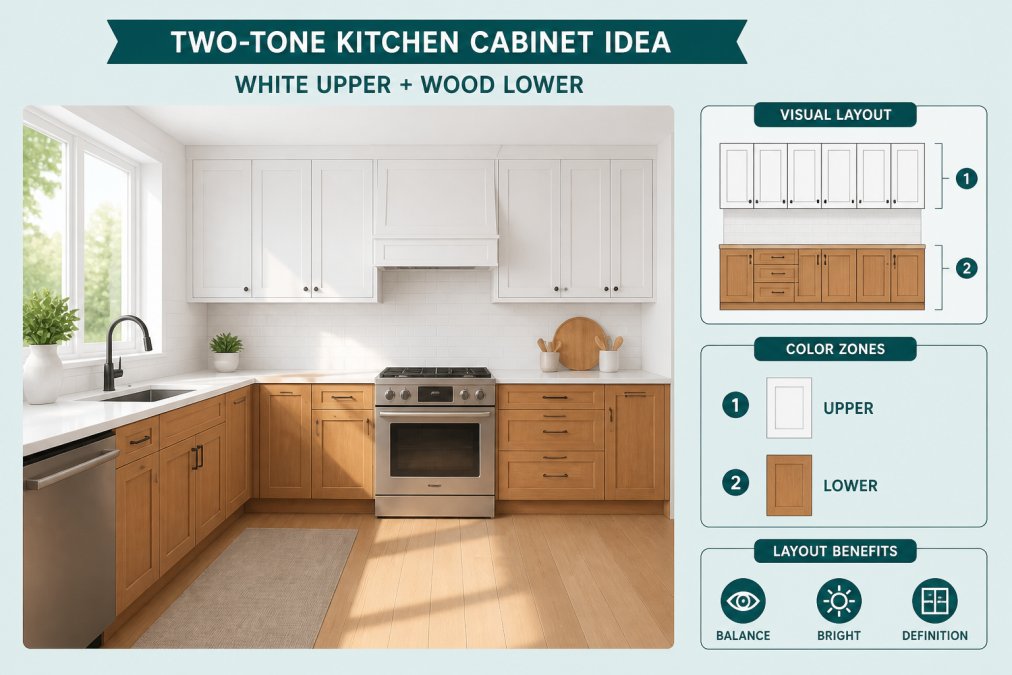
White Uppers with Wood Lowers
The most popular configuration pairs white upper cabinets with wood lower cabinets. This layout works because lighter elements draw the eye upward, making ceilings feel higher and kitchens feel more spacious. White uppers create an airy quality, while wood lowers ground the space and provide visual weight where the eye naturally rests.
This pattern is especially effective in smaller kitchens. The white overhead storage doesn't feel heavy or oppressive, and the wood base anchors the room without making it feel cramped. Practically speaking, white uppers hide dust and fingerprints better than natural wood, while wood lowers take daily wear and show patina rather than damage, extending the visible lifespan of your cabinetry.
Wood Uppers with White Lowers
Less common but equally striking, wood uppers with white lowers create a bolder statement. This reversal works best in kitchens with higher ceilings or in open-concept spaces where upper cabinets don't visually close off the room. Wood uppers showcase grain patterns and natural variation at eye level, while white lowers keep the base clean and minimal, preventing the space from feeling too textured.
This layout demands careful hardware coordination because the wood above and white below create a stronger visual break, making your hardware finish crucial to tying everything together.
Island as a Focal Point
The kitchen island is the perfect place to introduce a third design layer without overwhelming the space. Many designers use the island to bridge white perimeter cabinets and wood cabinetry, or to introduce a color that ties both together. An island in contrasting wood or a different finish creates a focal point that draws people into the kitchen and functions as a practical testing ground before committing to perimeter cabinets.
Best Wood Species for Kitchen Cabinets: Choosing Your Tone
Warm Wood Tones vs. Cool Undertones
The wood you choose determines whether your two-tone kitchen feels cohesive or disjointed. Warm wood tones, honey, amber, golden oak, pair naturally with white because they share warmth. Cool-toned woods like ash can feel disconnected from warm whites, creating visual tension.
Look at wood samples under the lighting conditions of your actual kitchen, not under showroom lights. A wood that looks golden in daylight might shift toward gray under artificial kitchen lighting. Warm woods work with creamy whites and off-whites, while cool woods pair better with pure whites or whites with blue undertones.
Grain Pattern and Visual Weight
Grain patterns affect how much visual weight a wood brings to your kitchen. Tight, uniform grain feels controlled and modern, while open, dramatic grain feels rustic and traditional. A wood with heavy, dramatic grain paired with stark white cabinets creates maximum contrast, working well in rustic or farmhouse kitchens. In transitional spaces, moderate grain and white cabinets feel more balanced. Modern kitchens benefit from woods with subtle, consistent grain.
Visual weight also depends on stain color. A light natural stain weighs less visually than a dark walnut stain. If your perimeter cabinets are already visually heavy, balance them with lighter wood or more white in upper cabinets.
Mixing Wood Tones in Kitchen Design: Technical Ratios and Balance
The 60-30-10 Visual Balance Rule
Interior designers use the 60-30-10 rule as a starting point for color balance: 60% dominant color, 30% secondary color, 10% accent. In a two-tone kitchen, white typically serves as the 60% dominant element, wood as the 30% secondary, and hardware or accent colors as the 10%.
This rule prevents your kitchen from feeling too wood-heavy or too white. Count your cabinet doors, drawer fronts, and panels to approximate your ratio. Upper cabinets typically make up 40-50% of total cabinet volume, so if those are white, you're already at your 60% baseline.
Avoiding a Choppy Kitchen Layout
A choppy kitchen layout happens when wood and white cabinets are scattered randomly throughout the space. Cluster your cabinetry by color: all white uppers, all wood lowers, or all white on one wall and wood on the adjacent wall. Grouping creates visual blocks that the eye processes as intentional zones rather than random variation.
Islands are the exception, they can be a different color because they're standalone elements. Consistent hardware and finishes also tie white and wood together, making the whole kitchen feel cohesive even if they're different colors.
How to Choose Cabinet Hardware for Two-Tone Kitchens
Hardware Finish Compatibility
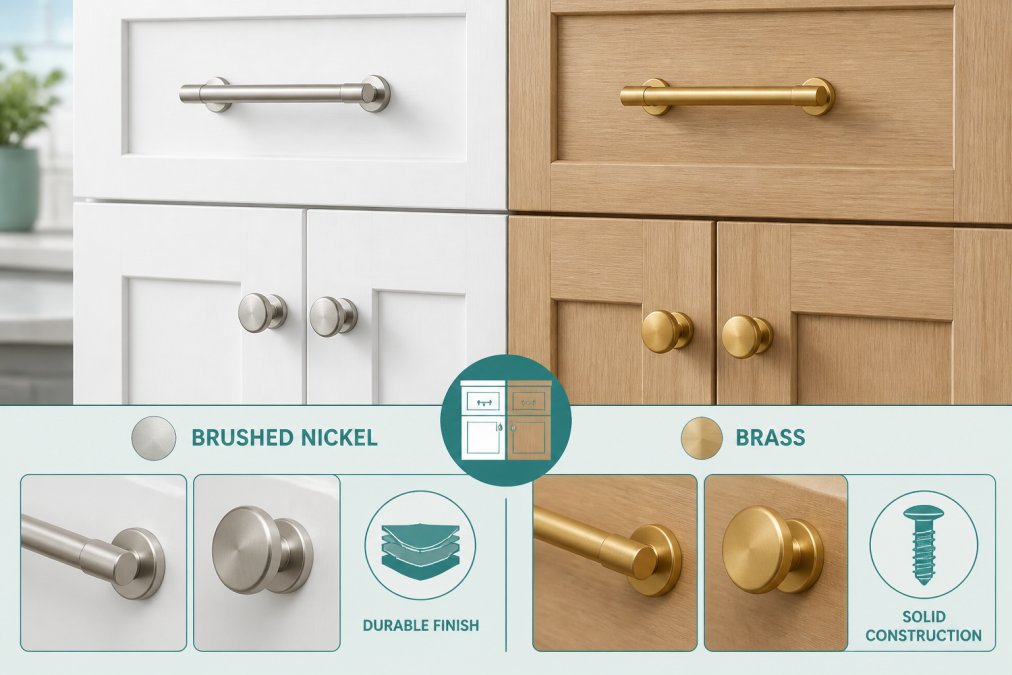
Hardware finish is the glue that holds a two-tone kitchen together. The finish you choose should work equally well on both white and wood surfaces. Brushed nickel looks clean on white and warm on wood. Polished brass looks elegant on both. Matte black works on both modern white and rustic wood.
Test hardware samples on actual cabinet doors if possible. Order a sample pull or knob and install it temporarily on a cabinet you can see in your kitchen's lighting. Hardware that looks good in a showroom might feel wrong once you see it every morning.
Coordinating Across Wood and White Sections
The hardware should be the same finish across all cabinets, white and wood alike, creating visual continuity. You can vary the style of hardware between sections if the finish is consistent, white uppers might have simple cup pulls while wood lowers have bar handles, but both in brushed nickel.
Size matters too. Larger hardware (2-inch to 3-inch pulls) works better on larger cabinet doors and creates a bolder statement. Keep the scale consistent across both wood and white cabinets so nothing feels out of proportion.
Design Styles: Rustic, Transitional, and Modern Applications
Rustic kitchens thrive with this approach because mixing wood and white cabinets is inherent to the aesthetic. Dark or medium wood lowers with white uppers, open shelving, and hardware with visible aging feel authentic. Pair this with butcher block or live-edge wood countertops for undeniable warmth.
Transitional design sits between traditional and modern. Medium-tone wood with creamy white, shaker-style doors, and brushed nickel hardware feels collected without being trendy. Two-tone cabinetry is inherently balanced for this style.
Modern kitchens can pull off two-tone cabinetry if the execution is clean. White flat-panel cabinets paired with light natural wood and minimalist hardware reads as intentional. Avoid dramatic wood grain or ornate details. The contrast should be subtle rather than a bold statement.
Budget-Friendly Implementation: Maximizing Impact Without Overspending
Two-tone cabinetry doesn't require premium materials across the board. Invest in quality wood for lower cabinets (where wear is visible and durability matters) and choose cost-effective white cabinetry for uppers (where the finish matters more than the wood species).
Custom Order Inset cabinets are available in a multitude of wood species and stain colors, plus an unlimited choice of Sherwin Williams paint colors for white sections. Reserve custom orders for visible areas and use standard finishes for less-visible sections.
Hardware is a place where small investments create big visual impact. Quality hardware across both wood and white sections ties everything together and makes the whole kitchen feel more cohesive.
Small Kitchen Solutions: Making Two-Tone Work in Compact Spaces
Small kitchens benefit dramatically from two-tone cabinetry because it creates visual interest without adding physical bulk. White uppers make the space feel taller and more open. Wood lowers provide warmth and prevent the kitchen from feeling too clinical.
In tight spaces, avoid dark wood tones that recede visually and make the room feel smaller. Light to medium wood tones work better. Use the island strategically as a focal point without taking up excessive space. Proper lighting ensures both colors read as intentional and makes the space feel larger.
Mixing wood and white kitchen cabinets is a design decision that pays dividends in both aesthetics and functionality. The approach gives you warmth and modernity, visual interest and balance, durability and style. The key is intentional planning, understanding your ratios, choosing complementary tones, and coordinating hardware so everything feels like it belongs together.
Start with a design consultation and build a kitchen that feels both timeless and unmistakably yours.
Frequently Asked Questions
Can you mix wood and painted cabinets in the same kitchen?
Yes, mixing wood and white (or other painted) cabinets is a proven design strategy. The key is intentional placement: use white uppers to brighten the space and wood lowers for warmth, or reverse the pattern based on your layout. Keep hardware finishes consistent across both cabinet types to maintain visual cohesion. Custom color inset cabinets allow you to achieve precise color matching between your painted and wood sections.
What is the rule for two-tone kitchen cabinets?
The primary rule is visual balance: typically use a 60-30-10 ratio where one tone dominates (usually white or natural wood), the secondary tone accents (the opposite finish), and a third accent color appears in hardware or trim. Avoid equal amounts of wood and white, as this creates a choppy, disjointed look. Group same-colored cabinets together, don't alternate randomly. Keep transitions at logical points like island edges or upper-to-lower cabinet lines.
How do you choose the right wood tone for a white kitchen?
Select a wood tone that complements your white cabinet finish and overall design style. Warm wood tones (honey, medium oak) pair well with creamy whites for transitional or rustic aesthetics. Cool wood tones (gray, whitewashed) work better with stark whites in modern settings. Consider your countertop, backsplash, and flooring colors to ensure the wood tone harmonizes with the full palette. Test wood samples next to your white cabinet finish under your kitchen's lighting before committing.
Should the island be a different color than the perimeter cabinets?
An island can be a different color, but it works best as a deliberate design anchor. If your perimeter cabinets are white uppers with wood lowers, consider making the island a bold accent color or the opposite combination (wood uppers with white base). This creates visual interest without overwhelming the space. Alternatively, match the island to one of your two-tone colors to tie the design together. The island's finish should coordinate with your hardware choices across all cabinet sections.


