 833-377-8663

How to Organize Deep Kitchen Cabinet Drawers

Table of Contents
- Assess Your Deep Kitchen Drawers and Remove What Doesn't Belong
- Group Items by Category and Use
- Choose the Right Deep Kitchen Drawer Organizers
- How to Organize Pots and Pans in Drawers
- Use Kitchen Drawer Dividers for Maximum Organization
- Deep Drawer Storage Ideas for Accessibility and Maintenance
- Frequently Asked Questions
Last Updated: October 6, 2026
Assess Your Deep Kitchen Drawers and Remove What Doesn't Belong
Deep kitchen cabinet drawers offer tremendous storage potential but quickly become a cluttered mess without a plan, which is why learning how to organize deep kitchen cabinet drawers starts with an honest assessment of what you have and what you use.
Pull everything out of each drawer and lay it on your counter so you can see the full scope. This is when most people realize they're keeping things they haven't touched in years.
Be ruthless about what stays:
- Items you use at least once per month
- Tools that serve a clear purpose in your kitchen
- Duplicates (you probably don't need four spatulas)
- Broken or damaged items that you've been meaning to fix
Remove anything that doesn't meet these criteria. If you haven't used it in a year, it's taking up valuable drawer space.
Group Items by Category and Use
Once you've trimmed down what stays, group similar items together so everything has a logical home and you spend less time searching.
Create these core categories:
- Cooking utensils: wooden spoons, spatulas, tongs, ladles
- Silverware and cutlery: forks, spoons, knives (if not in a separate silverware drawer)
- Baking supplies: measuring cups, measuring spoons, whisks
- Kitchen tools: can openers, peelers, graters, scissors
- Pots and pans: if your deep drawers are in lower cabinets
- Food storage: containers and lids (organized together, not scattered) Maintaining these groupings ensures that you organize kitchen drawers effectively while keeping your most frequently used items within easy reach.
Group by how you use items, not just what they are. If you bake weekly, keep baking supplies accessible; rarely used specialty tools can go toward the back.
Choose the Right Deep Kitchen Drawer Organizers
The right organizers make all the difference. Deep kitchen drawer organizers come in many forms, and choosing depends on your space and what you're storing, starting with measuring first.
Measure Before You Buy
Pull the drawer all the way out and measure three dimensions:
- Interior width at the narrowest point (usually between the drawer sides, not the cabinet opening)
- Interior depth front-to-back, measured inside the drawer box
- Interior height from the drawer bottom to the top edge of the drawer side
Write these numbers down, then subtract about 1/2 inch from each to account for slides, hardware, and bowing. An organizer that fits the opening but not the drawer box will jam or sit crooked. A drawer labeled "24-inch" often has an interior width closer to 21 or 22 inches, so trust your tape measure over the cabinet label.
Match Organizer Type to Drawer Depth
Deep drawers fall into three depth ranges:
- Under 6 inches deep: shallow trays, flat dividers, and single-layer bins.
- 6 to 10 inches deep: stackable clear bins and tiered inserts, two layers without burying the bottom one.
- Over 10 inches deep: two-level systems, sliding trays, or roll-out shelves.
Organizer Types Worth Considering
- Stackable clear containers: best for utensils, baking supplies, and small tools.
- Adjustable drawer dividers: wooden, plastic, or metal; resize zones as needs change.
- Tiered or stepped organizers: use vertical space; look for a lip or stop so the upper tier doesn't slide forward.
- Drawer inserts with compartments: pre-sized for silverware; measure first, since these come in fixed footprints.
- Sliding trays and roll-out shelves: bring items forward automatically; best in lower cabinets for pots, pans, or small appliances.
Two-Level Storage Without the Tipping Problem
A tiered insert only helps if the lower layer stays reachable. Put heavier items on the bottom tier and lighter items on top to lower the center of gravity, and leave at least 1 inch of clearance above the top tier so items don't catch. For very deep drawers holding heavy cookware, a roll-out shelf is usually better because it carries weight on its own glides.
Clear Containers Beat Opaque Ones
Clear bins let you see what's inside without pulling everything out and keep items from sliding around. Opaque bins hide clutter but also hide the fact that you own three vegetable peelers. If you must use them, label the front face, not the lid.
At RTA Wholesalers, our Roll Out Shelf 18" - 36" Inset Cabinet brings items forward automatically, so you can reach what you need without digging through the back of your drawer. It works with inset cabinetry to maximize storage without sacrificing access.
How to Organize Pots and Pans in Drawers
Pots and pans are the biggest challenge in deep kitchen cabinet drawers because they take up so much space and are awkward to stack. Deep drawers in lower cabinets are ideal for cookware if you plan the layout around weight, reach, and lid storage.
Start With a Layout That Matches Your Cookware
Match the layout to what you store:
- Skillets and frying pans: store upright in vertical dividers so they stand like files, no scratching, easy handles, every pan visible.
- Saucepans and small pots: nest two or three of the same size in a back corner; keep the size you use most in front.
- Dutch ovens and stockpots: place directly over the drawer's structural bottom, not on a tiered insert, on the lowest level for a short, straight pull.
- Sheet pans: store vertically in a narrow slot or divider at the side.
- Lids: keep in a separate bin, rack, or shallow tray, the biggest source of cookware clutter.
Use Vertical Dividers for Pans
Use vertical dividers so pans stand upright like files, preventing sliding and letting you see every option at a glance. Plan on roughly 2 to 3 inches of width per pan slot, and measure your widest pan handle first, handles need more clearance than the pan body. Adjustable dividers let you widen a slot later.
Overlay Shaker Cabinet Roll Out Shelf 18" - 36" CWS/CWB →
Handle Lids Separately
Store lids separately in a dedicated bin or lid organizer, they take up disproportionate space and create clutter when mixed with pans. Dedicate one shallow drawer or one side of a deep drawer to lids only; a tiered lid rack lets you stack them on edge and flip through them like records.
Stack Safely When You Must Stack
Stack pans of similar sizes with the largest on the bottom and smallest on top to prevent warping and keep the stack stable. A few rules keep stacks safe:
- Never stack more than three pans of the same size.
- Put a felt or silicone protector between pans to prevent scratching.
- Keep the heaviest stack at the back so the drawer doesn't feel front-heavy when opened.
Plan for Reach and Weight
Accessibility matters for everyone in your household. If items are too far back or too heavy to lift comfortably, family members will leave them on the counter instead.
- Keep daily-use pans in the front half of the drawer.
- Put heavy Dutch ovens and stockpots where you can lift them with a straight pull rather than a twist.
- For anyone with limited grip strength or mobility, a roll-out shelf beats a deep drawer because it brings the weight forward on glides.
- Keep sharp or hot items away from the front edge if young children can reach the drawer.
Consider These Strategies
- Vertical dividers for upright pan storage
- Separate bin or organizer for lids
- Tiered shelving for two-level storage in very deep drawers
- Nesting smaller pans inside larger ones (if you don't need frequent access)
- A roll-out shelf system to bring pans forward without reaching
Use Kitchen Drawer Dividers for Maximum Organization
Kitchen drawer dividers are the backbone of an organized deep drawer, creating separate zones and preventing everything from sliding into one chaotic pile.
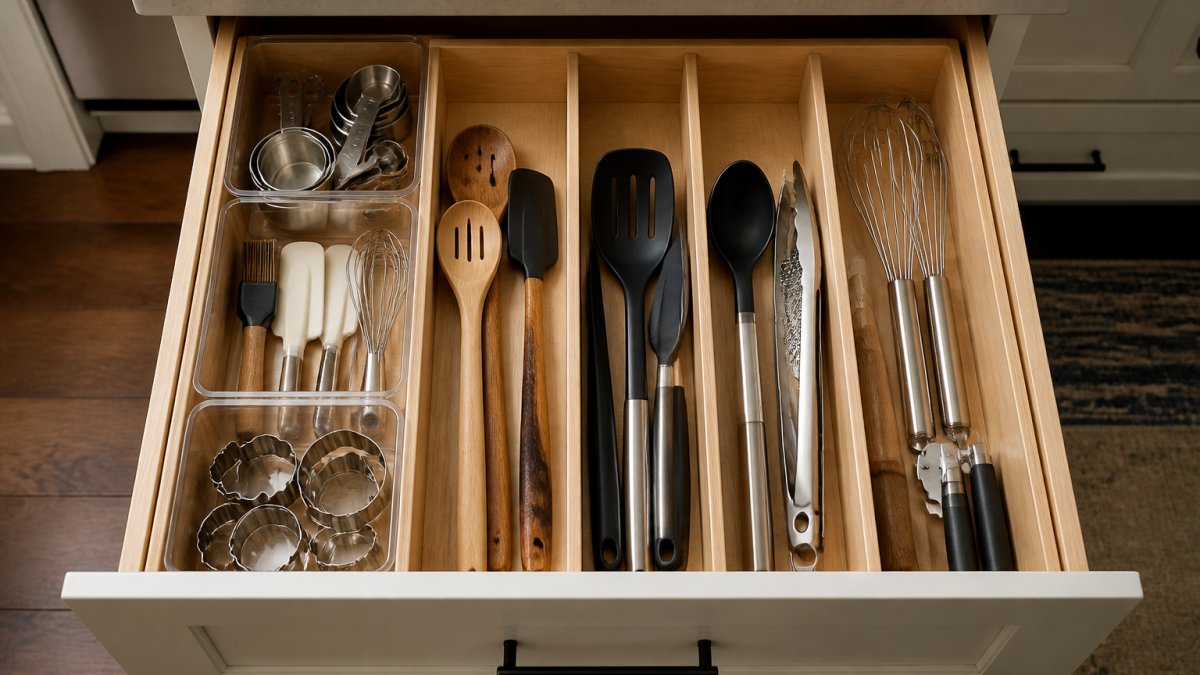
Install dividers to create zones based on your categories, a utensil zone, baking zone, tool zone, and food storage zone. This keeps utensils from migrating into the baking supplies.
Placement tips for dividers:
- Front-to-back dividers separate major categories
- Side-to-side dividers create smaller compartments within categories
- Adjustable dividers let you resize zones as needs change
- Taller dividers (3-4 inches) work better in deep drawers than short ones
The Drawer Base Cabinet - 12", 15", 18", 21", 24" & 27" Snow White Shaker Inset - Three Drawers from RTA Wholesalers includes quality drawer construction with soft-close glides, giving you a solid foundation for your organizers.
Deep Drawer Storage Ideas for Accessibility and Maintenance
The most organized drawer is one you can maintain. If your system is too complicated or requires constant rearranging, you'll abandon it within weeks.
Maintenance strategies that actually work:
- Assign a home for every item so you know where it belongs
- Use clear containers so you can see when supplies are running low
- Keep a "donate" bin nearby for items you realize you don't use
- Review your drawer organization quarterly and adjust as needed
- Don't let items accumulate at the back; periodically pull everything forward
Make sure frequently used items are easy to reach without bending, stretching, or digging, otherwise family members will leave things on the counter instead.
Organizing deep kitchen cabinet drawers takes time, but the payoff is a kitchen that works for you.
RTA Wholesalers offers custom color inset cabinetry available in most any size, so you can get drawers that fit your kitchen perfectly.
Frequently Asked Questions
What are the best organizers for deep kitchen drawers?
Clear bins, tiered trays, and adjustable dividers work best for deep drawers because they maximize vertical space and keep items visible. Roll-out shelves are excellent for base cabinets, allowing you to access items at the back without reaching. For utensils and smaller items, stackable drawer inserts prevent clutter. Choose organizers that match your drawer depth, typically 18 to 24 inches, and prioritize adjustable options so you can reconfigure as your needs change.
How do you keep items from getting lost at the back of a deep drawer?
Use tiered storage, roll-out shelves, or two-level organizers to bring back items forward. Dividers and bins create clear zones so nothing slides out of sight. Label containers so you know what's stored where. Keep frequently used items in the front half of the drawer and reserve the back for seasonal or occasional-use items. This way, nothing gets forgotten, and you maintain easy access to what you use most.
Can I organize pots and pans in deep drawers safely?
Yes. Deep drawers are ideal for cookware because they accommodate larger items. Use adjustable dividers or vertical file organizers to stand pans upright so you can see and grab what you need. Ensure the drawer slides are rated for weight and use full-extension glides with soft-close action to prevent slamming. Store lids separately in a nearby drawer or container. This approach keeps cookware stable, prevents damage, and makes items easy to reach.
What should I store in deep kitchen drawers?
Deep drawers work best for pots, pans, baking supplies, food containers, utensils, and kitchen essentials that don't fit in shallow drawers. Group similar items together: baking tools in one zone, cooking utensils in another, and food storage containers with lids in a third. Avoid mixing categories, which creates clutter. Use clear bins for snacks and pantry items so you can see contents at a glance. Keep frequently used items accessible in the front half of the drawer.


