 833-377-8663

How to Replace Kitchen Cabinet Doors: A 2026 Guide

Table of Contents
- Measuring for Replacement Cabinet Doors
- Inset vs Overlay Cabinet Doors: Which Style Fits Your Kitchen?
- Best Tools for Cabinet Door Installation
- How to Install Hidden Cabinet Hinges
- Step-by-Step: How to Replace Kitchen Cabinet Doors
- Refacing vs. Replacing Doors: What Makes Sense for Your Project?
- Frequently Asked Questions
Last Updated: September 30, 2026
Measuring for Replacement Cabinet Doors
Replacing kitchen cabinet doors starts with accurate measurements, a door an eighth of an inch off will rub, gap, or refuse to close. The core rule: measure the cabinet opening (the space inside the face frame), not the old door. That's what your new door must cover.
Recording Opening Dimensions and Hinge Bore Positions
Measure width at three points, top, middle, and bottom, and record the smallest number. Do the same for height at the left, center, and right edges.
- Opening width (smallest of three)
- Opening height (smallest of three)
- Hinge cup diameter
- Bore distance from door edge
- Number of hinges per door
Inset vs Overlay Cabinet Doors: Which Style Fits Your Kitchen?
The choice between inset and overlay doors shapes your entire kitchen look. Overlay doors sit on top of the face frame, covering part or all of it; full overlay hides the frame almost completely, while partial overlay leaves a strip visible. Inset doors sit flush inside the frame, showing the full frame and demanding precise sizing.
| Style | Frame Visibility | Look | Best For |
|---|---|---|---|
| Full overlay | Minimal | Modern, clean | Contemporary kitchens |
| Partial overlay | Some | Traditional | Budget remodels |
| Inset | Full frame | Classic, custom | High-end and period homes |
Checking Face Frame and Box Integrity Before Ordering
Run your hand along the face frame. Feel for soft spots, swelling, or cracks. Press on the cabinet box panels.
Check these before you order:
- Face frame is flat and dry
- No soft wood or rot
- Box corners are square
- Shelves sit level
- No sagging at the bottom
Best Tools for Cabinet Door Installation
You don't need a full shop to swap cabinet doors. A few good tools make the job fast and clean.
- Cordless drill with a clutch for driving hinge screws
- 35mm Forstner bit if you're boring new hinge cups
- Measuring tape and a sharp pencil
- Drill template for consistent hinge placement
- Screwdriver set for hinge adjustment
- Sanding block and wood filler for touch-ups
- Level for checking door alignment
- Shims for leveling cabinet boxes
How to Install Hidden Cabinet Hinges
Concealed hinges mount inside the cabinet, so you never see them when the door is closed. They're standard on nearly every modern cabinet, and where most door-swap projects go wrong: the hinge is simple, but matching it to your existing box is the hard part. Each hinge has two parts, the cup that presses into the bored hole on the door back, and the mounting plate that screws to the cabinet side or face frame.
Match the Hinge to Your Existing Bore Before You Order
Before you buy doors, confirm three numbers on your current setup and give them to whoever cuts your doors.
- Cup diameter. Almost all modern European-style hinges use a 35mm cup. Older or imported cabinets sometimes use 26mm. A 35mm cup will not fit a 26mm bore, and re-boring a finished door is risky.
- Bore distance from the door edge. This is the measurement from the hinge-side edge of the door to the center of the cup hole. Common values are 3mm, 4mm, and 5mm. It determines the overlay the hinge can achieve.
- Overlay. Full overlay, half overlay (also called 1/2-inch overlay), and inset each use a different hinge geometry. A full-overlay hinge will not make an inset door sit flush, and an inset hinge will not let a full-overlay door cover the frame.
Soft-Close Upgrades: What Actually Changes
Soft-close is a feature of the hinge, not the door. You can add it to almost any cabinet by swapping hinges, provided the cup bore and overlay match. Two mechanisms dominate:
- Integrated soft-close. The damper is built into the hinge cup. Cleaner look, fewer parts, but the whole hinge must be replaced if the damper fails.
- Clip-on soft-close adapter. A small damper clips onto an existing standard hinge. Cheaper and reversible, but it adds bulk inside the cabinet and can interfere with shelf clearance on shallow cabinets.
Install in This Order
- Press the hinge cup into the bored hole. It should seat flush with light hand pressure; if not, check the bore diameter.
- Drive the two cup screws to lock the hinge in place, snug, not torqued.
- Clip or screw the mounting plate to the cabinet side or face frame, using existing screw holes if they line up; if not, fill and redrill rather than forcing a screw into a stripped hole.
- Snap the hinge onto the plate; most clip-on hinges click when seated.
- Close the door and check the gaps at the top, bottom, and hinge side before adjusting.
Adjusting Hinges for Door Alignment
Most concealed hinges adjust in three directions. Turn each screw a quarter turn at a time and re-check. Small moves go a long way.
Sample Door 13 Honey Glow Shaker 1-1/4" →
- Side adjustment (left/right): moves the door laterally along the face frame. Use it to even the gap on the hinge side versus the strike side.
- Height adjustment (up/down): raises or lowers the door on the plate. Use it when the top gap is wider than the bottom gap.
- Depth adjustment (in/out): pushes the door toward or away from the frame. Use it when the door sits proud of the frame or rubs against it.
Step-by-Step: How to Replace Kitchen Cabinet Doors
Replacing kitchen cabinet doors takes about two to three hours for a standard run of cabinets. Here's the process.
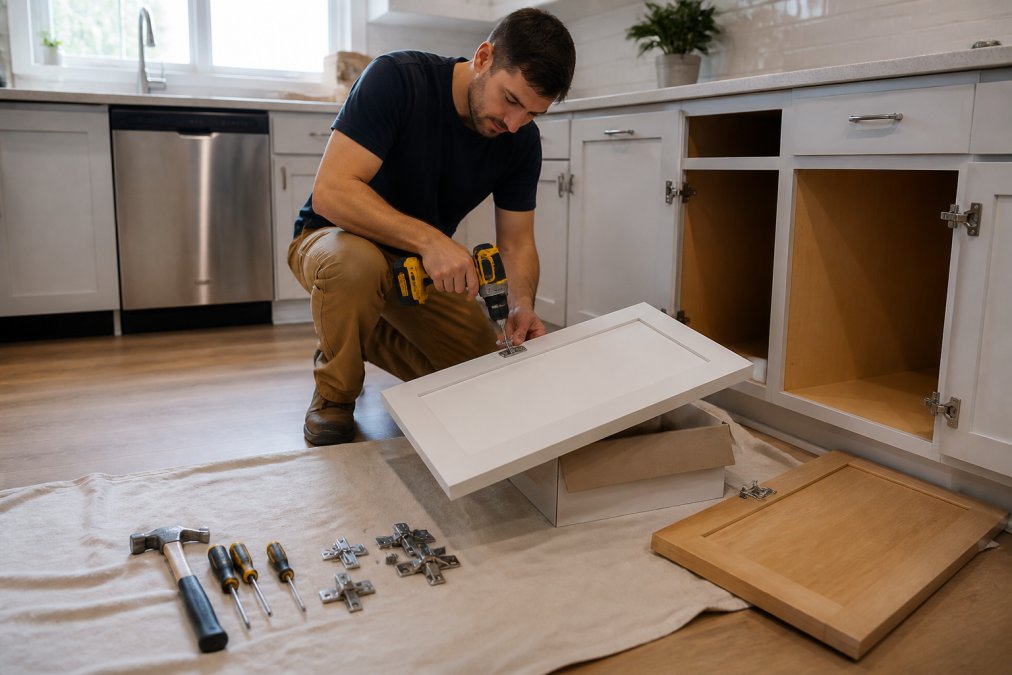
- Empty the cabinet and remove everything from inside.
- Unscrew the old hinges from the door and the cabinet.
- Label each door with painter's tape so you know where it goes.
- Clean the face frame and check for damage.
- Fill old screw holes with wood filler if needed.
- Test-fit the new door before driving any screws.
- Attach the hinge cups to the new door.
- Mount the plates to the cabinet sides.
- Hang the door and check the gaps.
- Adjust the hinges until the door sits flush.
Refacing vs. Replacing Doors: What Makes Sense for Your Project?
Refacing keeps the existing cabinet boxes and swaps only the doors and drawer fronts. Replacing doors alone is the cheaper path; replacing the whole cabinet costs the most. But the decision isn't really about cost, it's about whether your existing boxes can carry new doors.
The Box Integrity Test
Before you order anything, run this checklist on every cabinet in the run. A single failing box can pull an entire wall of doors out of alignment.
- Face frame is flat. Lay a 4-foot level across the front. Any gap under the level more than about 1/16 inch means the frame is twisted.
- No soft wood or rot. Press a screwdriver tip into the frame near the sink, dishwasher, and any exterior wall. If it sinks easily, the wood is compromised.
- Box corners are square. Measure corner to corner inside the box. The two diagonals should match within 1/8 inch.
- Shelves sit level. A shelf that sags means the box has racked or the shelf pins have wallowed out.
- No sagging at the bottom. Look at the bottom rail of the face frame. If it bows downward, the box is overloaded or the particleboard has swollen.
- Hinge screw holes hold. Try driving a screw into an existing hinge hole. If it spins, the hole is stripped and will need to be plugged before new hinges go on.
When Refacing Is the Right Call
Refacing makes sense when the boxes pass the integrity test and the layout still works for how you cook. You keep the cabinet interior, shelf positions, and plumbing and electrical rough-ins; only the visible surface changes, doors, drawer fronts, and the veneer or laminate skin on the face frames and exposed sides.
Refacing is a good fit when:
- The boxes are solid but the door style is dated.
- The layout works and you do not want to move the sink, range, or refrigerator.
- You want a new look without a permit or a contractor.
- The cabinet interiors are in good shape and do not need new shelving or pull-outs.
When Full Replacement Is the Right Call
Full replacement is the right answer when the boxes fail the integrity test, when the layout no longer works, or when you want features the existing boxes can't support, deep drawers, pull-out trash, a mixer lift, or a taller upper run. It's also right when the boxes are an odd size no stock door will fit: custom doors solve a lot, but if every cabinet is a different dimension, you're paying custom prices for a box that was never square.
The Middle Path: Doors Now, Boxes Later
A common pattern is to replace doors and drawer fronts now, live with the layout for a year, and replace the boxes later when budget allows. This works only if the boxes pass the integrity test. If they do not, the new doors will telegraph every flaw in the frame.
| Project | What Changes | Best For | Typical Time |
|---|---|---|---|
| Door swap only | Doors and hinges | Solid boxes, dated doors | 2-4 hours |
| Full refacing | Doors, fronts, veneer | Solid boxes, full new look | 2-4 days |
| Full replacement | Everything | Damaged or outdated boxes | 1-2 weeks |
Frequently Asked Questions
Can you just replace kitchen cabinet doors without replacing the boxes?
Yes, replacing only the doors and drawer fronts is a common and cost-effective update. The cabinet boxes, or carcasses, stay in place as long as they are structurally sound. Inspect the face frames for cracks, water damage, or warping before ordering. If the boxes are solid, new doors and hardware can transform the kitchen's look without the expense and mess of a full cabinet tear-out.
What measurements are required before ordering replacement cabinet doors?
You need the exact width and height of each door opening, measured at the inside edges of the face frame. For overlay doors, also note the overlay amount. For inset doors, measure the opening precisely because the door sits flush inside it. Record hinge bore distance from the door edge and the bore diameter, typically 35mm. Measure every opening individually since cabinet dimensions can vary slightly.
How do I choose between inset and overlay cabinet door styles?
Inset doors sit flush inside the face frame for a traditional, furniture-like look. Overlay doors rest on top of the face frame, hiding more of it and offering easier installation with adjustable hinges. Full overlay covers most of the frame; partial overlay leaves more visible. Inset requires precise custom sizing and compatible hinges, while overlay is more forgiving for DIY installation.
Is it better to paint existing cabinets or replace the doors?
Painting works if the existing doors are structurally sound and you like their style. Replacing doors makes sense when the current doors are damaged, outdated, or you want a different material or profile. New doors also let you upgrade to soft-close hinges and modern hardware. For a long-term update, replacement doors often provide better durability and a more professional finish than a paint refresh.


