 833-377-8663

Kitchen Cabinets: Complete 2026 Buying Guide

Table of Contents
- Understanding Kitchen Cabinet Types and Construction
- Average Cost of Kitchen Cabinets: Pricing Breakdown
- Kitchen Cabinet Material Comparison: What Works Best
- How to Measure for Kitchen Cabinets: Step-by-Step
- Refacing vs. Replacing Kitchen Cabinets: Which Option Is Right?
- Styles, Hardware, and Storage Solutions for Kitchen Cabinets
- Installation Guide and What to Expect
- Conclusion: Choosing Your Perfect Kitchen Cabinets
Last Updated: June 23, 2026
Choosing the right kitchen cabinets is one of the most impactful decisions in any kitchen renovation, often accounting for a significant portion of the total budget. This guide from RTA Wholesalers breaks down everything you need to know, from construction types and materials to measuring and installation. A well-planned cabinet selection defines the look and feel of your space while increasing your home's value.
Understanding Kitchen Cabinet Types and Construction
The foundation of any great kitchen begins with the cabinet construction, which dictates durability, appearance, and cost. Your first major decision is choosing between ready-to-assemble (RTA) and pre-assembled cabinets, followed by selecting the level of customization that fits your project's scope.
RTA (Ready-to-Assemble) vs. Fully Assembled Cabinets
Ready-to-assemble (RTA) cabinets are delivered flat-pack and require on-site assembly. This option is more budget-friendly as it reduces labor and shipping costs. Modern RTA cabinets use high-quality materials and construction methods like dovetail joints and plywood boxes, making them durable for homeowners and contractors. The trade-off is the need for assembly, which can be DIY or handled by a professional installer.
Fully assembled cabinets arrive ready to install, saving time during installation and ensuring factory-controlled construction. This convenience comes at a higher price due to increased labor and freight charges. The choice comes down to balancing your budget against the time and effort you're willing to invest.
Custom, Semi-Custom, and Stock Cabinet Options
Kitchen cabinets fall into three main categories based on customization level, each offering a different balance of price, flexibility, and lead time.
- Stock Cabinets: Mass-produced in standard sizes with minimal customization. Most affordable with shortest lead times, though you may need filler strips to fit your layout.
- Semi-Custom Cabinets: Start with stock sizes but allow modifications in dimensions, finishes, and storage features. Provides design flexibility without the full custom price tag.
- Custom Cabinets: Built to exact specifications with limitless possibilities in size, style, material, and finish. Best for unique layouts but most expensive with longest lead times.
| Cabinet Type | Customization Level | Average Lead Time | Best For |
|---|---|---|---|
| Stock | Low | 1-3 weeks | Budget projects, standard layouts |
| Semi-Custom | Medium | 4-8 weeks | Design flexibility on a moderate budget |
| Custom | High | 8-16+ weeks | Unique layouts, specific design visions |
Average Cost of Kitchen Cabinets: Pricing Breakdown
Understanding cabinet pricing involves several factors including material, construction type, and customization level. The cost spectrum is broad, catering to different financial plans.
Budget, Mid-Range, and High-End Cabinet Pricing
- Budget-Friendly: Stock RTA cabinets made from particle board with thermofoil or laminate finishes. Limited durability and finish options, suitable for rentals or quick updates.
- Mid-Range: Semi-custom cabinets and higher-quality RTA options with plywood construction and durable finishes like paint and stains on solid wood doors. Offers the best balance of quality, customization, and cost for most homeowners.
- High-End: Custom and premium semi-custom cabinets with solid hardwoods, high-end plywood construction, and specialty finishes. Soft-close hinges, full-extension drawer glides, and extensive storage accessories are standard.
Kitchen Cabinet Material Comparison: What Works Best
The material you choose directly impacts durability, appearance, and resistance to daily wear. The cabinet box construction and door/drawer front materials are the two most important components.
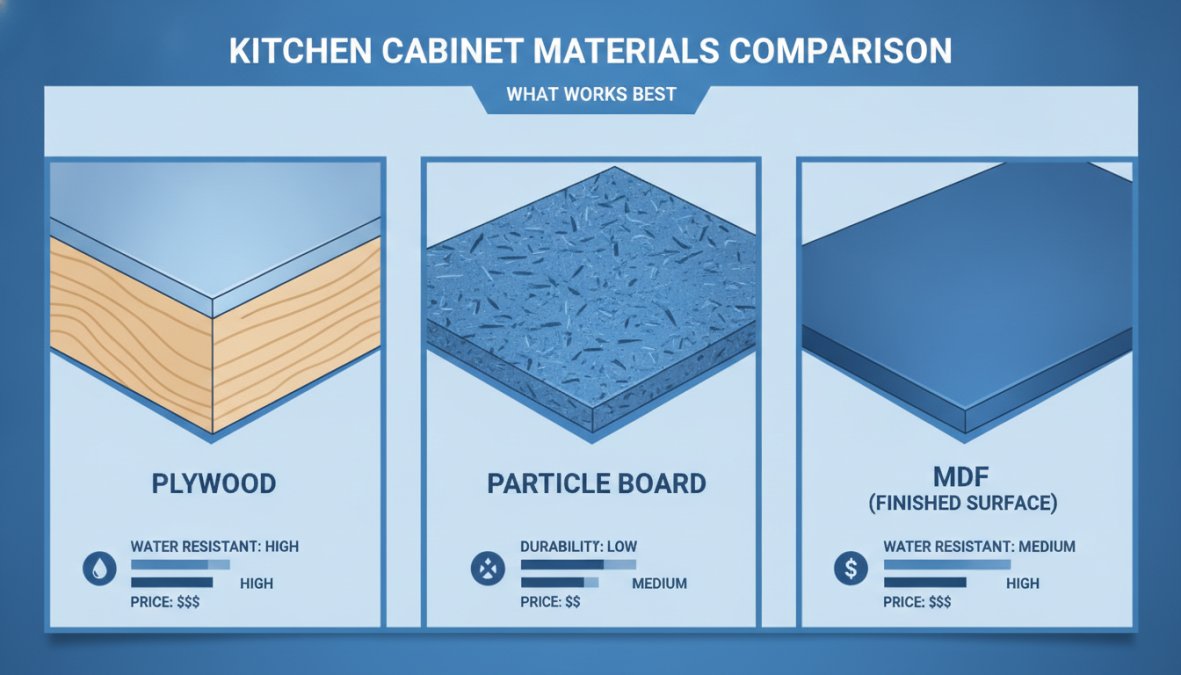
Plywood vs. Particle Board and Cabinet Carcass Quality
- Plywood: Made from thin layers of wood veneer glued together, plywood offers strength and stability. It holds fasteners securely and resists moisture and sagging better than particle board.
- Particle Board (MDF/Furniture Board): An engineered wood product made from wood particles combined with resin and compressed. Denser than plywood but more susceptible to moisture damage. High-quality furniture board with durable laminate or veneer finish can be cost-effective and stable.
Finishes, Durability, and Sustainability Considerations
Common finishes include paint, stain, laminate, and thermofoil. Factory-applied, multi-step finishes offer the best resistance to chipping and fading. Increasingly, homeowners prioritize eco-friendly materials like sustainable woods or low-VOC finishes. Certifications from the Forest Stewardship Council (FSC) indicate responsibly sourced wood.
How to Measure for Kitchen Cabinets: Step-by-Step
Accurate measurements are critical for successful cabinet installation. This prevents costly errors and ensures proper fit.
Measuring Your Kitchen Layout and Space
- Sketch the Room: Draw a rough floor plan including doors, windows, and existing appliances.
- Measure Wall to Wall: Record the length of each wall at countertop height, measuring at three heights to check for plumb.
- Mark Obstructions: Measure exact locations and dimensions of windows and doors, including trim and swing direction.
- Locate Utilities: Mark centerlines of sink, plumbing, gas line, and electrical outlets for proper appliance and cabinet placement.
- Measure Ceiling Height: Measure in several spots to check for variations, crucial for selecting correct wall cabinet height.
Common Mistakes to Avoid During Measurement
Another frequent oversight is failing to measure existing appliances you plan to keep. Provide exact width, height, and depth of your refrigerator, range, and dishwasher to your designer to ensure a seamless fit. Always double-check your numbers before submitting them.
Refacing vs. Replacing Kitchen Cabinets: Which Option Is Right?
When planning a kitchen update, many homeowners face the choice between full replacement and cabinet refacing. The right path depends on your budget, the condition of existing cabinets, and whether you're happy with your current layout.
Full replacement involves tearing out old cabinets and installing new ones. This is best if existing cabinet boxes are in poor condition, made of low-quality materials, or if you want to change the kitchen layout. Replacing cabinets gives complete freedom to redesign for better workflow, add features like a pantry or island, and choose modern materials.
Cabinet refacing keeps existing cabinet boxes in place. The process involves removing old doors and drawer fronts, covering the visible face frames with new veneer, and installing new doors, drawer fronts, and hardware. This is viable if cabinet boxes are structurally sound and you're satisfied with the current layout. Refacing is typically less expensive and faster than replacement with less disruption, though it doesn't allow layout changes or interior upgrades.
Styles, Hardware, and Storage Solutions for Kitchen Cabinets
After settling on construction and materials, define the aesthetic and functional details of your kitchen cabinets. These choices impact daily usability and personalization of your space.
Popular Cabinet Styles: Shaker, Frameless, and Face Frame
- Shaker-Style Cabinets: Simple, clean design with flat recessed center panel and no decorative detailing. Most popular style, works well in traditional, transitional, and contemporary kitchens.
- Face Frame Cabinets: Traditional American style with solid wood frame attached to the cabinet box front. Doors mount to this frame, providing strength and classic look with partial or full overlay options.
- Frameless (European Style) Cabinets: No face frame; doors mount directly to cabinet box sides. Sleek, modern appearance with full interior access and efficient space use.
Hardware, Hinges, Drawer Glides, and Accessories
Cabinet hardware comes in countless finishes and styles. Quality hinges and drawer glides are paramount, look for soft-close hinges and full-extension, soft-close drawer glides for smooth, quiet operation and easy access. These features are now standard for quality kitchen cabinets.
Storage Solutions and Smart Kitchen Integration
Modern cabinets incorporate storage accessories like pull-out spice racks, lazy Susans, vertical dividers, and deep drawers to maximize organization. Smart kitchen integration is a growing trend, including built-in charging stations, under-cabinet lighting connected to smart home systems, or motorized cabinets. Planning for these features during design ensures clean, integrated installation.
Installation Guide and What to Expect
The installation process transforms your collection of boxes into a functional kitchen. Proper installation is as important as cabinet quality for a beautiful, long-lasting result.
Installation begins with room preparation. The space should be clear, and walls should be patched and painted. A crucial first step is finding the highest floor point and marking a level line for the top of base cabinets.
Wall cabinets are installed first, preventing you from reaching over base cabinets and risking damage. Cabinets are clamped together, drilled, and screwed to each other before being fastened to wall studs. Shims ensure everything is level and plumb. Base cabinets are then set, leveled, and secured to the wall and each other. The process requires patience and precision, and having a helper is highly recommended.
Finally, doors and drawer fronts are attached and adjusted for perfect alignment, and hardware is installed. If you've chosen RTA cabinets, assembly must be completed before installation begins. Always follow manufacturer's instructions carefully.
Conclusion: Choosing Your Perfect Kitchen Cabinets
Selecting the right kitchen cabinets is a major investment, but it doesn't have to be overwhelming. By breaking down the process into manageable decisions, construction type, material, style, and features, you can design a kitchen that is both beautiful and highly functional. From budget-friendly RTA options to fully custom designs, there is a solution for every project. Quality materials like plywood box construction and durable finishes will pay dividends in longevity.
Frequently Asked Questions
What are the most durable materials for kitchen cabinets?
Plywood is generally the most durable cabinet material, offering superior strength and longevity compared to particle board. Plywood resists warping and moisture damage better, making it ideal for long-term kitchen cabinet investments. For finishes, lacquer and polyurethane provide excellent durability and resistance to scratches. Solid wood cabinets are also highly durable but come at premium prices. Consider your budget and kitchen environment when selecting materials, high-moisture areas benefit from plywood construction with quality finishes.
How much do kitchen cabinets typically cost?
Kitchen cabinet costs vary widely based on type and materials. Stock cabinets range from $100-300 per linear foot, semi-custom cabinets from $150-500, and custom cabinets from $500-1,500+ per linear foot. A typical 10x12 kitchen might cost $3,000-15,000 total. RTA (ready-to-assemble) options offer budget-friendly alternatives, often 20-40% less expensive than assembled cabinets. Installation adds $50-150 per linear foot. Get quotes from multiple suppliers to compare pricing and options for your specific project.
What's the difference between stock, semi-custom, and custom kitchen cabinets?
Stock cabinets come in standard sizes and styles, offering the lowest cost and fastest delivery (2-4 weeks). Semi-custom cabinets allow modifications to dimensions, finishes, and hardware while maintaining shorter lead times than full custom. Custom cabinets are built to exact specifications for your kitchen layout, offering maximum design flexibility but requiring longer lead times (8-12 weeks) and higher investment. Choose based on your budget, timeline, and design needs. RTA wholesalers often specialize in semi-custom and stock options with excellent value.
How long do kitchen cabinets usually last?
Quality kitchen cabinets typically last 15-20 years with proper care and maintenance. Plywood construction with quality hinges and drawer glides extends lifespan significantly. Factors affecting durability include material quality, finish type, humidity levels, and usage frequency. Cabinet refacing can extend the life of existing cabinets by 10+ years without full replacement. Regular cleaning, avoiding excessive moisture, and gentle use of soft-close hinges help maximize cabinet longevity. Investing in durable materials upfront provides better long-term value than budget options.
Navigating the world of kitchen cabinets can be complex, but you don't have to do it alone. RTA Wholesalers offers high-quality, ready-to-assemble options that deliver a professional look without the custom price tag. With our free kitchen design service and a wide selection of inset and overlay styles, our team can help you create the perfect space. Get started with RTA Wholesalers and build the kitchen you've always wanted.
This article was written using GrandRanker


