 833-377-8663

Can You Mix Inset and Overlay Cabinets in One Kitchen?

Table of Contents
- Defining Inset vs. Overlay Cabinets
- Inset vs Overlay Cabinets: Pros and Cons
- Full Overlay vs Partial Overlay Cabinets: What's the Difference?
- Mixing Cabinet Styles in Kitchen: Is It Possible?
- Design Strategies for Combining Inset and Overlay Cabinets
- Aesthetic Differences and Visual Impact
- Functional Differences and Interior Storage Capacity
- Durability and Maintenance Considerations
Last Updated: August 15, 2026
Defining Inset vs. Overlay Cabinets
Inset cabinets have doors that sit flush within the face frame, creating a clean, recessed appearance where the door aligns perfectly with the frame edges. Overlay cabinets have doors that sit on top of the face frame, covering part of it and creating a visible reveal or gap between the door and frame.
This distinction affects installation precision, interior storage space, maintenance demands, and overall cost. Inset cabinetry requires precise craftsmanship and tight tolerances because the door must fit perfectly within the frame opening. Wood expansion and contraction due to humidity changes can become problematic if not managed properly. Overlay cabinets are more forgiving during installation and accommodate wood movement more easily because the door covers the frame.
Inset vs Overlay Cabinets: Pros and Cons
Inset Cabinet Advantages and Disadvantages
Inset cabinets deliver a sophisticated, built-in appearance that works particularly well in traditional, transitional, and modern minimalist kitchens. The flush-mount design creates clean lines and a seamless look with no visible reveal or gap.
The main advantage is aesthetic appeal and full interior access since the door doesn't cover any part of the cabinet box. However, inset cabinets demand precision during installation. The cabinet box must be square, and the door opening must be accurate within very tight tolerances. Any deviation can cause the door to bind or create uneven gaps. Maintenance is another consideration, inset doors require careful hinge adjustment to maintain proper alignment as wood expands and contracts with seasonal humidity changes. Cost is typically higher due to manufacturing precision, complex hinge systems, and stricter quality control.
Overlay Cabinet Advantages and Disadvantages
Overlay cabinets offer practical advantages that make them the standard choice for most residential kitchens. The door sits on top of the face frame, making installation more forgiving and wood movement less problematic. Because the door covers part of the frame, minor variations in the cabinet box don't create visible gaps or binding issues.
The primary advantage is installation simplicity and durability. Overlay cabinets accommodate wood expansion and contraction naturally, making them ideal for kitchens in climates with significant humidity changes. They're also more affordable because the manufacturing process is more straightforward and tolerances are less critical.
The aesthetic trade-off is the visible reveal between the door and frame. However, modern overlay designs, particularly full overlay where the door covers most of the frame, have become increasingly refined and visually appealing. Full overlay creates a nearly seamless appearance, while partial overlay creates a more traditional look with a visible frame line.
Full Overlay vs Partial Overlay Cabinets: What's the Difference?
Full overlay cabinets have doors that cover almost the entire face frame, leaving only a small reveal (typically 1/8 inch) around the perimeter. This creates a nearly seamless appearance closer to the inset look without requiring inset-level precision.
Partial overlay cabinets have doors that cover only part of the face frame, leaving a visible frame line around the door edges. This style is more traditional and creates a distinct frame-and-panel appearance common in shaker-style cabinets.
The practical difference between the two is minimal; both are overlay cabinets with similar installation requirements and durability. The choice is primarily aesthetic. When mixing cabinet styles, the choice between full and partial overlay affects how dramatically the visual difference appears.
Mixing Cabinet Styles in Kitchen: Is It Possible?
Yes, you can absolutely mix inset and overlay cabinets in one kitchen. Many high-end kitchens intentionally mix styles to balance aesthetic goals with practical constraints and budget considerations.
Common mixing scenarios include:
- Island inset, perimeter overlay: Inset cabinets on the kitchen island create a focal point, while overlay cabinets on the perimeter walls are more practical and cost-effective
- Upper inset, lower overlay: Inset uppers create visual interest at eye level, while overlay lowers are more forgiving with wood movement
- Accent wall inset, other walls overlay: One prominent wall features inset cabinets for visual impact, while other areas use overlay for consistency
The key to successful mixing is intentionality. The mix should feel like a deliberate design choice, not a compromise born from indecision.
Design Strategies for Combining Inset and Overlay Cabinets
Visual Transition Techniques
Creating visual harmony when mixing inset and overlay cabinets requires deliberate transition strategies.
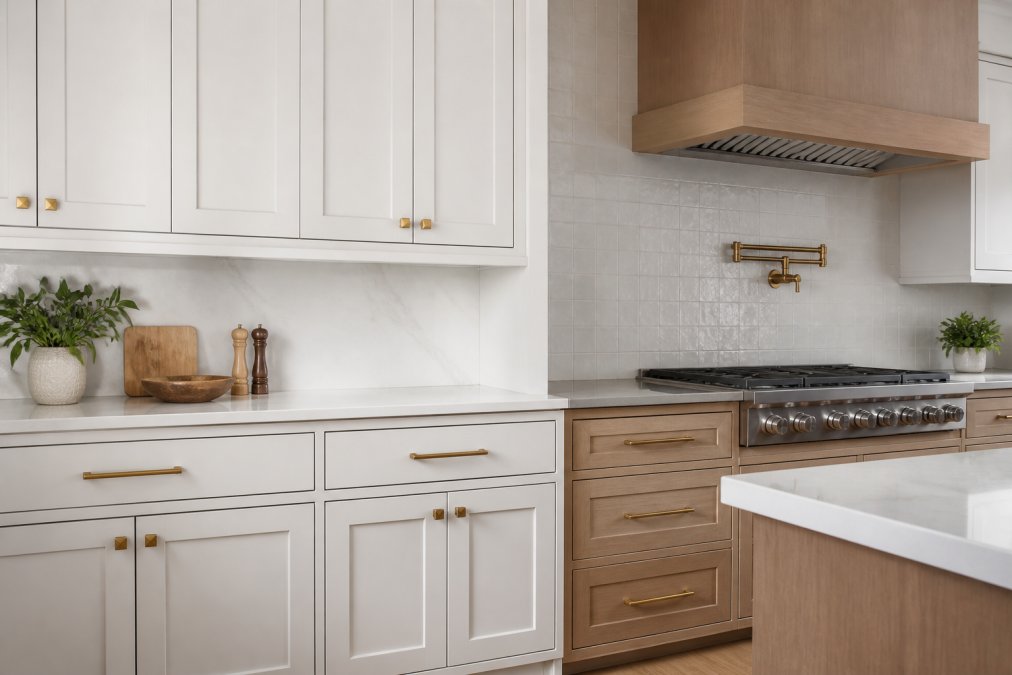
Use a consistent finish across both styles. The most effective way to unify mixed cabinet styles is through color and finish consistency. If both inset and overlay cabinets share the same paint color, stain, or wood species, the style difference becomes less visually jarring.
Separate styles by location. Cluster each style in distinct zones rather than scattering them throughout the kitchen. This creates visual logic and makes the mix feel intentional.
Use hardware as a unifying element. Matching hardware across both cabinet styles creates visual continuity despite structural differences.
Create a focal point with inset cabinets. Position inset cabinets where you want visual emphasis, typically the kitchen island or a prominent wall. This makes the inset style feel like a deliberate design feature.
Hardware Compatibility and Hinge Adjustment
Hardware compatibility is critical when mixing cabinet styles. Inset cabinets typically use concealed hinges mounted to the interior of the cabinet box. Overlay cabinets can use either concealed or surface-mounted hinges. When mixing styles, choose hardware that works across both cabinet types. Many modern hinge systems are designed to work with both inset and overlay applications.
Soft-close mechanisms function differently in inset versus overlay applications. In inset cabinets, the soft-close mechanism must work within tighter tolerances. Ensure soft-close hinges are specifically designed to handle both applications if you're using them across both styles.
Plan for a follow-up adjustment visit 3-6 months after installation to fine-tune door alignment across both inset and overlay sections. This prevents long-term binding issues and maintains visual cohesion.
Resale Value Impact of Mixed Cabinet Styles
A thoughtfully planned mix that feels intentional can enhance perceived value by demonstrating careful design thinking. A kitchen where inset cabinetry anchors a beautiful island and overlay cabinets complete the perimeter looks like a deliberate, well-designed space.
From an appraisal perspective, cabinet quality matters more than style consistency. High-quality inset and overlay cabinets from a reputable manufacturer will appraise better than lower-quality cabinets of a single style. When selling, frame the mixed style as an intentional design choice in your listing description.
Aesthetic Differences and Visual Impact
The visual difference between inset and overlay cabinets is immediately apparent and becomes the defining characteristic of any mixed-style kitchen.
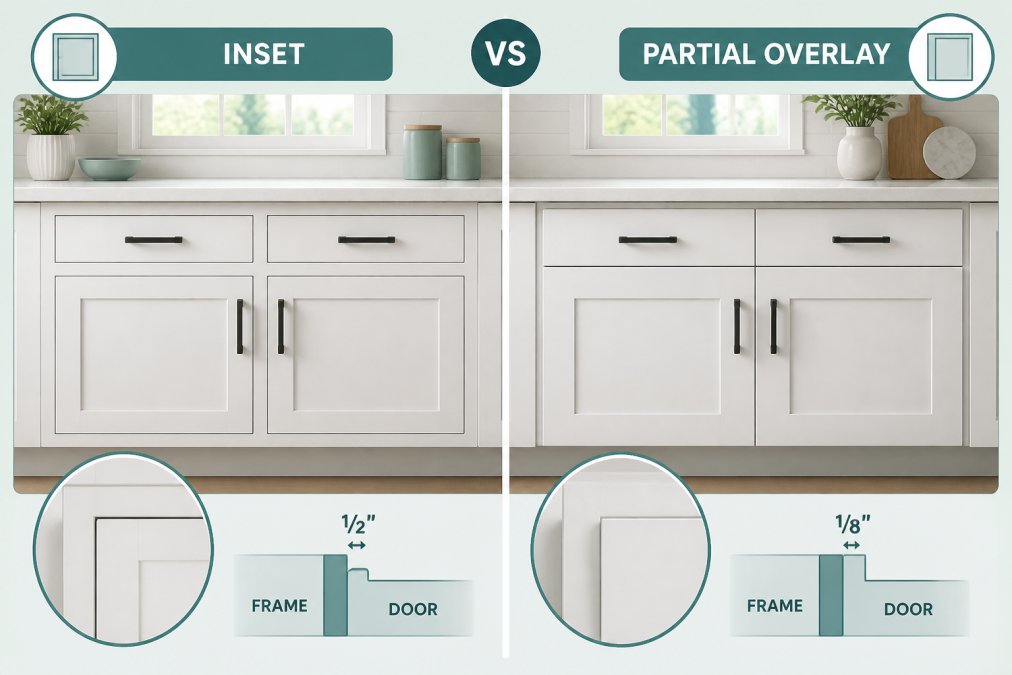
Inset cabinets create a formal, sophisticated appearance with their flush-mount design. The door aligns perfectly with the cabinet frame, creating seamless lines that read as high-end and custom. This style emphasizes clean lines and minimalist aesthetics, making it particularly effective in modern and transitional kitchens.
Overlay cabinets, particularly full overlay, create a sleek, contemporary look with minimal visual interruption. Partial overlay cabinets create a more traditional or transitional appearance that works well with frame-and-panel door designs.
The visual impact of mixing depends on how dramatically different the two styles appear. Mixing inset with full overlay creates less pronounced difference than mixing inset with partial overlay. Cabinet depth also affects visual impact, inset cabinets sit flush with the frame, while overlay cabinets project slightly forward, creating subtle visual layering.
Inset cabinets naturally draw attention because of their more refined appearance, making them ideal for highlighting a kitchen island or accent wall. Overlay cabinets recede visually, making them perfect for supporting roles.
Functional Differences and Interior Storage Capacity
Inset cabinets provide full access to interior storage capacity because the door doesn't cover any part of the cabinet box itself. Overlay cabinets reduce slightly usable interior space because the door overlaps the cabinet frame. For most kitchens, this difference is negligible.
Drawer slides and internal mechanisms function identically in inset and overlay cabinets. The real functional difference emerges in how the cabinet frame relates to adjacent appliances and countertops. Inset cabinets' flush design means there's no lip or overhang that might interfere with appliance installation. Overlay cabinets' slight projection can affect how appliances align with the cabinet line. When mixing styles, pay attention to how the frame depth difference affects your overall kitchen layout.
Durability and Maintenance Considerations
Both inset and overlay cabinets, when manufactured from quality materials and installed properly, last for decades. However, they require different maintenance approaches.
Inset cabinets demand more attention to wood movement and hinge adjustment. As wood expands and contracts with humidity changes, you may need to adjust hinges periodically to prevent binding or gaps. Overlay cabinets are more forgiving with wood movement because the door covers the frame and accommodates slight shifts naturally, making them lower-maintenance over the long term.
Both styles benefit from regular cleaning and care. Avoid excessive moisture exposure, wipe spills promptly, and use appropriate cleaning products for your finish. The durability difference comes down to manufacturing quality and installation precision, not the style itself. A high-quality overlay cabinet will outlast a poorly made inset cabinet.
Comparison Table: Inset vs. Overlay Cabinets
| Feature | Inset Cabinets | Overlay Cabinets | Winner for Mixed Designs |
|---|---|---|---|
| Visual Appearance | Flush, seamless, high-end | Clean lines, modern (full overlay) or traditional (partial overlay) | Inset for focal points, overlay for supporting areas |
| Installation Precision Required | Very tight tolerances | Forgiving, standard tolerances | Overlay easier to install |
| Wood Movement Accommodation | Challenging, requires adjustment | Natural accommodation | Overlay more stable long-term |
| Interior Storage Capacity | Full access, no loss | Minimal loss (full overlay) or slight loss (partial overlay) | Inset slightly better |
| Maintenance Demands | Regular hinge adjustment needed | Minimal maintenance | Overlay lower-maintenance |
| Hinge System | Concealed, interior-mounted | Concealed or surface-mounted | Both compatible with quality hardware |
| Best Kitchen Locations | Island, accent wall, focal point | Perimeter, supporting areas, secondary zones | Strategic placement maximizes both |
| Long-term Durability | Excellent with maintenance | Excellent, minimal adjustment | Equal when quality manufacturing |
| Design Flexibility | Limited to flush appearance | Full overlay (modern) or partial overlay (traditional) | Overlay offers more style options |
Mixing inset and overlay cabinets in one kitchen is a sophisticated design strategy when executed thoughtfully. The key is treating the mix as an intentional design choice rather than a compromise. By using consistent finishes, strategic placement, and compatible hardware, you can create a kitchen that feels cohesive while using the strengths of each cabinet style.
Start with a clear design vision. Decide where inset cabinets will anchor your design as focal points, and use overlay cabinets to complete the supporting areas. This approach ensures the mix feels deliberate and enhances your kitchen's overall aesthetic and functionality.
RTA Wholesalers has Inset cabinets that are top quality and available in Custom sizes and Custom colors at great Wholesale pricing. We also offer overlay cabinet options, making it practical to mix styles without exceeding your budget. Whether you're designing a complete kitchen renovation or updating specific areas, having access to quality options in both styles gives you the flexibility to create exactly the kitchen you envision.
Frequently Asked Questions
What is the main difference between inset and overlay cabinets?
Inset cabinets have doors and drawers that sit flush within the cabinet frame, creating a seamless, recessed appearance. Overlay cabinets have doors and drawers that overlap the cabinet box, sitting on top of the face frame. This difference affects both the visual aesthetic and the interior storage capacity. Inset cabinets require more precise installation and hinge adjustment but deliver a custom, high-end look. Overlay cabinets are more forgiving to install and offer slightly more usable interior space.
Can you mix inset and overlay cabinets in one kitchen?
Yes, you can mix inset and overlay cabinets in one kitchen, but it requires intentional design planning. The key is creating visual transition techniques that make the mix feel deliberate rather than accidental. Many homeowners use overlay cabinets in high-traffic areas and inset cabinets as focal points, or separate styles by room zone. Success depends on consistent hardware, matching wood species or paint finishes, and strategic placement. Working with design services can help you avoid visual clutter and ensure the mixed styles enhance rather than detract from your kitchen's cohesion.
Do inset cabinets cost more than overlay cabinets?
Inset cabinets typically involve higher material and labor costs due to their precision construction and installation requirements. The cabinet frame must be perfectly square, and hinge adjustment demands greater carpentry standards. However, pricing depends on quantity, wood species, custom colors, stain options, and delivery timelines. For accurate pricing on custom color inset cabinetry available in most any size, contact RTA Wholesalers for a quote. Wholesale pricing structures can make premium inset options more accessible than retail alternatives.
What are the disadvantages of inset cabinets?
Inset cabinets have several drawbacks: they cost more upfront, require more precise installation and hinge adjustment, and offer slightly less interior storage capacity due to the recessed design. Wood expansion and contraction can affect door alignment over time, especially in climates with high humidity or temperature swings. Home settling can also impact the cabinet frame, potentially creating gaps or misalignment. They're also more difficult to repair if hinges or doors become damaged. Despite these challenges, many homeowners find the aesthetic and long-term durability worth the investment.
How do you transition between inset and overlay cabinets in a kitchen layout?
Visual transition techniques include using consistent hardware across both styles, matching wood species or paint finishes, and strategically placing mixed styles in different zones. For example, use inset cabinets as a focal point on a kitchen island while keeping overlay cabinets on perimeter walls. Ensure cabinet depth and soft-close mechanisms are consistent to avoid visual clutter. Consider using shaker style doors for both to create design cohesion. Thoughtful placement and matching finishes make the transition feel intentional and professional rather than a compromise.


