 833-377-8663

Modern Kitchen Cabinet Hardware Trends to Watch in 2026

Table of Contents
- The 2026 Hardware Shift: From Trend to Timeless
- Warm Metals Take Center Stage in Cabinet Hardware Trends
- Textured, Knurled, and Etched Details Add Depth
- How to Choose Cabinet Hardware Size and Placement
- Mixing Metals in Kitchen Hardware Without the Clash
- Modern Cabinet Pulls for White Shaker Cabinets
- Hardware Durability and Finish Longevity: What to Check
- Conclusion: Build a Cohesive Hardware Plan
- Frequently Asked Questions
Last Updated: September 7, 2026
Choosing hardware might seem like the final, smallest detail of a kitchen remodel, yet it is the detail your hands touch every single day. The modern kitchen cabinet hardware trends to watch in 2026 are moving away from fleeting fads and toward finishes and forms designed to last decades. In this guide from RTA Wholesalers, we break down what is driving these choices, from warm metals to ergonomic shapes, so you can build a plan that feels current and remains timeless.
The most significant shift is a rejection of the sterile, all-stainless look in favor of personalization. Homeowners and designers are treating hardware as the jewelry of the kitchen. Below, we’ll show you how to select pieces that elevate your cabinetry, avoid common placement mistakes, and ensure your finish survives daily use.
The 2026 Hardware Shift: From Trend to Timeless
The biggest mistake in hardware selection is chasing a trend without considering how it ages. The underlying 2026 movement favors quality and cohesion over novelty, meaning pieces with a clear design rationale, whether a finish that complements your countertops or a pull profile that fits your hand.
Anchor your design in one primary finish and one accent finish. Consider how the hardware interacts with your faucet and lighting fixtures, as these metal touches should feel like they belong to the same family. The goal is a unified composition that supports the architectural style of the room.
Warm Metals Take Center Stage in Cabinet Hardware Trends
Warm metals are the defining force in current cabinet hardware trends, with brushed brass, unlacquered brass, and copper leading the charge. These finishes add a soft glow that contrasts beautifully with white shaker cabinets, gray islands, and quartz countertops. Unlike polished chrome, brushed brass hides fingerprints and develops a natural patina over time.
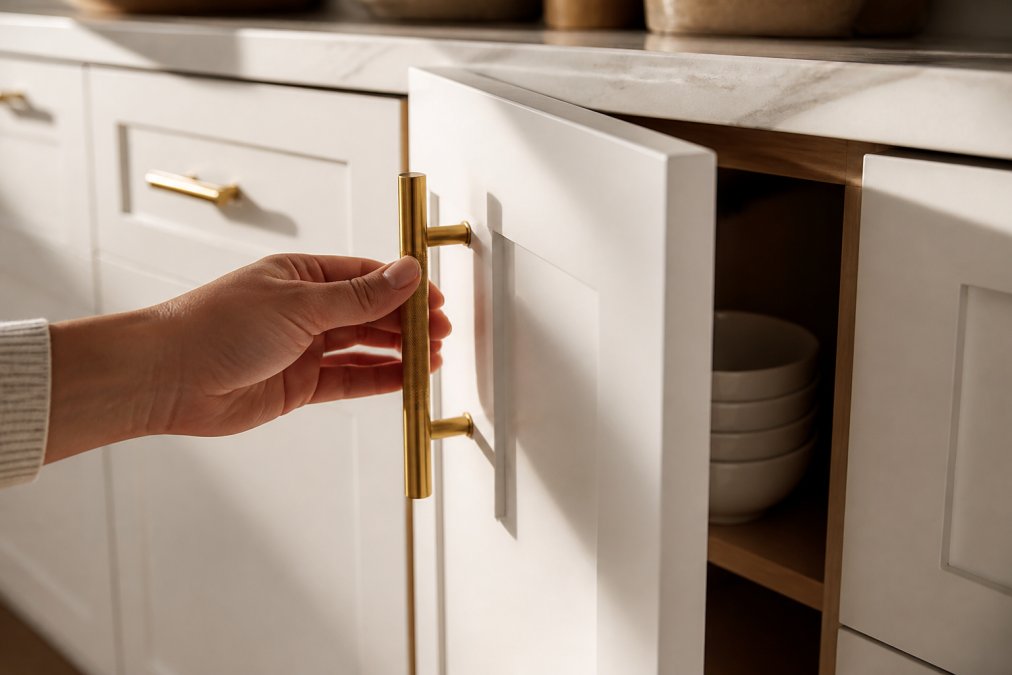
Pay attention to undertone: bright, yellow-toned brass feels traditional, while subdued, aged brass leans transitional. Unlacquered brass darkens with handling, creating a living finish. Pairing these metals with matte black hinges or a satin nickel faucet is a popular way to execute the mixed-metal trend without visual chaos.
Textured, Knurled, and Etched Details Add Depth
Flat, smooth hardware is giving way to pieces with tactile interest. Knurled textures add a machined, industrial aesthetic while providing a non-slip surface. These details change how the hardware feels in your hand, offering a more secure grip, particularly effective on edge pulls and T-bar pulls in contemporary kitchens.
Etched details and geometric shapes are appearing on backplates and knobs, not ornate flourishes but subtle, linear engravings that catch the light. For a minimalist design, a simple cup pull with a brushed interior creates a play of light and shadow that elevates the cabinetry.
How to Choose Cabinet Hardware Size and Placement
Selecting the correct size and placement is where most DIY installations go wrong. Proportion and ergonomics follow measurable rules that separate a professional-looking kitchen from a haphazard one.
Measuring Pulls and Knobs by Cabinet Type
For drawer fronts: The pull should be one-third to one-half the width of the drawer front. A 24-inch-wide drawer calls for an 8- to 12-inch pull. A 12-inch-wide drawer looks best with a 4- to 6-inch pull. For double-stacked drawers, use the same pull length on both for visual continuity.
For cabinet doors: The door height and panel style dictate the pull length. A 30-inch-tall upper cabinet door typically suits a 6- to 8-inch pull installed vertically. A 42-inch-tall pantry door can handle a 12- to 16-inch pull. For standard 18-inch base cabinet doors, a 4- to 6-inch pull or a single knob works well.
For inset cabinets: Inset doors sit flush with the frame, so hardware must clear the surrounding gap. A pull with a deeper projection, at least 1.25 inches from the mounting surface, gives fingers enough room to grip without scraping the cabinet face. This is a common oversight when homeowners switch from overlay to inset doors. If you are planning an inset kitchen, our Custom Order Inset cabinets can be specified with door dimensions that align with standard pull lengths, making it easier to maintain proper clearance.
Ergonomic Placement for Aging-in-Place and Accessibility
Hardware placement directly affects how easily you can open cabinets. The Americans with Disabilities Act (ADA) provides useful guidelines for accessible design (ada.gov). Install pulls so the centerline sits between 34 and 44 inches above the finished floor for base cabinets, accommodating both standing and seated users (peer-reviewed research).
For upper cabinets, avoid placing hardware higher than 48 inches above the floor if accessibility is a priority. Lever-style or D-shaped pulls are easier to grip than knobs for individuals with arthritis or reduced hand strength, allowing a full-hand grasp rather than a pinch grip. essential kitchen gadgets.
Installation Mechanics That Protect Your Cabinetry
Before drilling, confirm the door or drawer front thickness. Most cabinet doors are 3/4 inch thick, which accepts standard 1-inch screws. For inset doors with a thinner profile, use shorter screws to avoid penetrating the front face.
Use a template to keep holes consistent. Mark the center point of the door or drawer front, then measure equal distances from that center to each screw hole. A misaligned pull by even 1/8 inch is noticeable across a bank of drawers.
The 5-Week Assembly Advantage
When you order assembled cabinets, the doors arrive pre-finished and ready for hardware. You can lay all doors flat, use a single template, and drill consistent holes before hanging them, far easier than installing hardware on mounted doors. Our assembled cabinets ship in as little as 5 weeks, giving you time to order samples and test pull lengths first.
For inset cabinet buyers, our custom sizes allow you to specify door dimensions that align with standard pull lengths.
Mixing Metals in Kitchen Hardware Without the Clash
The idea that all metal finishes must match is outdated. Mixing metals in kitchen hardware, when done intentionally, adds depth. Limit yourself to two, or at most three, finishes: a dominant finish for most hardware and a secondary finish for accents like the sink faucet or lighting.
For example, you might use satin nickel pulls throughout the kitchen but introduce a matte black pot filler at the stove. The contrast creates a focal point without feeling chaotic. To ensure cohesion, find a common thread, such as similar undertones. Warm brass pairs well with warm nickel, while cool chrome works with stainless steel. Guidance on mixing metal finishes from the design experts at Architectural Digest suggests that keeping the same shape across different finishes can also unify the look.
Modern Cabinet Pulls for White Shaker Cabinets
White shaker cabinets are a staple in American kitchens because of their versatility. Modern cabinet pulls for white shaker cabinets range from sleek, minimal bar pulls to substantial T-bars. For a clean look, a long, thin edge pull in matte black creates a sharp, graphic line. To introduce warmth, a brushed brass cup pull offers a softer silhouette that still feels current.
The beauty of white shaker doors is their ability to anchor bolder hardware choices. A long, geometric pull in a knurled texture can transform a simple shaker door into a design feature. Conversely, if your cabinets feature a complex wood grain or custom color, opt for a simpler, minimalist design to let the cabinetry shine. Our team at RTA Wholesalers sees many clients pair these trends with our white shaker options.
Hardware Durability and Finish Longevity: What to Check
Hardware is a mechanical component that endures thousands of open-close cycles per year, a single drawer might be cycled 20 times a day, over 7,000 pulls annually. What separates a 5-year piece from a 25-year piece comes down to base material, finish application method, and internal mechanism quality.
Base Materials: What You Are Actually Buying
Solid brass is the gold standard, naturally corrosion-resistant, dense, and re-finishable. It is also the most expensive. If the product description does not state solid brass, assume zinc alloy or steel.
Stainless steel (304-grade) offers excellent durability and is common in commercial kitchens. It resists rust and cleaning chemicals, but its cooler visual tone may not suit warm design schemes.
Zinc alloy is the most common mid-priced material. It casts into intricate shapes and feels substantial, but it is softer than brass or steel, mounting posts can wear and finish can chip. A quality zinc piece with a PVD finish can last a decade; a cheap painted piece may fail in two years.
Aluminum is lightweight and inexpensive but dents easily, best reserved for low-use areas like a pantry, not a main kitchen work zone.
Finish Application: PVD vs. Electroplating vs. Powder Coating
| Finish Type | Application Method | Durability | Best For |
|---|---|---|---|
| PVD (Physical Vapor Deposition) | Metal vapor bonded at a molecular level in a vacuum chamber | Highest, resists scratching, tarnishing, and UV fading | High-traffic kitchens, outdoor kitchens, commercial settings |
| Electroplating | Metal dissolved in a solution and bonded via electric current | Medium, good for moderate use, can wear at edges over time | Standard residential kitchens |
| Powder Coating | Dry powder sprayed and baked onto the surface | Medium-high, thick and chip-resistant but can look less metallic | Matte black and matte white finishes |
| Lacquered Brass | Clear or tinted lacquer sprayed over polished brass | Low-medium, lacquer can yellow or peel within 3-5 years | Decorative, low-touch areas |
A PVD finish is not a coating that sits on top of the metal; it is a molecular bond that becomes part of the surface, allowing it to withstand harsh cleaners like bleach or ammonia. Standard electroplated hardware can develop pinhole corrosion at edges and corners within 18 to 24 months in a humid environment.
Testing Hardware Before You Commit
Before installing a full set, order a single sample and run these three tests:
- The scratch test: Take a standard house key and drag it across the finish. A quality PVD or powder-coated finish will not show a mark. A thin electroplated finish will reveal a silver line.
- The cleaner test: Apply a small amount of bleach-based kitchen cleaner to a cotton swab and rub the finish for 10 seconds. Wipe dry and inspect for discoloration.
- The wobble test: Mount the pull on a scrap piece of wood. Grip it and apply lateral pressure. A quality pull has no play; a poorly constructed one will rock slightly, indicating loose internal threading.
Matching Hardware Lifecycle to Cabinet Lifecycle
Your hardware should outlast your cabinet finish. If you invest in custom-color inset cabinets with a painted finish that lasts 20 years, do not pair them with hardware that needs replacement in 5. Designers commonly allocate a portion of the total cabinet budget to hardware, ensuring solid brass internals and PVD or high-quality electroplated finishes.
For our inset cabinets, available in custom sizes and an unlimited choice of Sherwin Williams paint colors, we recommend hardware with at least a PVD or powder-coated finish. The cabinet finish is designed to last decades; cheaper hardware can also scratch the cabinet finish when it loosens and shifts against the door face. If you are considering a natural look, our Special Order Oak Inset Kitchen Cabinets offer a warm wood grain that pairs especially well with the brushed brass and knurled finishes trending this year.
Conclusion: Build a Cohesive Hardware Plan
The most successful kitchen designs treat hardware as an integral part of the architecture. By focusing on warm, durable finishes, thoughtful placement, and tactile details, you can create a space that feels both of-the-moment and enduring. Start by defining your primary finish, select your accent metal, and pay close attention to size and proportion.
Planning a refresh and want to see how these trends look on different door styles? RTA Wholesalers offers a free kitchen design service to help you visualize your project, and our range of inset and overlay cabinets, including white shaker options, provides the perfect canvas for your hardware selections.
Frequently Asked Questions
What are the trends for kitchen cabinet hardware in 2026?
The main cabinet hardware trends for 2026 focus on warm metals like brushed brass and unlacquered brass, which develop a natural patina over time. Textured finishes such as knurled and etched details add visual and tactile interest. Oversized statement pulls and minimalist edge pulls are both strong choices. The key shift is toward selecting pieces with durable PVD finishes that will look good for years, rather than chasing short-lived fads.
Should cabinet hardware match the kitchen faucet?
Cabinet hardware does not need to match the kitchen faucet exactly. The 2026 approach is to coordinate finishes within a cohesive palette. For example, pair brushed brass cabinet pulls with a satin nickel faucet if both have warm undertones. Mixing metals in kitchen hardware is acceptable when you limit yourself to two primary finishes and repeat them in other elements like lighting or appliance pulls to create a deliberate, unified look.
How do I choose modern hardware for shaker cabinets?
For white shaker cabinets, modern cabinet pulls in matte black, brushed brass, or satin nickel create a clean contrast. Choose a pull length based on cabinet size: 3 to 4 inches for upper cabinets and 6 to 12 inches for lower drawers. A horizontal orientation on drawers and vertical on tall doors adds visual interest. The simple recessed panel of shaker doors lets the hardware finish become the focal point.
What are the most durable finishes for kitchen cabinet hardware?
PVD (Physical Vapor Deposition) finishes are the most durable option for kitchen cabinet hardware. They resist tarnishing, scratching, and corrosion far better than standard electroplated finishes. Unlacquered brass is an exception, as it intentionally ages and develops a patina over time. For high-use kitchens, choose PVD-coated brushed brass or matte black to maintain the finish's appearance with minimal upkeep.


