 833-377-8663

Plywood vs Particle Board Cabinets: A Durability & Value Guide

Table of Contents
- Plywood vs Particle Board Cabinets: Key Differences at a Glance
- What Is Plywood and How It's Used in Cabinet Construction
- What Is Particle Board and Its Role in Cabinetry
- Cabinet Durability Comparison: Structural Integrity and Longevity
- Moisture Resistance in Cabinet Materials: Water Damage and Swelling
- MDF vs Plywood Cabinets: Where Particle Board Fits the Spectrum
- Cost of Plywood vs Particle Board Cabinets: Budget and Long-Term Value
- Screw Holding Power, Weight, and Installation Considerations
Plywood vs Particle Board Cabinets: A Durability & Value Guide
Last Updated: August 1, 2026
When comparing plywood vs particle board cabinets, understanding the structural differences between these materials is essential for making an informed decision on your next renovation project. At RTA Wholesalers, we help customers navigate these choices by breaking down the real performance gaps, not just the marketing claims. The choice between these two materials affects durability, moisture resistance, long-term value, and how your cabinets will perform over 10, 15, or 20 years of daily use.
Plywood vs Particle Board Cabinets: Key Differences at a Glance
Plywood is manufactured from thin layers of solid wood veneer glued together in alternating grain directions, creating a cross-laminated structure. Particle board consists of wood particles and sawmill waste compressed with adhesive into a solid sheet. These fundamental differences in construction lead to measurable performance gaps.
The cross-grain construction of plywood provides superior dimensional stability and screw holding power. When you drive a screw into plywood, it grips across multiple wood layers, creating a stronger mechanical connection. Particle board's compressed particle structure offers less grip; screws can pull loose over time, especially under repeated stress or in high-humidity environments.
Moisture resistance heavily favors plywood. Because plywood is made from solid wood veneers, it resists water absorption better than particle board. Particle board absorbs moisture readily, which causes swelling, warping, and eventual delamination. In kitchens and bathrooms where humidity fluctuates, this difference becomes critical.
What Is Plywood and How It's Used in Cabinet Construction
Plywood is engineered wood made by laminating thin wood veneers (typically 1-3mm thick) in alternating grain directions and bonding them with adhesive under heat and pressure. This cross-grain construction creates a material stronger than solid wood in many applications and more stable across temperature and humidity changes.
Cabinet-grade plywood typically comes in 3/4-inch thickness for cabinet boxes and 1/2-inch for backing panels. The outer veneer can be any wood species, oak, birch, maple, cherry, giving you flexibility in appearance while maintaining structural integrity. In cabinet construction, plywood serves as the structural backbone, bearing the weight of dishes, glassware, cookware, and decorative items. The cross-laminated structure distributes load stress across multiple layers, preventing the sagging and warping that occurs with particle board.
The veneer accepts hardware, hinges, and drawer slides with excellent holding power. Screws driven into plywood edges hold securely because they grip across multiple wood layers. This matters for cabinet doors, which swing on hinges thousands of times over the cabinet's lifespan.
What Is Particle Board and Its Role in Cabinetry
Particle board is a composite material made from wood particles, sawmill waste, and wood chips compressed under heat and pressure with a phenol-formaldehyde or urea-formaldehyde adhesive binder. The result is a flat, uniform, void-free sheet that is lightweight and inexpensive to manufacture.
In cabinet construction, particle board typically appears in budget-tier cabinetry as the cabinet box material. It's cheaper to manufacture than plywood, which is why it's attractive to budget-conscious cabinet makers. However, the cost savings come with performance trade-offs that become apparent within 3-5 years of use.
Particle board's compressed particle structure has several weaknesses. First, it has poor screw-holding capacity. Screws driven into particle board edges can pull loose because they don't grip across solid wood layers. Second, it absorbs moisture readily. When humidity rises, particle board swells; when humidity drops, it shrinks. This cycling leads to loose joints, warped cabinet boxes, and visible gaps between cabinet doors and frames. The adhesive used in particle board production typically contains formaldehyde, which can off-gas into your kitchen over time.
Cabinet Durability Comparison: Structural Integrity and Longevity
Plywood cabinets outperform particle board in durability across nearly every measurable metric. The structural integrity difference is the most significant: plywood resists warping, sagging, and delamination far better than particle board over a 10-20 year timeframe.
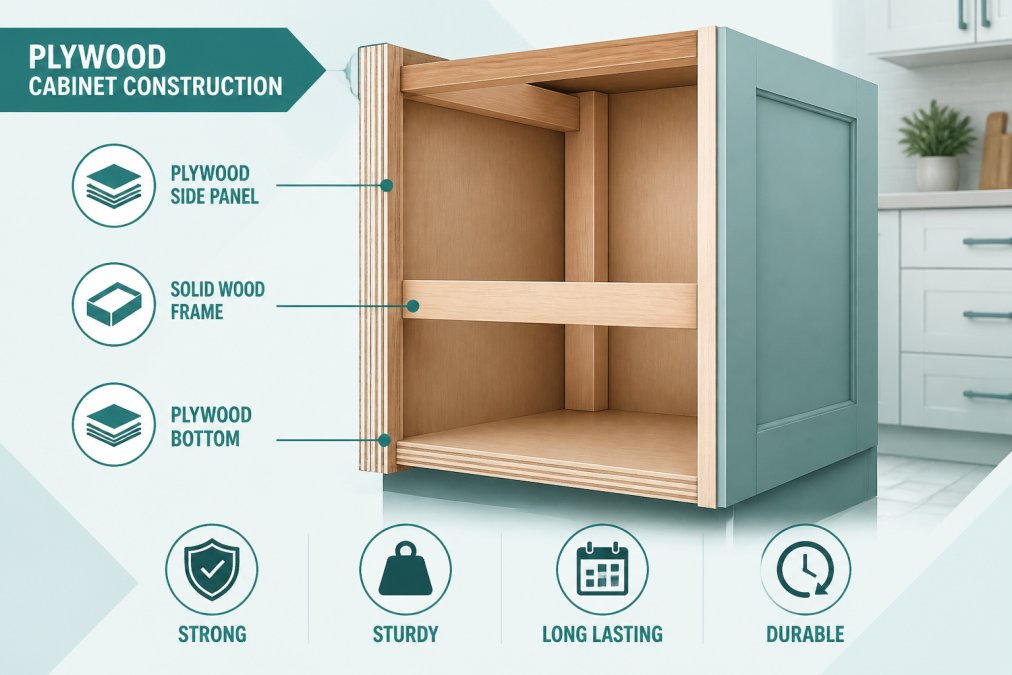
In real-world conditions, plywood cabinet boxes maintain their shape and structural strength. The cross-laminated construction distributes stress evenly, so even when cabinets are fully loaded with heavy items, the box maintains its geometry. Particle board begins to show stress within 5-7 years under the same conditions, with the cabinet box bowing slightly and creating visible gaps where cabinet doors meet the frame.
Weight-bearing capacity differs significantly. A fully loaded plywood cabinet can support 100+ pounds per shelf without sagging. The same shelf constructed from particle board may begin to bow at 60-70 pounds, especially if the span exceeds 24 inches.
Screw-holding power is where the difference becomes most practical. When you mount a heavy cabinet to a wall or attach hinges and drawer slides, the fasteners must grip securely. Plywood allows you to remove and reinstall screws multiple times without stripping. Particle board loses holding power after 2-3 screw removals in the same location.
Delamination, where the veneer separates from the core, is rare in plywood but common in particle board, especially in humid environments. Once delamination begins, the cabinet is compromised and difficult to repair.
Moisture Resistance in Cabinet Materials: Water Damage and Swelling
Moisture resistance is where plywood vs particle board cabinets shows the starkest performance gap. Plywood resists water absorption; particle board absorbs it readily and suffers permanent damage as a result.
Plywood's solid wood veneer structure allows it to shed water and resist swelling. If a plywood cabinet gets wet from a sink leak, dishwasher overflow, or high humidity, the material dries out and returns to its original dimensions. The cross-grain construction also reduces the wood's tendency to swell across its width, which is the primary cause of cabinet door misalignment.
Particle board absorbs water readily. The compressed particle structure is porous, and the adhesive binder breaks down when exposed to moisture. Once particle board absorbs water, it swells permanently. Even after drying, the swelling doesn't fully reverse. Repeated moisture cycles cause progressive swelling and eventual structural failure.
In kitchens, moisture sources are constant: steam from cooking, humidity from dishwashers, condensation from refrigerators, and occasional spills. Particle board cabinets in these environments show visible signs of water damage, soft spots, discoloration, and joint separation within 3-5 years.
Plywood's moisture resistance is why it's the material of choice for cabinet construction in coastal climates, humid regions, and any area where indoor humidity regularly exceeds 50%. The investment in plywood pays dividends in longevity.
MDF vs Plywood Cabinets: Where Particle Board Fits the Spectrum
Medium-density fiberboard (MDF) sits between plywood and particle board in terms of performance and cost. Understanding where particle board fits in this spectrum clarifies its role in cabinetry.
MDF is made from wood fibers (finer than particle board) compressed with adhesive. It's denser and more uniform than particle board, which gives it better screw-holding power and dimensional stability. However, MDF still absorbs moisture more readily than plywood and lacks the cross-grain structural advantage.
The durability hierarchy looks like this:
| Material | Screw Holding | Moisture Resistance | Weight Capacity | Lifespan | Best Use |
|---|---|---|---|---|---|
| Plywood | Excellent | Excellent | 100+ lbs/shelf | 20+ years | Structural cabinet boxes |
| MDF | Good | Fair | 70-80 lbs/shelf | 10-15 years | Painted cabinets, shelving |
| Particle Board | Poor | Poor | 50-60 lbs/shelf | 5-10 years | Budget cabinets, temporary use |
Particle board occupies the lowest tier because it combines poor moisture resistance with weak screw-holding capacity. It's the cheapest material to manufacture, which is its only advantage. In cabinet construction, it's a false economy, the savings upfront are erased by earlier replacement costs.
RTA Wholesalers offers inset cabinets that are top quality and available in custom sizes and custom colors at great wholesale pricing. Our products are selected for their quality and ease of installation, making them a practical choice for those looking to renovate or build with high-quality, accessible materials.
Cost of Plywood vs Particle Board Cabinets: Budget and Long-Term Value
The upfront cost difference between plywood and particle board cabinets is significant. Particle board cabinets cost substantially less to manufacture, which translates to lower retail prices. However, the long-term value calculation tells a different story.
When evaluating cost, consider the total cost of ownership: purchase price plus replacement cost plus labor. A particle board cabinet that fails after 8 years and requires replacement costs far more over a 20-year period than a plywood cabinet that lasts 20 years.
Plywood cabinets command higher prices because the material is more expensive and the manufacturing process is more complex. The durability justifies the premium. For custom color inset cabinetry available in most any size, the investment reflects the quality and longevity of the construction.
The resale value impact is also significant. Homes with quality plywood cabinets appeal to buyers because they represent durability and low maintenance. Particle board cabinets, especially those showing signs of warping or water damage, reduce a home's perceived value. If you plan to sell your home within 10 years, upgrading from particle board to plywood can recover much of the additional cost through higher sale price.
Screw Holding Power, Weight, and Installation Considerations
Screw-holding power is a practical difference that affects installation, maintenance, and long-term performance. This is where plywood vs particle board cabinets becomes immediately apparent to installers and homeowners.
When cabinet hinges are mounted, screws must grip securely. Plywood's cross-laminated structure provides excellent grip; a 1-1/4 inch wood screw driven into plywood edge grain holds with tremendous force. The same screw in particle board edge grain pulls loose within months under the repeated stress of opening and closing cabinet doors.
Installers report that particle board cabinets require larger diameter screws, more fasteners, or specialized fasteners to achieve adequate holding power. Plywood allows standard fastening practices and tolerates repeated screw removal and reinstallation without stripping.
Weight capacity per shelf is another practical difference. A plywood shelf 24 inches wide can safely hold 80-100 pounds of dishes and cookware. A particle board shelf of the same dimensions should not exceed 50-60 pounds. This constraint affects how you organize cabinets and may require additional shelves or support structures.
Installation time differs slightly. Plywood cabinets are slightly heavier due to material density, but they're more forgiving during assembly. Particle board cabinets are lighter but more prone to damage during handling. For DIY installers, plywood cabinets are more forgiving if you need to drill holes for shelf pins or adjust hinges.
| Installation Factor | Plywood | Particle Board |
|---|---|---|
| Screw Holding (initial) | Excellent | Fair |
| Screw Holding (after 5 removals) | Excellent | Poor |
| Weight Capacity (24" shelf) | 80-100 lbs | 50-60 lbs |
| Damage Resistance | High | Low |
| Repair Difficulty | Easy | Difficult |
| DIY-Friendly | Yes | Requires care |
When you're planning a kitchen or bathroom renovation, the material you choose for your cabinet boxes determines how well those cabinets will serve you over the next 15-20 years. Plywood delivers superior durability, moisture resistance, and screw-holding power, advantages that compound over time. At RTA Wholesalers, we prioritize quality construction with inset cabinets available in custom sizes and colors at great wholesale pricing, ensuring your investment in quality materials translates to long-term value and performance.
EPA guidelines on formaldehyde emissions in composite wood products
ANSI standards for cabinet construction and wood products
Moisture management in wood cabinetry
Frequently Asked Questions
What is the main difference between plywood and particle board cabinets?
Plywood is made from thin layers of wood veneer glued together in alternating grain directions, creating a strong, cross-laminated structure with excellent dimensional stability and screw holding capacity. Particle board is made from wood chips and sawdust bonded with adhesives, resulting in a denser but less structurally rigid material. Plywood offers superior strength and durability, while particle board is more economical but more susceptible to moisture absorption and sagging over time.
Which material has better moisture resistance for kitchen cabinets?
Plywood generally has superior moisture resistance due to its layered construction and lower water absorption rate. Particle board, while sometimes available in moisture-resistant grades, absorbs water more readily and is prone to swelling and delamination when exposed to humidity or water. For kitchens and bathrooms where moisture exposure is common, plywood's structural integrity remains more reliable over the cabinet's lifespan.
How does the cost of plywood vs particle board cabinets compare?
Particle board typically has a lower initial material cost, making it attractive for budget-conscious projects. However, when considering long-term value, including durability, moisture resistance, repairability, and potential resale impact, plywood cabinets often provide better overall value. The choice depends on your project timeline, climate conditions, and whether you prioritize upfront savings or long-term performance and resale value.
Can particle board cabinets last as long as plywood cabinets?
Particle board cabinets can perform adequately in dry, climate-controlled environments, but they typically have a shorter lifespan than plywood due to lower structural integrity and moisture sensitivity. With proper care and protective finishes, particle board may last 10-15 years, while plywood cabinets commonly last 20+ years or longer. Factors like humidity levels, usage intensity, and installation quality significantly affect longevity for both materials.
What should I consider when choosing between plywood and particle board for my kitchen renovation?
Evaluate your climate (high humidity favors plywood), budget constraints, project timeline, and resale intentions. Consider the cabinet's location, plywood is essential for kitchens and bathrooms exposed to moisture, while particle board may suffice for dry storage areas. Also assess the cabinet style you need; custom inset cabinets in various wood species and colors offer flexibility regardless of core material, so discuss your specific requirements with your cabinet provider to ensure the material matches your project's durability and aesthetic goals.


