 833-377-8663

RTA Cabinets Hardware: What's Included & What You Need

Table of Contents
- Do RTA Cabinets Come with Hardware? The Short Answer
- Functional vs. Decorative Hardware: Understanding the Difference
- RTA Cabinet Hardware Quality Tiers: Standard vs. Upgraded Options
- Soft Close Hinges for RTA Cabinets: Are They Included?
- RTA Cabinet Assembly Instructions: Hardware Installation Steps
- RTA Cabinet Quality: How Hardware Affects Overall Durability
- RTA Cabinet vs. Assembled Cabinet: Hardware Differences
- Verifying Your RTA Cabinet Hardware Upon Delivery
RTA Cabinets Hardware: What's Included & What You Need
Last Updated: July 28, 2026
When you order ready-to-assemble cabinets, the first question is straightforward: do RTA cabinets come with hardware? The answer depends on whether components are structural or decorative. Most RTA cabinets arrive with essential assembly hardware, hinges, drawer slides, cam-locks, dowels, and mounting brackets, but decorative pulls and knobs come separately. Below, we'll walk you through exactly what arrives in your box, what you'll source yourself, and how to verify everything before assembly.
Do RTA Cabinets Come with Hardware? The Short Answer
Ready-to-assemble cabinetry ships with all functional hardware required to assemble and hang your cabinet boxes: hinges, drawer slides, soft-close mechanisms (on upgraded options), cam-locks, dowels, screws, and mounting brackets. Decorative hardware, pulls, knobs, and handles, does not come included, as these are finish selections rather than assembly components.
This distinction matters because functional hardware is engineered specifically for each cabinet's construction. A hinge from one manufacturer won't fit another brand's pre-drilled holes. Decorative hardware is interchangeable and chosen based on design preference.
What's Typically Included in the Box
Your RTA cabinet shipment contains several categories of functional hardware.
Assembly hardware forms the backbone of RTA construction. Your box contains cam-locks (cylindrical fasteners that secure the cabinet frame), wooden dowels (which reinforce corner joints), and screws in various sizes. Pre-drilled holes throughout the cabinet align with these components.
Hinges arrive pre-installed or packaged separately depending on cabinet style. Inset cabinets typically have hinges already mounted on the frame, while overlay cabinets may ship with hinges loose. These hinges are sized for your exact cabinet door, so substituting them can cause misalignment.
Drawer slides come in pairs and are typically pre-mounted on cabinet box sides. Full-extension slides allow complete drawer opening, while standard slides stop before full extension. Soft-close drawer slides have a dampening mechanism that slows the final inches, preventing slamming. Verify whether your order includes soft-close features.
Mounting brackets secure your cabinet to the wall. These L-shaped metal brackets attach to the cabinet's interior back panel and anchor into wall studs. Brackets are sized for the cabinet's weight capacity.
Backing material may arrive as plywood, particle board, or MDF depending on cabinet grade. This forms the rear panel and contributes to structural integrity.
What's Not Included (And Why)
Decorative hardware, pulls, knobs, and handles, does not come with RTA cabinets. Manufacturers exclude these because they're purely aesthetic and come in hundreds of styles, finishes, and sizes.
Finishing materials like stain, paint, and sealant are also not included. Your cabinet arrives in raw or pre-finished wood depending on your order. Some Custom Order Inset cabinetry arrives pre-finished in your chosen color, but standard RTA options typically require finishing before installation.
Fasteners beyond assembly hardware are not included. You won't receive screws for mounting decorative pulls (typically #6 or #8 wood screws, 1 inch long), though these are inexpensive to source separately.
Installation hardware specific to your wall type, drywall anchors, toggle bolts, or concrete fasteners, is your responsibility. Your cabinet ships with universal mounting brackets, but fasteners depend on your home's construction.
Functional vs. Decorative Hardware: Understanding the Difference
The line between functional and decorative hardware determines what you'll find in your box and what you'll purchase separately.
Functional hardware serves mechanical purposes. Hinges hold doors in place and allow them to swing. Drawer slides enable smooth rolling and support weight. Soft-close hinges and slides use dampening technology to slow movement and prevent slamming. Cam-locks compress cabinet frame joints, creating rigid connections. Dowels reinforce corner joints. Mounting brackets anchor the cabinet securely to your wall. All these components are structural and come included.
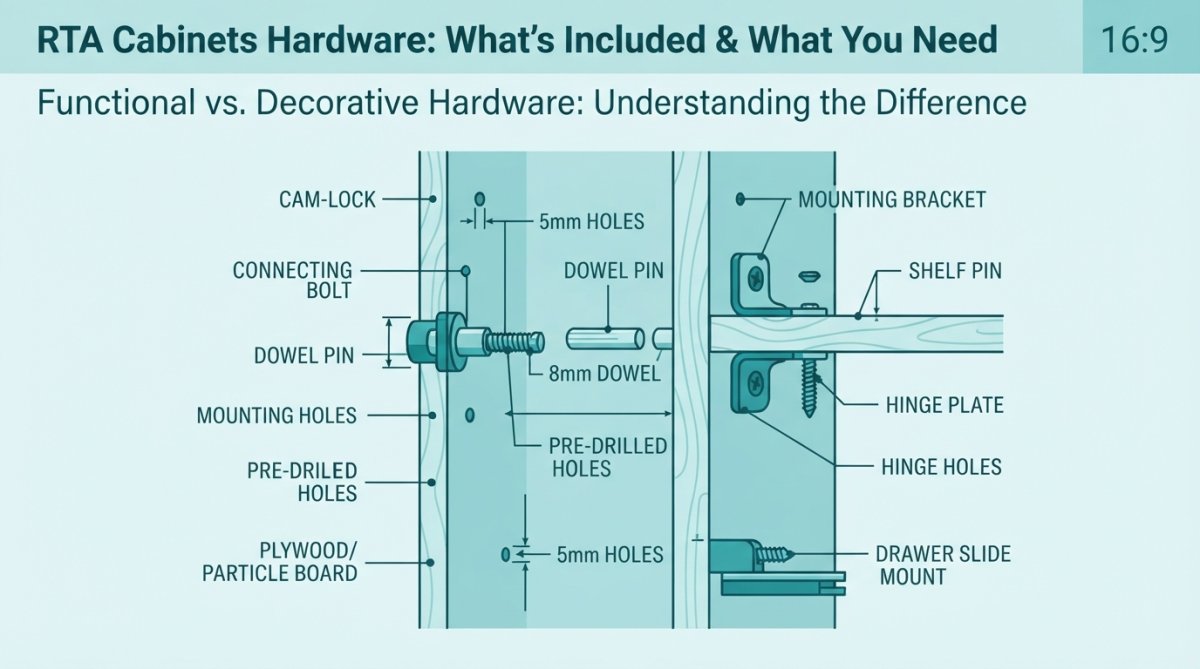
Decorative hardware is purely visual and optional. Cabinet pulls and knobs serve no structural function, they're simply what your hand grabs to open a door or drawer. The finish (brushed nickel, oil-rubbed bronze, stainless steel, matte black) contributes to your kitchen's aesthetic but doesn't affect performance.
Functional hardware is engineered to exact specifications for each cabinet model. Decorative hardware uses standardized hole patterns (typically 32mm spacing on European-style cabinets, or 96mm/128mm hole-to-hole spacing on traditional cabinets). You can choose any decorative pull matching your cabinet's hole pattern without affecting function.
Assembly Hardware That Holds Everything Together
The functional hardware inside your RTA cabinet serves specific structural purposes.
Cam-locks are distinctive RTA fasteners. These cylindrical fasteners twist into pre-drilled holes, compressing wooden dowels that reinforce cabinet frame joints. A typical cabinet contains 8-12 cam-locks. When assembling, you'll insert dowels into holes on one frame piece, align the adjacent piece, then twist cam-locks to compress the joint.
Dowels are wooden pins (typically 5/16 inch diameter, 1.25 inches long) that reinforce corner joints. They fit into pre-drilled holes and work with cam-locks. A typical cabinet requires 16-24 dowels.
Mounting brackets secure your cabinet to the wall. These metal brackets bolt to the cabinet's interior back panel and screw into wall studs. A typical wall cabinet uses two brackets; larger cabinets may use three or four.
Screws arrive in several sizes, each serving different purposes. Assembly screws secure the cabinet back panel to the frame. Hinge screws mount hinges to doors and frames. Bracket screws fasten mounting hardware to the cabinet. Manufacturers include 20-30% extras.
Hinges are pre-selected for your cabinet style. Frameless (European) cabinets use cup hinges that sit inside cylindrical recesses on the door. Face-frame cabinets use butt hinges or wraparound hinges. The hinge type determines door alignment and swing.
Drawer slides allow drawers to roll in and out. Standard slides have two components: one mounted to the cabinet box side and one mounted to the drawer box side. Full-extension slides allow complete drawer opening; standard slides typically open 75%. Soft-close slides incorporate a damping mechanism that slows the last few inches.
Decorative Hardware: Pulls, Knobs, and Handles
Decorative hardware is where your cabinet's personality emerges. Pulls, knobs, and handles come in countless styles, finishes, and sizes, and they're entirely your choice.
Cabinet pulls are the most common choice. They're typically 3 to 5 inches long and require two mounting holes (usually 3 or 4 inches apart, center-to-center). Pulls come in hundreds of finishes: brushed nickel, polished chrome, oil-rubbed bronze, matte black, brass, and stainless steel.
Knobs are round or square handles requiring a single center mounting hole. They're typically 1 to 1.5 inches in diameter and work well on smaller drawers and cabinet doors.
Handles are similar to pulls but typically shorter (1.5 to 3 inches) and often more decorative.
The standard hole spacing on most RTA cabinets is 32mm (European standard) or 96mm/128mm (traditional American standard). Before purchasing decorative hardware, verify your cabinet's hole pattern.
RTA Cabinet Hardware Quality Tiers: Standard vs. Upgraded Options
Manufacturers offer different hardware grades. Understanding the tiers helps you choose the right cabinet for your budget and expectations.
Standard hardware includes basic hinges, standard drawer slides, and simple cam-lock systems. The cabinet functions reliably, but hardware longevity depends on usage.
Mid-range hardware includes improved hinges with better motion control and drawer slides rated for more frequent use. Some mid-range options introduce soft-close features on select drawers. Hardware feels smoother during operation.
Premium hardware features high-quality hinges with precision-engineered motion, full-extension soft-close drawer slides on all drawers, and soft-close hinges on cabinet doors. Premium hinges often include adjustment mechanisms for fine-tuning door alignment after installation. Drawer slides are rated for commercial use.
The difference between tiers is most noticeable in soft-close mechanisms. Standard cabinets have no soft-close feature. Mid-range options may have soft-close on drawers only. Premium options have soft-close on both doors and drawers. For heavy-use kitchens, investing in upgraded hardware is worthwhile.
Soft Close Hinges for RTA Cabinets: Are They Included?
Soft-close hinges are a premium feature not included on all RTA cabinets. Whether your cabinet includes them depends on the grade you select and the manufacturer's specifications.
Standard RTA cabinets do not include soft-close hinges. Doors close with whatever force you apply.
Mid-range RTA cabinets sometimes include soft-close hinges. Check product specifications carefully.
Premium RTA cabinets typically include soft-close hinges as standard. These hinges contain a hydraulic damping mechanism that slows the door's final inches, ensuring a smooth, quiet close.
The soft-close mechanism works by restricting oil flow through a small valve as the door closes, creating resistance that slows movement. If your RTA cabinet doesn't include soft-close hinges but you want that feature, you can upgrade by purchasing soft-close hinges separately and swapping them out.
RTA Cabinet Assembly Instructions: Hardware Installation Steps
Assembling an RTA cabinet requires understanding how the hardware works together. The process is straightforward if you follow the manufacturer's instructions and take time to align components correctly.
Pre-Drilled Holes and Cam-Locks: How They Work
Every RTA cabinet arrives with pre-drilled holes positioned at precise intervals. The manufacturer's instructions include a diagram showing which holes serve which purpose.
The dowel-and-cam-lock system is the core of RTA assembly. You'll insert wooden dowels into holes on one cabinet frame piece. You'll then align the adjacent frame piece so its corresponding holes align with the dowel ends. Once aligned, you'll twist a cam-lock into a pre-drilled hole on the adjacent piece. As you turn the head, it compresses the dowel, pulling the two frame pieces together and creating a rigid joint.
This system requires precision alignment. If holes don't align perfectly, the dowel won't seat properly and the cam-lock won't compress fully. Take time with this step; rushing leads to misaligned joints and difficulty closing cabinet doors.
Pre-drilled holes for hinges are typically larger (cup-shaped recesses on the inside of doors for European-style hinges, or standard screw holes for traditional hinges). Do not drill additional holes or enlarge existing holes, as this weakens the door.
Installing Hinges, Drawer Slides, and Mounting Brackets
Once your cabinet box is assembled, you'll install the functional hardware that makes it operational.
Hinge installation depends on your cabinet style. For European-style (frameless) cabinets, hinges typically mount into cup-shaped recesses on the inside of the door. For face-frame cabinets, hinges mount to the door's edge and the frame using screws. Hinges are pre-adjusted at the factory, but you can fine-tune alignment after installation.
Drawer slide installation is straightforward. One component (the rail) attaches to the cabinet box side, and the other component (the glide) attaches to the drawer box side. You'll attach the rail to the cabinet first, then attach the glide to the drawer, and finally slide the drawer into the cabinet so the glide engages with the rail. Soft-close slides require an additional step: you'll engage a locking mechanism once the drawer is fully inserted.
Mounting bracket installation secures the cabinet to the wall. Brackets attach to the cabinet's interior back panel using bolts. You'll then position the cabinet against the wall and secure the brackets to wall studs using appropriate fasteners. Never rely on drywall alone to support a cabinet; fasteners must reach solid wood studs.
Common Hardware Installation Mistakes to Avoid
Assembly errors often stem from rushing or skipping steps.
Misaligning dowels and cam-locks is the most frequent error. If frame pieces aren't perfectly aligned before inserting dowels, the dowel won't seat fully. Use alignment guides or spacers, and ensure pieces are flush before tightening cam-locks.
Over-tightening cam-locks can strip the internal mechanism or crack the cabinet frame. Tighten until you feel resistance, then turn an additional quarter-turn.
Installing hinges upside down or in the wrong orientation will cause doors to hang crooked. Carefully review the manufacturer's instructions before installing.
Mounting brackets to drywall without studs is a safety hazard. Always locate studs and bolt brackets directly to studs.
Forgetting to engage soft-close locking mechanisms on drawer slides means the soft-close feature won't activate. Follow the manufacturer's instructions carefully.
RTA Cabinet Quality: How Hardware Affects Overall Durability
The hardware you get with your RTA cabinet directly impacts how long it will last and how well it performs over years of use.
Hinge durability depends on the quality of materials and engineering. Budget hinges use softer metals and simpler mechanisms, wearing faster and developing play (looseness) after a year or two. Premium hinges use hardened steel and precision-engineered mechanisms that maintain tight tolerances even after thousands of open-close cycles.
Drawer slide durability is similarly dependent on quality. Standard slides are rated for 50,000 to 100,000 open-close operations. Premium slides are rated for 200,000+ cycles and often include soft-close damping that extends component life.
Soft-close mechanism longevity depends on the quality of the hydraulic fluid and seals inside the damping cartridge. Budget soft-close mechanisms may lose effectiveness after a few years. Premium mechanisms maintain consistent performance for 10+ years.
Cam-lock and dowel reliability is generally consistent across quality tiers. However, the cabinet frame material (plywood vs. particle board) affects how well dowels grip. Plywood frames hold dowels more securely than particle board.
Better hardware means longer service life and better performance. For high-use environments, investing in premium hardware is economically sensible.
RTA Cabinet vs. Assembled Cabinet: Hardware Differences
Ready-to-assemble and pre-assembled cabinets differ fundamentally in how hardware is installed and what quality you can expect.
Pre-Assembled Cabinets: What Comes Ready-to-Install
Pre-assembled cabinets arrive fully assembled and ready to hang on the wall. All functional hardware (hinges, drawer slides, mounting brackets) is already installed and adjusted. Doors and drawers are hung and aligned.
In practice, pre-assembled cabinets require careful handling during shipping because all components are already connected. Damage during transit can misalign doors or bend mounting brackets.
Pre-assembled cabinets cost more than RTA cabinets because labor is included in the manufacturing process. Hardware on pre-assembled cabinets is typically the same quality as on RTA cabinets from the same manufacturer. Factory assembly is more precise and consistent than DIY assembly, so pre-assembled cabinets generally function better out of the box.
RTA Cabinets: What You Assemble Yourself
RTA cabinets ship flat-packed with all hardware included but not yet installed (except for some pre-mounted components like hinge cups on doors). You assemble the cabinet box, install hinges, mount drawer slides, and secure mounting brackets. This requires time and basic tools but is well within the capability of most homeowners.
The advantage of RTA cabinets is cost savings. By doing the assembly yourself, you avoid paying for factory labor. If you follow instructions carefully, an RTA cabinet you assemble yourself will perform identically to a factory-assembled cabinet.
Verifying Your RTA Cabinet Hardware Upon Delivery
When your RTA cabinet arrives, the first step is verification. Checking that all hardware is present and undamaged prevents assembly delays.
Hardware Checklist for Incoming Shipments
Create a checklist based on the manufacturer's packing list and work through it systematically.
Cabinet box components: Verify that all frame pieces (sides, top, bottom, back panel) are present and undamaged. Look for cracks, dents, or warping.
Cam-locks and dowels: Count the cam-locks and dowels. Cam-locks are small and easy to lose, so count carefully.
Hinges: If hinges are pre-mounted on the door, verify they're secure and not bent. If hinges are loose in the hardware bag, count them and verify they match the packing list.
Drawer slides: Verify that drawer slide pairs are present and undamaged. Check that the rails and glides are clearly marked as left and right (if applicable).
Mounting brackets: Count the brackets and verify they're not bent or damaged.
Screws and fasteners: Verify that screw bags are present and sealed.
Assembly instructions: Verify that the instruction manual or QR code for digital instructions is present.
Decorative hardware: If you ordered decorative pulls or knobs with the cabinet, verify they're present and match your order.
Document any missing or damaged items immediately. Take photos of damage if present. Contact the manufacturer within 24 hours to report discrepancies.
Missing Hardware Troubleshooting: What to Do
If you discover missing hardware after you've started assembly, stop and address it before continuing.
Missing cam-locks or dowels: Contact the manufacturer immediately. These components are inexpensive, and the manufacturer will typically ship replacements quickly.
Missing hinges: If a hinge is missing, you cannot hang the door. Contact the manufacturer.
Missing drawer slides: Without drawer slides, you cannot install drawers. Contact the manufacturer.
Missing mounting brackets: You cannot safely hang the cabinet without proper mounting brackets. Contact the manufacturer before proceeding.
Damaged soft-close mechanism: If a soft-close hinge or slide is damaged and leaking fluid, do not attempt to repair it. Contact the manufacturer for a replacement.
Most manufacturers respond to hardware requests within 24 hours and ship replacements within a week.
RTA Cabinet Hardware: A Comparison of What Comes Included
| Hardware Component | Typically Included? | Pre-Installed? | Quality Varies by Grade? |
|---|---|---|---|
| Hinges | Yes | Sometimes | Yes |
| Drawer slides | Yes | Usually | Yes |
| Soft-close mechanisms | Depends on grade | Usually | Yes |
| Cam-locks | Yes | No | No |
| Dowels | Yes | No | No |
| Mounting brackets | Yes | No | No |
| Screws and fasteners | Yes | No | No |
| Decorative pulls/knobs | No | N/A | N/A |
| Finishing materials | No | N/A | N/A |
Understanding exactly what hardware arrives in your RTA cabinet box and what you'll source separately is essential for successful assembly. Functional hardware, hinges, drawer slides, cam-locks, and mounting brackets, always comes included, but quality varies significantly across price tiers. Decorative pulls and knobs are always your choice, giving you complete control over your cabinet's final appearance.
RTA Wholesalers offers Custom Order Inset cabinets and Special Order Oak Inset Kitchen Cabinets that are top quality and available in custom sizes and custom colors at wholesale pricing. When you understand what hardware you're getting and what you're choosing separately, you can confidently select the cabinet grade that matches your budget and performance expectations.
Frequently Asked Questions
What hardware typically comes with RTA cabinets?
Most RTA cabinets include essential assembly hardware: cam-locks, dowels, screws, and mounting brackets for the cabinet box structure. Hinges and drawer slides are usually included, though quality varies by manufacturer. Decorative hardware like knobs and pulls is rarely included, you typically purchase these separately. Always verify the exact contents in your product listing or assembly instructions before ordering.
Do RTA cabinets come with soft close hinges?
Standard RTA cabinets typically do not include soft-close hinges; they come with basic hinges instead. Soft-close hinges are usually an upgrade option available for an additional cost. If soft-close functionality is important to your project, check the product specifications or contact the manufacturer to confirm what's included and whether you can add this upgrade before assembly.
What's the difference between RTA cabinet assembly hardware and decorative hardware?
Assembly hardware, cam-locks, dowels, screws, mounting brackets, and hinges, holds the cabinet box together and enables it to function. Decorative hardware includes knobs, pulls, and handles that you grip to open doors and drawers. RTA cabinets include assembly hardware but rarely include decorative hardware. Understanding this distinction helps you plan your project budget and know what to order separately.
How do I know if my RTA cabinet hardware delivery is complete?
Create a checklist from your assembly instructions before opening the box. Verify quantities of screws, dowels, cam-locks, hinges, and drawer slides match the documentation. Check for damage to metal hardware and plastic components. If items are missing or damaged, document it with photos and contact the manufacturer immediately. Many companies offer replacement hardware kits or will ship missing items at no charge if reported promptly.


