 833-377-8663

RTA vs Custom Kitchen Cabinets: A Complete 2026 Comparison

Table of Contents
- RTA vs Custom Kitchen Cabinets: Key Differences at a Glance
- Cost of Custom Kitchen Cabinets vs RTA: Breaking Down the Budget
- Quality and Material Differences: Construction Methods Matter
- RTA Cabinet Pros and Cons: Is Ready-to-Assemble Right for You?
- Custom Cabinet Lead Times and Design Flexibility
- DIY Kitchen Cabinet Installation vs Professional Installation
- Long-Term Maintenance, Repairability, and Resale Value
- How to Choose: RTA or Custom Cabinets for Your Kitchen
Last Updated: July 7, 2026
RTA vs Custom Kitchen Cabinets: Key Differences at a Glance
When planning a kitchen renovation, the decision between ready-to-assemble (RTA) and custom cabinetry shapes everything from your timeline to your final design. The core distinction is straightforward: RTA cabinets arrive flat-packed and require assembly on-site, while custom cabinets are built to your exact specifications by a manufacturer and arrive ready to install. Understanding the trade-offs across cost, quality, design flexibility, and timeline is essential to a successful renovation.
What Defines Each Category
Ready-to-assemble cabinets come pre-cut and pre-drilled, with hardware and instructions included. RTA options typically use modular sizing, standard widths like 24, 30, 36, and 42 inches, which keeps costs down but limits customization. Construction usually relies on plywood or particle board with veneer or laminate finishes, and soft-close hinges and drawer slides are increasingly standard.
Custom cabinetry is manufactured to your exact dimensions and specifications. A designer works with you to understand your kitchen layout, storage needs, and aesthetic preferences. Custom cabinets are built in 1/4-inch increments, meaning they fit perfectly into odd-shaped spaces. Materials range from solid wood to engineered plywood, and you control every detail: door style, hardware, interior organizers, finish, and edge treatments. Lead time is typically 8-16 weeks from order to delivery.
Semi-custom cabinets occupy the middle ground, offering more customization than stock RTA but less than fully custom, with lead times of 4-8 weeks.
Cost of Custom Kitchen Cabinets vs RTA: Breaking Down the Budget
RTA cabinets are substantially less expensive upfront because they're mass-produced and require no custom manufacturing. Custom cabinets command higher prices due to design consultation, custom manufacturing, premium materials, and precision construction. However, this higher initial investment often translates to better durability, superior fit, and designs that maximize storage and workflow.
Hidden Costs to Consider
RTA cabinets seem affordable until you factor in assembly labor. If you're not assembling them yourself, hiring a contractor adds 20-40% on top of the cabinet price. Custom cabinets incur higher installation labor due to their complexity. Both options may require costs for removal of old cabinetry, countertop modifications, or backsplash work.
Quality and Material Differences: Construction Methods Matter
RTA cabinets typically use particle board cores with veneer, plywood with veneer, or solid wood. Budget-friendly RTA relies on particle board, which is lighter and cheaper but less durable under stress. Mid-range and premium RTA increasingly use plywood, a more stable material that resists warping and handles moisture better.
Custom cabinets frequently use solid wood or high-grade plywood with solid wood face frames and doors. This construction is inherently more durable and repairable. If a solid wood door gets damaged, it can be refinished or replaced.
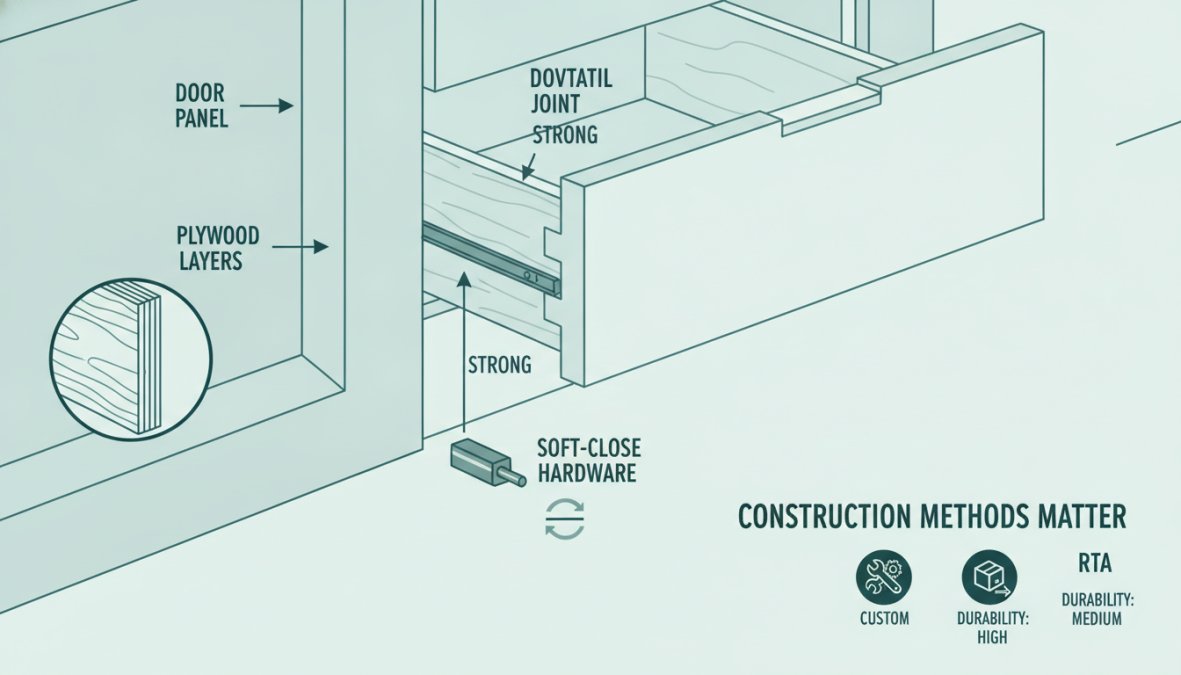
Cabinet Box Construction and Durability
RTA cabinets often use cam locks or dowels for quick assembly. Drawers in budget RTA use particle board bottoms and simple slide hardware; premium RTA upgrades to plywood bottoms and ball-bearing slides. Custom cabinets typically feature dovetail or mortise-and-tenon joints, creating stronger connections. Drawer construction uses solid wood or plywood throughout, with premium ball-bearing slides standard.
RTA works fine for 7-10 years of typical use. Custom cabinets are built to last 25+ years, which significantly shifts the cost-per-year calculation if you're staying in your home long-term.
RTA Cabinet Pros and Cons: Is Ready-to-Assemble Right for You?
The biggest advantage of RTA is immediate availability, most stock ships within days or weeks, not months. The lower upfront cost is another significant draw, especially for budget-conscious renovators. RTA cabinets are also more forgiving for DIY enthusiasts, with straightforward assembly and inexpensive replacement parts.
The cons are equally real. Standard sizing limits how well RTA cabinets fit unusual kitchen layouts. Particle board construction, common in budget RTA, doesn't handle moisture well and can swell or degrade in humid kitchens. Once assembled, RTA cabinets are harder to modify. If you want to add a shelf, upgrade hardware, or reconfigure interior storage, you're often limited by the fixed design.
Custom Cabinet Lead Times and Design Flexibility
Custom cabinetry requires patience but delivers unmatched flexibility. The design process begins with a consultation where a designer measures your kitchen, discusses your workflow, and explores aesthetics. This collaborative phase catches problems early and can reveal storage solutions tailored to how you cook and live.
Customization Options and Space Optimization
Custom cabinets can be built to fit any dimension with 1/4-inch precision, meaning no gaps or awkward spaces. Sloped ceilings, angled walls, and architectural quirks become design opportunities, not constraints.
Interior customization is where custom cabinets shine. You can specify drawer dividers, spice racks, pull-out shelves, bread boxes, wine racks, or specialty organizers. Some custom manufacturers offer integrated smart storage, motion-activated lighting, or pull-outs that extend fully for easy access.
Material and finish options are nearly limitless. Solid wood species like cherry, maple, walnut, or oak can be stained any color, or choose painted finishes. Hardware choices range from simple pulls to statement pieces that define your kitchen's style. For those seeking the look and precision of custom cabinetry with faster turnaround, [Custom Order Inset](https://rtawholesalers.com/collections/snow-white-custom-order) and Custom Color Inset options provide flexibility in sizing and color without the full 12-16 week lead time of traditional custom builds.
DIY Kitchen Cabinet Installation vs Professional Installation
RTA cabinets are designed for DIY assembly; instructions are detailed and parts are pre-cut. A typical RTA kitchen takes a dedicated person 3-5 days to assemble. Professional installation of RTA cabinets is faster, with a crew completing a kitchen in 1-2 days.
Custom cabinet installation is more complex. Cabinets arrive fully assembled, but fitting them into your kitchen requires precision. Walls are rarely perfectly plumb or square, so installers must shim and adjust. Professional installation is essentially mandatory for custom cabinets.
Assembly Difficulty and Tools Required
RTA assembly requires basic tools: a drill, screwdriver set, level, and measuring tape. Most modern RTA includes pre-drilled holes and cam locks, which simplify the process. The main skill is patience and attention to detail.
Custom cabinet installation demands more specialized knowledge. Installers need to understand how to shim and level heavy, complex cabinetry and manage electrical or plumbing integration if needed. This is why custom installation is typically handled by professionals.
Long-Term Maintenance, Repairability, and Resale Value
RTA cabinets with veneer finishes should be wiped clean with a damp cloth and dried immediately. Custom solid wood cabinets develop character over time and can be refinished after 15-20 years. Solid wood can be sanded, restained, or repainted, making custom cabinets repairable rather than replaceable.
RTA cabinets are harder to repair. If a veneer edge chips, professional repair is expensive. If a drawer slide breaks, you may need to replace the entire drawer box. This limitation means RTA cabinets often have a shorter useful lifespan before replacement becomes more practical than repair.
Warranty Coverage and Sustainability Considerations
RTA cabinets typically come with limited warranties of 1-3 years. Custom cabinets may include warranties of 5-10 years or even lifetime coverage. From a sustainability perspective, custom cabinets' longevity, 25+ years versus 7-10 years for RTA, means fewer replacements over a lifetime, potentially making them more sustainable despite higher initial material use.
Resale value considerations matter if you're planning to sell. High-quality, well-maintained cabinetry commands higher resale premiums. A beautifully designed custom kitchen often becomes a selling point that justifies a higher asking price.
How to Choose: RTA or Custom Cabinets for Your Kitchen
The comparison ultimately comes down to five factors: timeline, budget, design complexity, durability expectations, and your personal involvement.
Start with timeline. If you need cabinets in 4-6 weeks, RTA is your answer. If you can wait 12-16 weeks and want a design consultation, custom makes sense. Semi-custom splits the difference with 4-8 week lead times.
Next, assess your budget realistically, including assembly labor for RTA. Design complexity is the third factor. If your kitchen layout is standard with no unusual angles, RTA often works fine. If your kitchen has quirks or ambitious design goals, custom cabinetry is worth the investment.
Consider durability expectations. If you're staying 10+ years, custom cabinets' longevity justifies their higher upfront cost. Finally, think about your involvement. Do you want to participate in the design process? Custom offers that collaboration.
Decision Framework Based on Project Needs
| Your Situation | Best Option | Why |
|---|---|---|
| Standard kitchen, tight budget, moving within 5 years | RTA | Lower cost, adequate durability for short-term use |
| Odd dimensions, staying 10+ years, want perfect fit | Custom | Precision fit and longevity justify higher cost |
| Standard layout, want quality, moderate budget | Semi-custom or premium RTA | Balance of customization and value |
| Complex design, high-end aesthetic, long-term investment | Custom | Design flexibility and durability worth the premium |
| Timeline is critical | RTA | Fastest option available |
| Design consultation matters, can wait 8-12 weeks | Custom | Collaborative process delivers better outcomes |
At RTA Wholesalers, we offer Inset cabinets available in custom sizes and colors at wholesale pricing, giving homeowners the flexibility of customization without waiting months or paying premium prices. Our assembled cabinets are available in 5 weeks in multiple wood species and stain colors, or unlimited Sherwin Williams paint colors. We also offer Special Order Oak Inset Kitchen Cabinets for those seeking the warmth and durability of solid oak. Our free kitchen design service helps you make the right choice for your specific project.
The choice between RTA and custom cabinetry shapes your kitchen renovation's success. RTA offers speed and affordability; custom delivers precision and durability. Most homeowners find their answer by honestly assessing their timeline, budget, and how long they plan to live in their home. RTA Wholesalers offers solutions that balance speed, flexibility, and value to ensure your kitchen renovation delivers exactly what you envisioned.
Frequently Asked Questions
Are RTA cabinets good quality compared to custom options?
RTA cabinets vary widely in quality. Premium ready-to-assemble options use plywood construction, soft-close hinges, and dovetail drawers, matching semi-custom durability. Budget RTA models rely on particle board and basic hardware, making them less durable long-term. Custom cabinets typically offer superior build quality and material selection, but quality RTA cabinets can last 15-20 years with proper care. The key is evaluating specific construction methods rather than assuming all RTA is inferior.
What are the main disadvantages of RTA cabinets?
Key RTA drawbacks include assembly time and skill requirements, limited customization for non-standard kitchen layouts, and potential quality inconsistencies with budget brands. Particle board construction in lower-tier RTA options is less durable than plywood. Assembly errors can affect door alignment and soft-close functionality. Lead times vary, and some RTA products lack comprehensive warranty coverage. However, these concerns are less relevant for premium RTA brands offering plywood construction and detailed assembly instructions.
How long do custom cabinets last compared to RTA options?
Well-constructed custom cabinets typically last 25-30+ years due to superior materials, solid wood frames, and professional installation. Premium RTA cabinets with plywood box construction and quality hardware can last 15-20 years. Budget RTA with particle board may deteriorate faster, 10-15 years, especially in high-moisture kitchens. Longevity depends on materials (solid wood vs. veneer vs. particle board), hardware quality, installation precision, and maintenance. Custom cabinets' higher initial investment often translates to better long-term value.
How long are custom cabinet lead times versus RTA delivery?
RTA cabinets typically ship within 2-8 weeks depending on stock availability and customization level. Custom cabinets generally require 8-16 weeks for manufacturing, though some semi-custom options fall in between. Lead times vary by manufacturer and current demand. If timeline is critical, stock RTA or semi-custom options with faster lead times work best. When planning a kitchen remodel, factor lead times into your project schedule early, custom work requires patience but offers unmatched design flexibility and space optimization for unique layouts.


