 833-377-8663

Smart Storage for Deep Corner Cabinets

Table of Contents
- Why Deep Corner Cabinets Are Hard to Use
- Lazy Susan Cabinet Inserts for Full-Access Corner Storage
- Blind Corner Cabinet Organizers That Pull Away from the Wall
- Pull-Out Shelves and Sliding Trays for Easier Access
- Maximizing Kitchen Cabinet Space with Vertical Organization
- Measuring Your Corner Cabinet Before Ordering
- DIY Installation vs. Professional Assembly
- Frequently Asked Questions
Last Updated: September 20, 2026
Why Deep Corner Cabinets Are Hard to Use
Corner cabinets are notorious for wasting space. You reach into the opening and your hand disappears into darkness. The back corner sits unreachable, and anything stored there becomes forgotten inventory. This dead space problem affects nearly every kitchen layout where two cabinet runs meet at a 90-degree angle. The deeper the cabinet, the worse the issue becomes.
The real challenge isn't the corner itself, it's access. A standard corner cabinet might be 36 inches wide, but only the first 12-18 inches are reachable without contorting your arm. The remaining space becomes a black hole where Tupperware goes to disappear. Homeowners and contractors alike struggle with this geometry, often accepting wasted storage rather than solving it.
At RTA Wholesalers, we help customers transform these problem zones into fully functional storage. The solution isn't accepting the dead space, it's choosing the right system to reclaim it. Below, we'll walk you through the best options for maximizing your corner cabinet, from rotating shelves to pull-out mechanisms that bring everything within arm's reach.
Lazy Susan Cabinet Inserts for Full-Access Corner Storage
A lazy susan corner cabinet solves the access problem by rotating. Two pie-shaped shelves spin 360 degrees, bringing stored items to the front of the cabinet without requiring you to reach into the back. When you open the doors, everything rotates toward you.
How Rotating Shelves Eliminate Dead Space
Rotating shelves work because they match the geometry of the corner. Instead of fighting the 90-degree angle, they use it. Each shelf is a 3/4-circle that pivots on a center post. Open the cabinet doors and the shelves rotate forward, exposing items that would normally sit in the unreachable back corner.
The practical benefit is immediate: pots, pans, small appliances, and pantry items become visible and accessible without reaching. You're not managing two separate storage zones anymore, you're managing one rotating unit. This eliminates the "I forgot what I stored back there" problem that plagues standard corner cabinets.
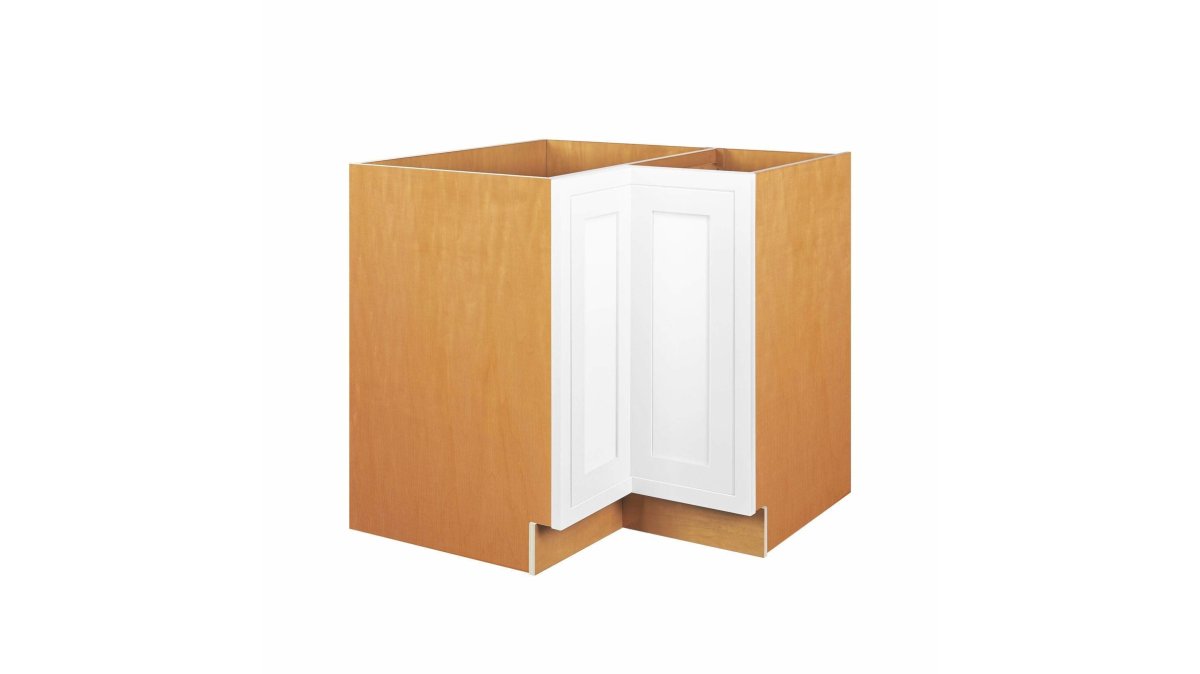
The Lazy Susan Base Cabinet 33" & 36" White Shaker 1-1/4" Overlay from RTA Wholesalers includes two 3/4-circle rotating shelves. The cabinet uses soft-close hinges and DTC full-extension drawer glides with catch-and-soft-close action, so everything operates smoothly. Assembly is straightforward for DIY installers, and the white shaker finish works with most kitchen styles.
For a more customized approach, the Custom Order Inset Lazy Susan Corner Base Cabinet allows you to specify exact dimensions to the nearest 1/4 inch and choose from any Sherwin-Williams color. This cabinet is built to order in solid birch with a factory-baked UV-cured lacquer finish that resists chips and moisture far better than site-painted cabinets. Custom-order cabinets require 8-11 weeks for production before shipping begins.
Choosing Between Overlay and Inset Styles
The difference between overlay and inset is how the doors sit in the face frame. An overlay door sits on top of the face frame, covering it. An inset door sits flush inside the face frame, creating a traditional, furniture-like appearance.
Overlay cabinets are easier to assemble and adjust. The doors can be shimmed and repositioned without precision. They're also typically less expensive and more forgiving if measurements are slightly off.
Inset cabinets demand precise measurements and assembly. The doors sit flush inside the frame with minimal reveal, usually 1/16 inch or less. They create a seamless, high-end look that many homeowners prefer. Our custom color inset cabinetry is available in most any size. Get Inset cabinets at wholesale pricing in most any size. Inset options arrive fully finished with a professional lacquer coating that's ready for daily use immediately.
Choose overlay if you're prioritizing ease of installation and cost. Choose inset if you want a finished, built-in appearance and are willing to invest in precision measurement and assembly.
Blind Corner Cabinet Organizers That Pull Away from the Wall
A blind corner cabinet solves the access problem differently. Instead of rotating, it pulls out from the wall. The cabinet extends forward, exposing a hidden shelf that was previously unreachable in the back corner.
How Blind Corner Cabinets Work
A blind corner cabinet has a face frame that wraps around the corner. When you open the door, the cabinet can be pulled away from the wall, sometimes 8-10 inches or more, to expose the interior shelf. This pulls the dead space into view without requiring rotation.
Blind Corner 1-1/4" Overlay Base (Left →
The mechanism works because the face frame extends beyond the typical corner depth. A standard cabinet sits flush against the wall. A blind corner cabinet intentionally extends further, creating the space needed to pull it forward. The shelf inside slides out automatically or manually, depending on the design.
The Blind Corner 1-1/4" Overlay Base (Left or Right) Gray Shaker Blind 36"-42" & 42"-45" measures 36" wide (up to 42" wide when pulled from corner) or 42"s wide with the maximum 45"s and 24" deep by 34-1/2" tall. It features a single top drawer and lower section with two doors. The cabinet can be configured for left or right door opening, and exposed sides are painted to match the cabinet front, so skin panels are not required for exposed sides.
For a more premium option, inset blind corner cabinets provide the flush, built-in appearance of inset construction. Both styles can be pulled away from the corner to eliminate the need for filler strips, reclaiming several additional inches of usable space.
When to Choose a Blind Corner Over a Lazy Susan
Blind corners work best when you need flexibility. Items can be stored on a stationary shelf, and you access them by pulling the cabinet forward. There's no rotation, so tall items won't hit the cabinet doors when you open them. This makes blind corners ideal for storing baking sheets, cutting boards, or anything with height.
Blind corners also work well when you want a simpler mechanism. There are fewer moving parts than a lazy susan. A rotating shelf requires hinges, a center post, and careful balancing. A blind corner just requires the cabinet to slide smoothly and a shelf that either stays put or slides out on glides.
The trade-off is convenience. You must pull the entire cabinet forward to access the back shelf. With a lazy susan, everything rotates to you without moving the cabinet. For high-traffic kitchens where speed matters, a lazy susan feels faster.
Pull-Out Shelves and Sliding Trays for Easier Access
Pull-out shelves solve the corner problem by bringing storage forward without requiring rotation or pulling the entire cabinet away from the wall. A full-extension slide mechanism lets the shelf glide completely out of the cabinet, exposing everything stored on it.
Maximizing Kitchen Cabinet Space with Vertical Organization
Once you've solved the corner access problem, think vertically. Deep cabinets can hold more than you think, if items are organized by height and accessibility.
Measuring Your Corner Cabinet Before Ordering
Accurate measurements are non-negotiable. A cabinet that's 1 inch too wide won't fit. One that's too shallow won't provide the storage you need. Measure three times before ordering.
DIY Installation vs. Professional Assembly
RTA cabinets arrive unassembled, which reduces shipping costs and damage risk. Assembly is straightforward for most homeowners, but it requires time, tools, and attention to detail.
| Installation Type | Time per Cabinet | Cost | Best For |
|---|---|---|---|
| DIY Assembly | 2-4 hours | $0 labor | Budget-conscious, experienced builders |
| Professional Installation | 1-2 hours | $100-300 | Precision, complex layouts, time-constrained |
Frequently Asked Questions
What are some effective storage solutions for deep corner kitchen cabinets?
Lazy susan inserts with rotating shelves spin stored items to the front, eliminating reach-back dead space. Blind corner cabinets pull away from the wall to expose hidden storage. Pull-out shelves and sliding trays bring corner items forward without removing the entire shelf. Each solution addresses the core problem: standard corner cabinets waste 30-40% of their interior space because items get lost in the back.
How do lazy susan cabinet inserts maximize deep corner storage?
Lazy susan cabinets use two rotating pie-shaped shelves mounted on a central pivot. When you open the doors, both shelves spin to bring every item to the front. This design uses the full depth of the corner without any dead space. Inset models like the custom options available feature soft-close hinges and factory-finished surfaces that resist moisture and wear better than site-applied finishes. Our assembled cabinets are available in just 5 weeks in a multitude of wood species and stain colors or an unlimited choice of Sherwin Williams paint colors.
What's the difference between blind corner cabinets and lazy susan corners?
Blind corner cabinets have a fixed face frame that can be pulled away from the wall (typically 10 inches) to expose hidden storage behind. Lazy susans use rotating shelves so items spin to you without moving the cabinet. Blind corners cost less and work well for items you don't access frequently. Lazy susans provide faster, easier access to everyday cookware and are worth the extra investment if kitchen workflow matters.
Can I install a corner cabinet solution myself, or do I need a professional?
Ready-to-assemble corner cabinets ship with all hardware and predrilled holes, making DIY assembly realistic for someone with basic tools and patience. Assembly typically takes 2-4 hours. Installation into your existing cabinet run requires accurate measurement and level mounting. If you're confident measuring to 1/4 inch and using a level, DIY works. If your kitchen has uneven walls or you're uncomfortable with precision fitting, hire an installer to avoid costly mistakes.


