 833-377-8663

White Shaker vs Overlay Kitchen Cabinets: A Complete Guide

Table of Contents
- What Are White Shaker Cabinets?
- Full Overlay vs Partial Overlay Cabinets: Key Differences
- Inset vs Overlay Cabinets: Understanding the Structural Difference
- White Shaker vs Overlay Kitchen Cabinets: Visual and Functional Comparison
- Cost of Kitchen Cabinets: Pricing and Budget Considerations
- Modern Kitchen Cabinet Trends: Where White Shaker and Overlay Fit
- Durability, Hardware, and Long-Term Performance
- Which Style Should You Choose for Your Kitchen?
White Shaker vs Overlay Kitchen Cabinets: A Complete Guide
Last Updated: July 22, 2026
When renovating your kitchen, the choice between white shaker vs overlay kitchen cabinets shapes your design aesthetic, installation timeline, and long-term maintenance. At RTA Wholesalers, we help homeowners navigate this decision by breaking down the structural, visual, and practical differences between these two popular cabinet styles.
What Are White Shaker Cabinets?
White shaker cabinets represent one of the most enduring kitchen design choices. A shaker door features a recessed panel framed by stiles and rails, the vertical and horizontal pieces that create the characteristic five-piece construction. The panel sits slightly inset from the frame, creating visual depth and shadow lines that add dimension. White shaker cabinets work equally well in traditional farmhouse kitchens and contemporary minimalist spaces.
Design and Aesthetic Appeal
White shaker cabinets deliver a refined, unfussy aesthetic with timeless appeal. However, white shows dust, fingerprints, and water spots more readily than darker stains. In kitchens with hard water or frequent cooking steam, white cabinets may need more frequent cleaning to maintain pristine appearance.
Shaker Door Construction
The shaker door's five-piece construction creates structural integrity that single-panel designs lack. The panel floats within the frame, allowing it to expand and contract independently as humidity changes, critical in climates with seasonal humidity swings. Quality shaker cabinets use mortise-and-tenon joinery at frame corners, creating a stronger bond than simple butt joints. This labor-intensive construction is why shaker cabinets cost more than flat-panel alternatives.
Full Overlay vs Partial Overlay Cabinets: Key Differences
The overlay style determines how the cabinet door sits relative to the cabinet box and face frame, affecting visual appearance, installation precision, and usable interior space.
Full Overlay Characteristics
A full overlay door completely covers the cabinet box and face frame, creating a clean, modern aesthetic with no visible wood frame around the perimeter. Full overlay cabinets require more precise manufacturing because misaligned doors become immediately obvious. One advantage is that you gain interior storage space, approximately 2-4 inches more usable width per cabinet compared to partial overlay. Modern kitchens increasingly favor full overlay because the seamless look aligns with contemporary design preferences.
Partial Overlay Characteristics
A partial overlay door covers only part of the face frame, leaving approximately 1-1.5 inches of frame visible around the door's perimeter. Partial overlay cabinets are more forgiving during installation, making them ideal for DIY installation or kitchens with slightly out-of-square openings. The visible frame also provides a traditional aesthetic that works well with shaker doors.
Inset vs Overlay Cabinets: Understanding the Structural Difference
The difference between inset and overlay represents a fundamental design choice affecting construction quality, installation difficulty, and durability.
Cabinet Box Construction Requirements
Inset cabinets require a cabinet box that's structurally sound and perfectly square, since the door sits flush within the opening. This demands precision manufacturing and high-quality box construction from solid wood or quality plywood with reinforced corners. Overlay cabinets are more forgiving because the door covers the box's edges, allowing hinge adjustment to compensate for minor imperfections.
At RTA Wholesalers, we offer custom color inset cabinetry available in most any size at wholesale pricing. The key is that inset cabinets demand quality construction throughout, not just the door, but the entire box.
Reveal and Gap Tolerance
An inset door sits flush with the face frame, creating a seamless, integrated appearance that reads as high-end. However, this requires tight manufacturing tolerances, the door and frame must align to within 1-2mm. Overlay doors have built-in tolerance because the door overlaps the frame, making gaps invisible. Climate also affects gap tolerance. In regions with significant humidity swings, wood naturally expands and contracts seasonally. An inset door might fit perfectly in winter but develop visible gaps in summer, while overlay doors handle this better because the overlap provides margin for movement.
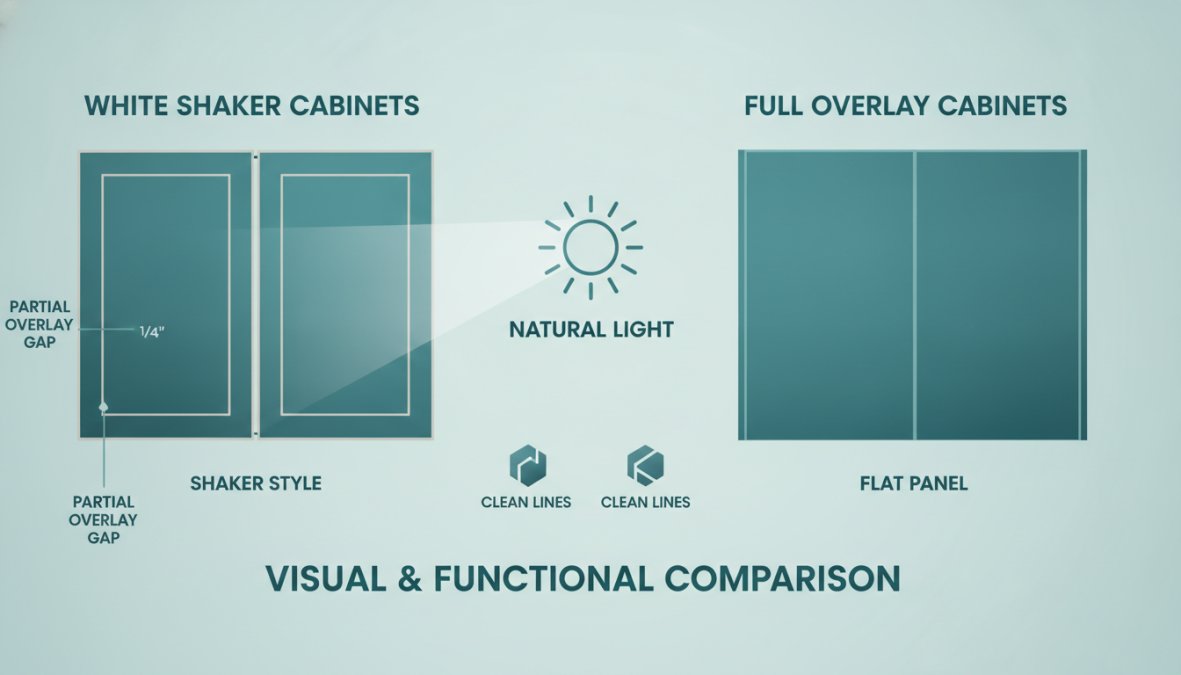
White Shaker vs Overlay Kitchen Cabinets: Visual and Functional Comparison
The choice between white shaker and overlay styles involves trade-offs across aesthetics, storage, maintenance, and installation.
Aesthetic Differences
White shaker cabinets with partial overlay create a traditional, detailed aesthetic where the visible frame breaks up the cabinet run into distinct sections. White shaker cabinets with full overlay create a more modern aesthetic with seamless door coverage while the recessed panel still provides visual interest. Flat-panel overlay doors in white create the most minimal aesthetic but can feel stark and show dust more obviously.
Maintenance of White Finishes
White cabinets require more frequent cleaning than natural wood or darker stains. In a kitchen with hard water and frequent cooking steam, you might need to wipe down cabinets 2-3 times per week. The finish type matters enormously, lacquer finishes provide a harder, more durable surface that resists water spotting better than paint. Maintenance also depends on climate. In dry climates, white cabinets stay cleaner longer.
Cost of Kitchen Cabinets: Pricing and Budget Considerations
Cabinet pricing depends on door style, overlay type, wood species, finish quality, and whether you're buying stock, semi-custom, or fully custom.
Factors Affecting Cabinet Pricing
The door style drives much of the cost difference. Shaker doors cost more than flat panels because of five-piece construction and additional labor. Full overlay cabinets typically cost 5-10% more than partial overlay. Inset cabinets cost significantly more than overlay cabinets, often 20-40% more, because of the precision required. Wood species also affects price substantially, with hardwoods costing more than engineered options.
At RTA Wholesalers, our assembled cabinets are available in just 5 weeks in a multitude of wood species and stain colors or an unlimited choice of Sherwin Williams paint colors.
| Factor | Budget Impact | Notes |
|---|---|---|
| Door style (flat vs shaker) | 10-20% difference | Shaker costs more due to construction |
| Overlay type (partial vs full) | 5-10% difference | Full overlay requires tighter tolerances |
| Inset vs overlay | 20-40% difference | Inset demands precision box construction |
| Wood species | 15-30% difference | Hardwoods cost more than engineered |
| Finish quality | 10-25% difference | Lacquer and multiple coats cost more |
| Custom colors | 5-15% difference | Standard colors are less expensive |
Installation and Labor Costs
Installation costs vary based on cabinet complexity and kitchen layout. Partial overlay cabinets are more forgiving during installation, typically reducing labor costs by 10-15% compared to full overlay. DIY installation is feasible for partial overlay cabinets, especially if your kitchen is relatively square and level. Professional installation typically adds 30-50% to the cabinet cost.
Modern Kitchen Cabinet Trends: Where White Shaker and Overlay Fit
Current kitchen design trends favor several directions, and white shaker cabinets with full overlay doors fit multiple aesthetic preferences.
Integration with Modern Appliances
Modern appliances have become design statements. Panel-ready refrigerators, integrated dishwashers, and flush-mounted range hoods all require careful cabinet coordination. Full overlay cabinets work better with modern appliances because the seamless door coverage extends visually to the appliance panels, creating a unified appearance. White cabinets pair well with stainless steel appliances or with panel-ready appliances in white.
Climate Considerations and Wood Expansion
Wood expands and contracts with humidity changes. In climates with seasonal humidity swings exceeding 20 percentage points, this movement is significant. Inset doors struggle in these climates because they have minimal gap tolerance. Overlay doors handle this better because the door's overlap provides margin for movement. Shaker doors handle wood movement better than flat panels because the panel can move independently of the frame.
Durability, Hardware, and Long-Term Performance
Beyond aesthetics, cabinet longevity depends on construction quality, hardware choices, and how well the design accommodates real-world use.
Soft-Close Hinges and Cabinet Hardware
Soft-close hinges prevent doors from slamming, reduce wear on hinges and door frames, and protect dishes from movement during closure. Over a 15-20 year lifespan, soft-close hinges reduce hinge wear by 60-70% compared to standard hinges. Hardware quality matters significantly, budget hinges use stamped steel that wears quickly, while quality hinges use solid brass or stainless steel with precision-engineered mechanisms. Ball-bearing drawer slides with soft-close mechanisms also outperform budget slides significantly.
Resale Value and Design Longevity
Kitchen renovations recoup 50-60% of their cost at resale in most markets. White shaker cabinets have maintained value better than trendy alternatives because they're timeless. Full overlay cabinets with white shaker doors represent a safe, value-preserving choice. The finish quality directly affects resale value, high-quality lacquer finishes on white shaker cabinets read as high-end and well-maintained.
Which Style Should You Choose for Your Kitchen?
Choose white shaker cabinets with full overlay if you want a contemporary kitchen that feels clean and minimalist while maintaining timeless appeal. Choose white shaker cabinets with partial overlay if you prefer a traditional or transitional aesthetic and want more forgiving installation requirements. Choose inset cabinets if budget allows and you want the refined, built-in appearance that reads as high-end and custom.
Consider your climate when making this choice. In humid climates with seasonal swings, full overlay cabinets with shaker doors handle wood movement better than inset designs. Consider your installation approach, if you're hiring a professional, overlay cabinets are standard and cost-effective. If you're considering DIY installation, partial overlay is more forgiving.
When you're ready to move forward with your cabinet selection, RTA Wholesalers can help you navigate the full range of options. We offer inset and overlay cabinets in white shaker styles, available in custom sizes and colors at wholesale pricing. Our assembled cabinets ship in just 5 weeks. Whether you're choosing between white shaker and overlay styles or exploring inset options, having someone walk you through the trade-offs, climate considerations, and long-term durability makes the difference between a kitchen you tolerate and one you love for 15+ years.
External Sources Referenced
According to the National Kitchen & Bath Association, cabinet quality and construction methods significantly influence both initial performance and long-term durability in residential kitchens.
Research from the Remodeling Impact Report by the National Association of Realtors shows that kitchen renovations recoup 50-60% of their cost at resale, making cabinet quality and design longevity important investment considerations.
The Woodworking Industry Association guidelines document the importance of accounting for wood expansion and contraction in cabinet design, particularly in regions with significant seasonal humidity variation.
Frequently Asked Questions
What is the difference between shaker and overlay cabinets?
Shaker cabinets refer to a door style featuring a recessed panel with a frame, offering a traditional aesthetic. Overlay cabinets describe how doors mount to the cabinet box, either full overlay (covering the entire face frame) or partial overlay (revealing part of the frame). You can combine both: a shaker door can be full overlay or partial overlay. The key difference is that shaker defines style, while overlay defines the door-mounting method and visual reveal.
Are inset cabinets more expensive than full overlay cabinets?
Inset cabinets typically require more precise cabinet box construction and skilled installation, which can increase costs compared to full overlay options. However, pricing depends on quantity, dates, delivery, wood species, finish, and customization. For current pricing and a detailed quote comparing inset and overlay options, visit RTA Wholesalers' website or request a free design consultation to understand the investment for your specific project.
Do white shaker cabinets require more maintenance than overlay styles?
White finishes, whether on shaker or overlay cabinets, require consistent maintenance to prevent visible dust, fingerprints, and staining. The door style (shaker vs. flat-front overlay) doesn't significantly affect maintenance burden; the finish color does. White shaker cabinets benefit from regular wiping with a soft, damp cloth and appropriate wood or paint-safe cleaners. Climate-related wood expansion can create small gaps in both styles, but proper gap tolerance during installation minimizes this issue.
Can I get custom sizes and colors in white shaker or inset cabinets?
Yes. RTA Wholesalers offers custom color inset cabinetry in most any size at wholesale pricing, available in an unlimited choice of Sherwin Williams paint colors. Their assembled cabinets are available in just 5 weeks in multiple wood species and stain colors. A free kitchen design service helps ensure your custom specifications match your space perfectly, catching dimension errors before ordering and preventing costly mistakes.


