 833-377-8663

Wholesale Cabinets: The Complete Buyer's Guide

Table of Contents
- What Are Wholesale Cabinets and Why They Matter
- Understanding RTA Kitchen Cabinets and Assembly Options
- Kitchen Cabinet Material Quality: What Sets Wholesale Cabinets Apart
- How to Measure Your Kitchen for Wholesale Cabinets
- Key Benefits of Buying Wholesale Cabinets
- Budgeting for Hidden Costs in Cabinet Projects
- Maintenance and Long-Term Care for Cabinet Durability
- Conclusion
Wholesale Cabinets: The Complete Buyer's Guide
Last Updated: July 4, 2026
What Are Wholesale Cabinets and Why They Matter
Wholesale cabinets offer professional-grade materials at accessible price points, making kitchen renovations feasible for more budgets than custom cabinetry alone. These ready-to-assemble solutions combine factory-direct efficiency with customization flexibility, whether you're planning a complete kitchen overhaul or updating a single bathroom.
RTA Kitchen Cabinets vs. Pre-Assembled Options
Ready-to-assemble kitchen cabinets arrive in flat-pack form with all components and hardware included, requiring assembly at your location or by a professional installer. Pre-assembled cabinets ship as complete units, ready to install immediately.
The trade-off is clear: RTA kitchen cabinets cost 30-50% less because you're paying for materials and design, not shipping logistics for bulky assembled boxes. Assembly typically takes 4-8 hours for an average kitchen. Many customers hire local installers who charge hourly rates, which remains substantially less than pre-assembled cabinet premiums.
Understanding RTA Kitchen Cabinets and Assembly Options
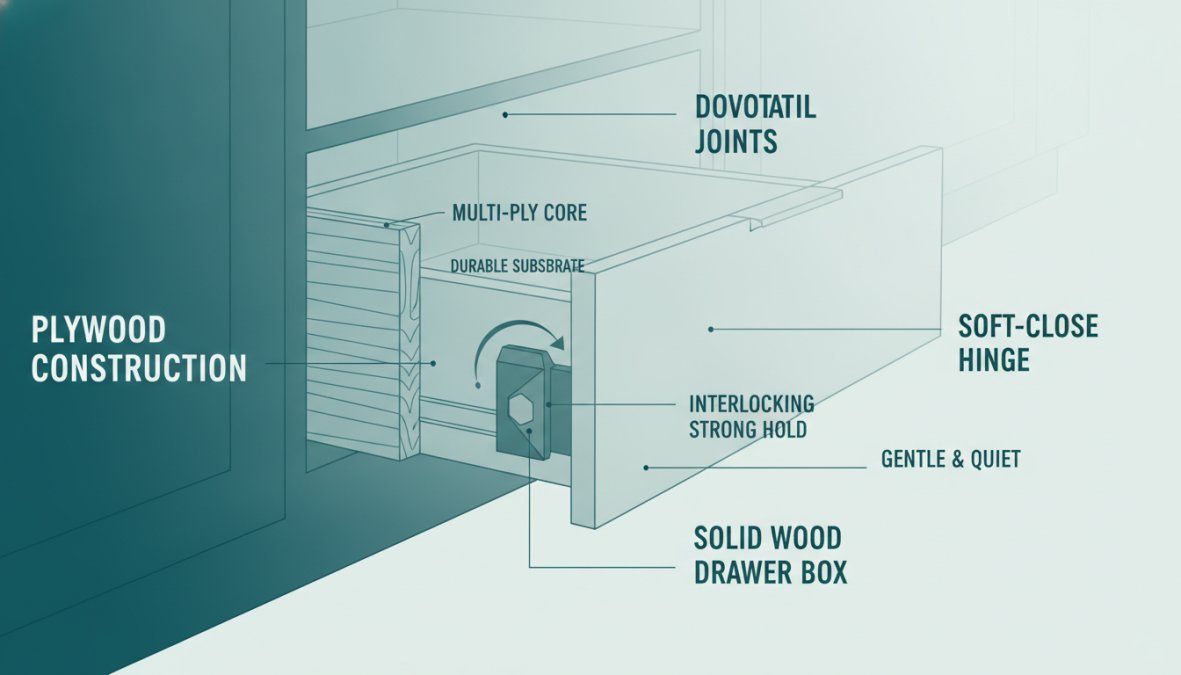
Modern RTA kitchen cabinets use quality construction methods as standard: dovetail drawer joints, plywood box construction, and soft-close hardware. The difference between budget and quality RTA comes down to material thickness, hardware durability, and finish application.
Assembly isn't complicated if you follow instructions carefully. Most manufacturers include detailed guides with labeled components and step-by-step illustrations. The process involves connecting cabinet boxes with cam locks and dowels, installing shelves and dividers, and attaching doors and drawer fronts. A cordless drill and basic hand tools suffice for most installations.
Ready-to-Assemble Benefits
Cost savings are substantial, 30-50% less than comparable pre-assembled cabinets. This savings flows directly to your renovation budget, allowing investment in better hardware, countertops, or backsplash materials instead.
Customization flexibility means you're not forced into standard sizes. Wholesale cabinet distributors offer RTA kitchen cabinets in increments matching your exact measurements. If your kitchen requires a 33-inch base cabinet instead of the standard 36-inch, RTA options accommodate that without custom-build delays or fees.
Assembly on-site means no damage risk during shipping. RTA components pack efficiently, reducing damage claims. You also control the assembly timeline, receive your order and assemble immediately, or wait weeks if your renovation schedule demands it.
Inset vs. Overlay Cabinet Styles
Inset cabinets feature doors that sit completely within the frame opening, creating a flush, recessed appearance and traditional, furniture-like aesthetic. Overlay cabinets have doors that sit on top of the frame, creating a modern, seamless look and maximizing interior storage space.
Inset cabinets suit traditional, farmhouse, and transitional designs. Overlay cabinets work better in modern, minimalist, and contemporary spaces. Modern wholesale cabinet options offer both styles at accessible pricing, so your choice can be purely aesthetic rather than budget-driven. If you're drawn to the classic look of inset cabinetry, options like Custom Order Inset and Special Order Oak Inset Kitchen Cabinets provide flexibility in sizing and finishes to match your exact design vision.
Kitchen Cabinet Material Quality: What Sets Wholesale Cabinets Apart
The materials used in cabinet construction determine durability, appearance, and long-term value. Quality wholesale cabinets use construction methods that withstand daily kitchen use for decades.
Plywood vs. Particleboard Construction
Plywood consists of thin wood veneers glued together in alternating grain directions, creating a cross-laminated structure that resists warping and splitting. It remains stable across temperature and humidity fluctuations common in kitchens.
Particleboard is made from wood chips and sawdust bound with adhesive. It's less expensive to manufacture but absorbs moisture readily, swelling and weakening when exposed to kitchen humidity. Once particleboard swells, it doesn't return to original dimensions, causing doors to misalign and drawers to stick.
Wholesale cabinets worth the investment use plywood for cabinet boxes and drawer sides. This material choice costs more but delivers cabinets that remain functional and attractive for 20+ years. The difference becomes apparent within 3-5 years: plywood cabinets maintain alignment and smooth operation, while particleboard cabinets show warping and operational issues as humidity cycles through your kitchen.
Hardware and Finishing Options
Soft-close hinges and full-extension drawer slides have become standard on quality wholesale cabinets. These features improve functionality significantly, soft-close hinges prevent slamming and reduce wear, while full-extension slides let you access everything in deep drawers without reaching to the back.
Factory-applied finishes are more durable because they're applied in controlled environments with proper ventilation and curing time. Wholesale cabinet distributors offer finishes in multiple wood species (oak, maple, cherry, hickory) with various stain colors. Many now offer unlimited choices of Sherwin Williams paint colors, letting you match your kitchen design precisely. For those seeking specific color options, Custom Color Inset selections provide extensive flexibility to achieve your exact aesthetic.
Consider your lifestyle when selecting finishes. Stained wood shows dust and requires occasional touch-ups. Painted finishes hide dust better and simplify cleaning. Matte finishes look more contemporary but show fingerprints; gloss finishes hide fingerprints but feel less modern.
How to Measure Your Kitchen for Wholesale Cabinets
Accurate measurements are the foundation of a successful cabinet installation. Incorrect measurements lead to gaps, misalignment, and expensive modifications.
Step-by-Step Measurement Process
Begin by measuring the length of each wall where cabinets will install using a metal tape measure at three heights: 36 inches, 48 inches, and the ceiling. Record all measurements and take photos of your kitchen layout.
Next, identify obstacles: windows, doors, electrical outlets, and plumbing. Measure distances from corners to these obstacles. Note ceiling height in multiple locations since many kitchens have sloped or uneven ceilings. Mark the location of any appliances with exact dimensions.
Measure the height of your existing countertops if you're keeping them. Standard countertop height is 36 inches. Measure the depth of your existing cabinets or available space, standard depth is 24 inches for base cabinets and 12-15 inches for wall cabinets.
Create a simple floor plan sketch showing wall lengths, obstacle locations, and appliance positions. Transfer these measurements to your cabinet order form or share them with a designer.
| Measurement Type | Standard Dimension | Why It Matters |
|---|---|---|
| Wall length | Variable | Determines cabinet run length |
| Ceiling height | 8-10 feet | Affects wall cabinet sizing |
| Countertop height | 36 inches | Base cabinet alignment |
| Base cabinet depth | 24 inches | Counter depth and workspace |
| Wall cabinet depth | 12-15 inches | Clearance above counters |
| Obstacle distances | Variable | Cabinet layout planning |
Using Design Services for Accuracy
Many wholesale cabinet distributors offer free kitchen design services. A designer can create a 3D rendering showing how your cabinets will look in your space, helping you evaluate layout options and finishes before committing to an order.
Design services typically work like this: you provide measurements and photos, the designer creates a layout showing cabinet placement and door swing, then you review and request adjustments. This process catches measurement errors and design conflicts early, preventing expensive mistakes.
Working with a designer is particularly valuable if your kitchen has unusual dimensions, sloped ceilings, or complex layouts. They can suggest solutions for challenging spaces that you might not have considered.
Key Benefits of Buying Wholesale Cabinets
Cost Savings and Value
Wholesale cabinets cost substantially less than custom-built alternatives without sacrificing quality. Custom cabinet makers charge premium prices because they build each project individually. Wholesale cabinets achieve lower costs through standardized manufacturing and efficient distribution.
Modern wholesale cabinets use the same materials, hardware, and finishing techniques as expensive alternatives. The difference is efficiency, wholesale manufacturers produce thousands of units using optimized processes, passing savings to customers.
For a typical kitchen renovation, choosing wholesale cabinets instead of custom options saves thousands of dollars. These savings let you invest in better countertops, appliances, backsplash materials, or professional installation services. Wholesale cabinets also ship in 3-5 weeks versus 8-12 weeks for custom options, letting you complete your renovation faster.
Customization Without Compromise
Modern wholesale distributors offer extensive customization: custom sizes, custom colors, and design flexibility that rivals custom cabinet makers.
Size customization means your cabinets fit your exact space. Rather than choosing between standard 36-inch or 42-inch widths, wholesale options accommodate 33-inch, 39-inch, or any dimension your kitchen requires. This eliminates gaps and awkward filler pieces.
Color customization has expanded dramatically. Beyond standard wood stains, wholesale distributors now offer unlimited paint color options through partnerships with paint manufacturers. Design flexibility lets you combine cabinet styles, mix finishes, and create unique layouts without being locked into matching sets.
Budgeting for Hidden Costs in Cabinet Projects
Installation and Labor Expenses
Assembly and installation labor represents the largest hidden cost for many customers. If you assemble cabinets yourself, labor costs are zero but require 40-80 hours of your time. Professional installers typically cost 15-25% of the cabinet purchase price.
Professional installers handle assembly, wall preparation, leveling, and securing. They ensure cabinets are perfectly aligned and function smoothly. Installation typically takes 2-5 days depending on kitchen size and complexity. Budget 20-30% above cabinet costs for installation-related expenses including wall repair and removal of existing cabinets.
Hardware, Shipping, and Delivery
Cabinet hardware often costs more than expected. Basic hardware is included with wholesale cabinets, but upgrading to premium soft-close hinges or designer handles adds cost. Budget an additional 10-15% for hardware upgrades if you want premium options.
Shipping costs depend on cabinet quantity and your location. Wholesale distributors typically offer free shipping on orders above a certain threshold. Delivery to your home is usually included, but some distributors charge for white-glove delivery service.
| Cost Category | Typical Range | Notes |
|---|---|---|
| Wholesale cabinets | 30-50% of budget | Varies by kitchen size |
| Installation labor | 15-25% of budget | DIY reduces to 0% |
| Hardware upgrades | 5-10% of budget | Optional premium options |
| Countertops | 15-25% of budget | Material dependent |
| Backsplash & flooring | 10-20% of budget | Material and labor dependent |
| Appliances | 10-20% of budget | If replacing existing |
Maintenance and Long-Term Care for Cabinet Durability
Proper maintenance extends cabinet life and keeps them looking beautiful for decades.
Cleaning and Protection Strategies
Regular cleaning prevents buildup and maintains finishes. For painted cabinets, wipe surfaces with a soft cloth and mild soap solution. For stained wood, use wood-specific cleaners that nourish the finish.
Protect cabinet finishes from moisture and heat. Wipe spills immediately to prevent water damage. Install a range hood and use it when cooking to minimize steam exposure. Keep cabinets away from direct sunlight, which fades finishes over time.
Hardware requires periodic attention. Tighten hinges and drawer slides annually to maintain smooth operation. Soft-close mechanisms occasionally need adjustment if doors don't close smoothly.
When to Refinish or Replace
Quality wholesale cabinets rarely need replacement if properly maintained. However, finishes may need refreshing after 15-20 years of use. Refinishing costs significantly less than replacing cabinets, typically 30-40% of replacement cabinet costs.
You might refinish cabinets to update kitchen aesthetics without full renovation. Changing from stained wood to painted finish, or updating paint color, transforms your kitchen's appearance while preserving cabinet structure.
Replace cabinets only if structural damage makes them unusable. Water damage, severe warping, or broken box components warrant replacement. Quality plywood cabinets rarely experience these issues if properly maintained.
Conclusion
Choosing wholesale cabinets means making smart decisions about materials, customization, and long-term value. Quality wholesale cabinets use plywood construction, soft-close hardware, and durable finishes that rival expensive custom alternatives at a fraction of the cost.
Kitchen renovations represent significant home investments, and cabinet selection influences both aesthetics and functionality for decades. Wholesale cabinets offer inset and overlay styles in custom sizes and colors at accessible pricing. Free kitchen design services help ensure your project succeeds from planning through installation.
Frequently Asked Questions
Are wholesale cabinets cheaper than retail options?
Wholesale cabinets offer significant savings compared to retail because they eliminate middleman markups and reduce overhead costs. Factory-direct pricing from wholesale suppliers means you pay closer to production cost. Additionally, ready-to-assemble (RTA) options reduce labor expenses if you handle assembly yourself. The combination of lower base pricing and reduced installation costs makes wholesale cabinets a budget-friendly choice for kitchen renovations.
What is the difference between RTA and pre-assembled wholesale cabinets?
RTA (ready-to-assemble) cabinets arrive flat-packed and require on-site assembly, which saves shipping costs and allows customization flexibility. Pre-assembled wholesale cabinets come fully constructed but require more careful handling during delivery. RTA cabinets typically offer faster lead times and lower pricing, while pre-assembled options reduce installation time. Both maintain the same cabinet construction quality and material standards, the choice depends on your timeline, budget, and assembly comfort level.
How do I ensure kitchen cabinet material quality when buying wholesale?
Look for cabinets with plywood box construction rather than particleboard, which indicates superior durability. Check for dovetail drawer joints, soft-close hinges, and solid wood or veneer faces. Request sample doors to inspect finish quality firsthand. Reputable wholesale cabinet distributors provide detailed specifications on wood species, stain colors, and paint options. Ask about warranty coverage and review customer testimonials. Quality wholesale cabinets should match or exceed retail standards while costing significantly less.
Do I need a contractor's license to buy wholesale cabinets?
Most wholesale cabinet suppliers sell directly to homeowners without requiring a contractor's license. However, some distributors may offer additional contractor pricing or bulk discounts with licensing. Check with individual suppliers about their policies. Residential kitchen projects typically don't require licensing to purchase materials, only installation may have local permit requirements. Contact your local building department for specific regulations in your area regarding cabinet installation.


