 833-377-8663

Wholesale Inset Cabinetry for Contractors: A 2026 Guide

Table of Contents
- What Is Wholesale Inset Cabinetry for Contractors?
- Key Benefits of Wholesale Inset Cabinetry for Contractors
- Specifications for Wholesale Inset Cabinets
- Cabinetry Lead Times for Contractors: Planning Your Projects
- RTA Inset Cabinets for Pros: Ready-to-Assemble Advantages
- Selecting Inset Cabinet Suppliers for Builders
- Common Installation and Maintenance Issues for Contractors
- Measuring and Planning for Inset Cabinet Projects
Wholesale Inset Cabinetry for Contractors: A 2026 Guide
Last Updated: July 17, 2026
Wholesale inset cabinetry for contractors delivers the custom aesthetic clients demand while protecting contractor margins. These cabinets sit flush within the face frame, creating a seamless, built-in appearance that commands premium pricing.
What Is Wholesale Inset Cabinetry for Contractors?
Inset cabinets are cabinet doors and drawer fronts that sit flush within the face frame, creating a seamless, custom appearance. Unlike overlay cabinets where doors and drawers sit on top of the frame, inset construction requires precision craftsmanship and tighter tolerances. Wholesale inset cabinetry refers to these premium cabinets purchased at bulk pricing designed specifically for contractors, builders, and remodelers who move volume.
Inset vs. Overlay: Understanding the Difference
Inset cabinets sit fully inside the face frame opening, aligning flush with the frame edges. This design requires precise measurement and machining, any deviation of even 1/16 inch can cause binding or gaps. The payoff is undeniable: inset cabinets read as custom, high-end, and intentional.
Overlay cabinets rest on top of the face frame, with the frame visible around the perimeter. This construction is more forgiving during installation and costs less to manufacture, but reads as "builder grade" to design-conscious clients.
Why Contractors Choose Inset Cabinets
Clients scrolling through design inspiration see predominantly inset cabinets in high-end kitchens. By specifying inset cabinets, you're delivering the aesthetic your clients have already decided they want. Durability is the second driver, inset construction with precision joinery and quality materials outlasts overlay cabinets by years. The third factor is perception of value. Clients understand that inset cabinets are harder to make and harder to install, justifying premium pricing.
Key Benefits of Wholesale Inset Cabinetry for Contractors
Cost Savings and Profit Margin Potential
Wholesale pricing eliminates the middleman markup, allowing you to increase gross margin on the cabinetry line item. For contractors moving multiple projects per quarter, bulk order pricing compounds the advantage. Contractors who shift from retail cabinet sourcing to wholesale suppliers report recovering 8-15% in additional margin on cabinetry-focused projects within the first year.
Design Flexibility and Custom Aesthetics
Wholesale suppliers offer custom sizes and custom colors, allowing you to match client specifications exactly. Custom sizes mean you can specify cabinets that fit unusual openings without filler panels or awkward compromises. Many wholesale suppliers offer unlimited choice of paint colors on inset cabinets, along with flexibility on hardware, hinge types, and interior configurations. Options like [Custom Order Inset](https://rtawholesalers.com/collections/snow-white-custom-order) and Custom Color Inset give you the flexibility to match any design direction while maintaining wholesale pricing.
Quality Construction and Durability
Wholesale inset cabinets manufactured to professional standards embody construction practices that retail cabinets often cut corners on. Quality inset cabinets start with plywood box construction using cabinet-grade plywood with solid wood face frames. Dovetail drawer construction, where drawer sides interlock with the front and back using interlocking joints, represents the durability standard. Soft-close hinges and drawer slides reduce wear and add a subtle quality signal that clients feel every time they use the cabinets. Certifications like KCMA (Kitchen Cabinet Manufacturers Association) and CARB Phase 2 compliance signal that the manufacturer maintains rigorous standards.
Specifications for Wholesale Inset Cabinets
Materials: Solid Wood, Plywood, and Finishes
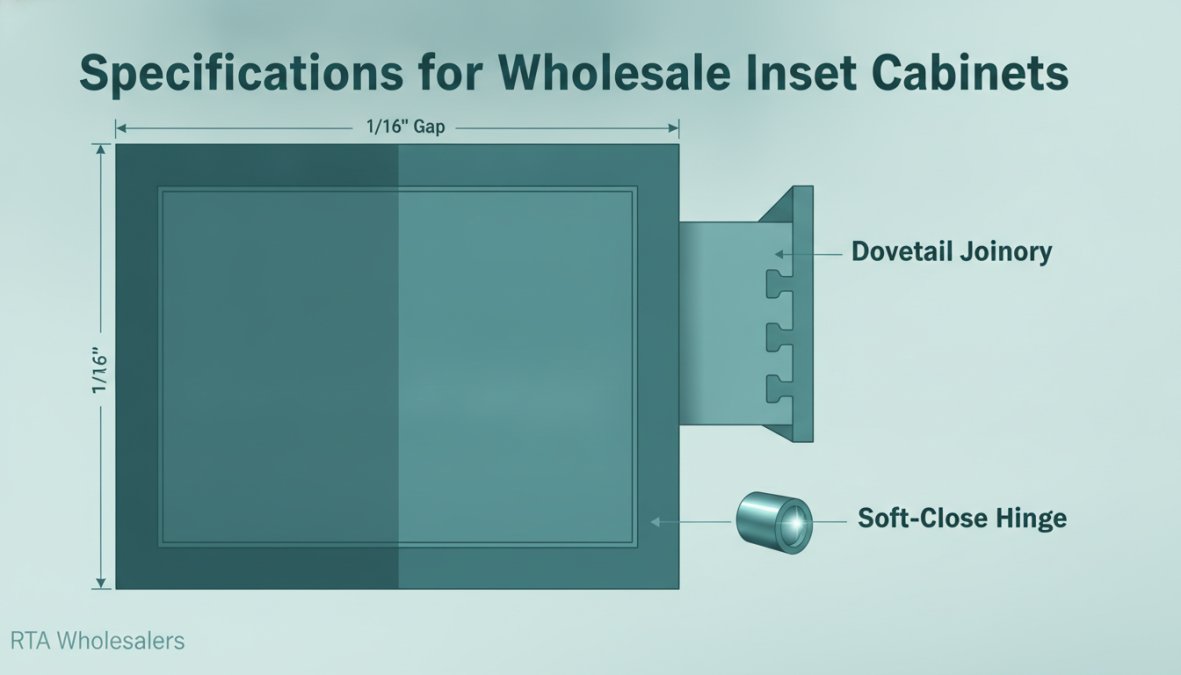
Plywood box construction forms the cabinet body. Cabinet-grade plywood (typically 3/4-inch thickness) provides structural rigidity and resists warping better than solid wood for large panels.
Solid wood face frames are the visible structural members that hold inset doors and drawers. Common species include maple (hard, stable, light color), cherry (rich reddish-brown tone that deepens with age), and oak (prominent grain pattern, classic choice for traditional designs). Oak remains a popular choice for contractors seeking a classic aesthetic, and options like Special Order Oak Inset Kitchen Cabinets provide a reliable sourcing option for projects that call for this timeless material.
Stained finishes showcase the wood grain and color variation, requiring multiple coats, sanding between coats, and final topcoat sealing with polyurethane or conversion varnish.
Painted finishes offer unlimited color options and create a clean, contemporary appearance. Many suppliers offer unlimited choice of paint colors on inset cabinets, allowing you to match any design direction.
Construction Standards: Face Frame and Dovetail Drawers
Face frame assembly determines whether cabinet doors will hang square and remain square over time. Quality manufacturers pocket-hole assemble or mortise-and-tenon the face frame components, creating rigid joints that won't rack or twist.
Dovetail drawer construction interlocks the drawer front, sides, and back using angled joints that resist pulling apart. Drawers built with dovetail joinery handle decades of use without sagging or loosening.
Drawer slide quality determines how smoothly drawers operate. Full-extension slides allow the drawer to open fully without tipping. Soft-close slides use a hydraulic mechanism to slow the drawer near the end of travel, preventing slamming and reducing wear.
Hardware and Hinge Types for Inset Doors
Concealed hinges (also called European cup hinges) are the standard for inset cabinets. The hinge cup mortises into the back of the door, and the hinge arm mounts to the face frame. This design allows the door to sit fully inset with the hinge completely hidden when the door is closed. Concealed hinges also offer three-way adjustment (in/out, up/down, side-to-side), allowing field adjustment to perfect the fit.
Soft-close concealed hinges add a hydraulic or spring mechanism that decelerates the door near closure, preventing slamming and improving perceived quality.
Drawer slides work in tandem with hinges to create smooth operation. Full-extension slides allow drawers to open completely. Premium slides (like Blum or Grass) operate smoothly for decades.
Cabinetry Lead Times for Contractors: Planning Your Projects
Standard vs. Custom Order Timelines
Standard lead times apply to cabinets built from existing specifications. Many wholesale suppliers maintain inventory of popular configurations, allowing them to ship standard orders within 2-3 weeks.
Custom order timelines are longer because the cabinets are built to spec after the order is placed. Custom sizes, custom colors, or special configurations require manufacturing lead times of 5 weeks or more. For contractors, the key is planning ahead. If you're specifying custom sizes or custom colors, factor the 5-week lead time into your project schedule. Order cabinets 6-8 weeks before the installation date to allow for shipping delays and on-site contingencies.
Managing Delivery and Inventory for Multiple Projects
Time orders so deliveries align with the installation phase of each project. Maintain a simple spreadsheet that tracks each project's cabinet order date, expected delivery date, and installation date. For contractors with consistent project volume, establishing a standing relationship with a wholesale supplier provides additional flexibility. Work with your supplier's design services team during the planning phase to reduce the risk of specification errors.
RTA Inset Cabinets for Pros: Ready-to-Assemble Advantages
Assembly Requirements and Installation Workflow
RTA (Ready-to-Assemble) inset cabinets arrive partially assembled, with major components pre-cut and pre-drilled. A typical cabinet box arrives with pre-cut and pre-drilled plywood sides, top, bottom, and back; a pre-assembled face frame; hardware in a separate bag; and detailed assembly instructions. The entire assembly process for a standard 36-inch base cabinet takes 45-90 minutes for an experienced installer, depending on complexity and hardware specifications.
Labor Efficiency and Time Savings on Site
RTA assembly reduces on-site labor compared to fully-assembled cabinets. RTA cabinets ship flat or semi-assembled, reducing freight costs and damage risk. A delivery truck can carry 2-3 times more RTA cabinets than fully-assembled cabinets. Because RTA cabinets are lighter and more compact, they're easier to move and position on site. By assembling cabinets on your schedule, you maintain control over quality and can inspect joints, verify hardware installation, and test drawer and door operation before the cabinets are installed in the home.
Selecting Inset Cabinet Suppliers for Builders
Evaluating Supplier Quality and Certifications
KCMA certification (Kitchen Cabinet Manufacturers Association) indicates that the manufacturer meets rigorous standards for materials, construction, and durability. CARB Phase 2 compliance (California Air Resources Board) certifies that the cabinet materials meet strict formaldehyde emission standards.
Evaluate the supplier's manufacturing process by asking specific questions: What materials do they use for box construction? How is the face frame assembled? What joinery method is used for drawers? What hardware brands do they use? What is their quality-control process?
| Evaluation Criterion | What to Look For | Red Flag |
|---|---|---|
| Certifications | KCMA, CARB Phase 2 | No third-party certifications |
| Materials | Cabinet-grade plywood, solid wood frames | Particle board, veneered MDF |
| Joinery | Dovetail drawers, mortise-and-tenon frame | Stapled or nailed assembly |
| Lead Time | Transparent, consistent timelines | Vague or frequently missed dates |
| Design Support | Free design services, responsive team | No design support, slow communication |
| Warranty | Comprehensive coverage, clear process | Limited warranty, unclear terms |
Customer Service and Design Support
Design services should include consultation during the planning phase. A good supplier offers free kitchen design services that help you visualize the project and refine specifications before manufacturing. Responsive communication matters when you're managing multiple projects. Your supplier should respond to emails and calls within 24 hours. Customization flexibility allows you to specify exactly what you need. The more flexible the supplier, the more you can tailor cabinets to client specifications. Warranty and support should be clear and comprehensive.
Bulk Order Pricing and Contractor Relationships
Ask the supplier directly: How does pricing scale with volume? What's the threshold for moving to the next price tier? A supplier committed to contractor relationships will also discuss payment terms. Net-30 or Net-45 terms allow you to manage cash flow more effectively than requiring payment on delivery.
Common Installation and Maintenance Issues for Contractors
Humidity and Binding: Prevention and Fixes
Inset cabinets are sensitive to humidity because the tight tolerances required for flush fit leave little room for wood movement. Prevention starts before installation. Ensure the kitchen or bathroom has proper ventilation. A range hood above the cooktop and a bathroom exhaust fan should be installed and functioning before cabinets arrive. Acclimation is the second prevention step. When cabinets arrive on site, allow them to acclimate to the home's humidity for 24-48 hours before installation. Installation technique matters too. Install cabinets plumb and level, using shims to adjust for out-of-plumb walls.
Hinge Adjustment and Door Alignment Best Practices
Inset doors must hang with perfect alignment: flush with the face frame, with equal gaps on all sides. Concealed hinges offer three-way adjustment to achieve this precision. Vertical adjustment (up/down): Loosen the hinge mounting screws slightly and slide the hinge arm up or down. Horizontal adjustment (in/out): The hinge cup can be adjusted in or out by loosening the cup mounting screws. Depth adjustment (side-to-side): Loosen the hinge arm mounting screws and adjust the arm position side-to-side. Make small, incremental changes and document the final hinge settings for future reference.
Sharing Maintenance Tips with End Clients
Cleaning: Wipe down cabinets monthly with a soft, damp cloth. For painted cabinets, use a mild soap solution. For stained cabinets, use a wood-specific cleaner. Hardware maintenance: Periodically check that all screws are tight. Humidity management: Remind clients to use range hoods and exhaust fans during cooking and showers. Soft-close care: Instruct clients to close doors and drawers gently; the soft-close mechanism does the work. Finish touch-ups: For painted cabinets, keep a small container of touch-up paint for minor nicks.
Measuring and Planning for Inset Cabinet Projects
Precision Measurement Techniques for Flush Fit
Inset cabinets require precision measurement because the door must fit flush within the face frame opening. A measurement error of 1/8 inch can cause binding or visible gaps. Measure the cabinet opening at three heights: top, middle, and bottom. Record all three measurements. Measure width at three points: left, center, and right. Measure the depth of the space where cabinets will sit, accounting for baseboards, trim, and any protrusions. Check for obstructions: Electrical outlets, plumbing, HVAC vents, or structural elements can affect cabinet placement. Use a laser level to verify that the floor and walls are level and plumb. Document everything with photos and detailed notes.
Using 3D Design Services for Project Visualization
Before ordering cabinets, use 3D design tools to visualize the final result. Many wholesale suppliers offer free kitchen design services that create 3D renderings of the project. 3D rendering benefits: See how the cabinets look in the actual space before manufacturing. Catch design issues early. Confirm that cabinet sizes, colors, and hardware match the client's vision. The design process typically involves providing the designer with detailed measurements and photos, specifying cabinet style and preferences, receiving a 3D model, reviewing the design with the client, and finalizing specifications before placing the order.
Wholesale inset cabinetry for contractors solves the core challenge of balancing quality, cost, and delivery speed. When you're managing multiple projects and need cabinets that perform flawlessly, a reliable wholesale supplier is essential.
Frequently Asked Questions
What are the main benefits of wholesale inset cabinetry for contractors?
Wholesale inset cabinetry offers contractors significant cost advantages, allowing for improved profit margins on kitchen and bathroom projects. Inset cabinets provide a premium custom aesthetic with flush-fit doors and drawers that appeal to high-end residential clients. The precision craftsmanship and quality construction ensure durability and client satisfaction, while wholesale pricing on bulk orders reduces material costs substantially. Contractors also benefit from design flexibility, as suppliers offer custom sizes and colors to match specific project requirements.
How do cabinetry lead times for contractors affect project scheduling?
Lead times vary significantly depending on whether you order standard stock cabinets or custom configurations. Ready-to-assemble (RTA) inset cabinets typically ship faster than fully assembled options, allowing contractors to plan tighter project schedules. Custom size and custom color orders require longer lead times but provide exact specifications. Understanding these timelines helps contractors manage multiple projects simultaneously and set realistic client expectations. Always confirm delivery windows with your inset cabinet suppliers for builders before committing to project start dates.
What specifications should contractors verify when selecting wholesale inset cabinets?
Key specifications include materials (solid wood, plywood box construction), finishes (stained, painted, or glazed options), hardware (soft-close hinges, quality hinges), and construction details (dovetail drawer joinery, face frame precision). Verify certifications like KCMA standards and CARB Phase 2 compliance. Request detailed spec sheets outlining door styles (Shaker, traditional, modern), wood species availability, and paint color options. Confirm that the supplier offers the customization your project needs, custom sizes and custom colors are essential for meeting client specifications.
Are RTA inset cabinets a practical option for professional contractors?
Yes, RTA (Ready-to-Assemble) inset cabinets for pros offer significant advantages including reduced shipping costs, faster delivery, and simplified on-site logistics. Assembly time is manageable for experienced installation crews, and the quality of precision craftsmanship in RTA construction has improved substantially. These cabinets work especially well for contractors managing multiple projects or working in tight spaces where fully assembled delivery is impractical. RTA options also provide better cost control and profit margin opportunities compared to pre-assembled alternatives.


