 833-377-8663

Wholesale Shaker Cabinet Pricing Guide: 2026

Table of Contents
- What Are Shaker Cabinets and Why They Matter for Wholesale Pricing
- RTA Shaker Cabinet Cost: Ready-to-Assemble vs. Pre-Assembled Options
- Factors Affecting Cabinet Pricing: Material Quality and Construction
- How to Buy Kitchen Cabinets Wholesale: Step-by-Step Process
- Hidden Costs of Kitchen Cabinets: What Buyers Often Miss
- Wholesale Shaker Cabinet Pricing Guide: Comparison Framework
- Budgeting Your Kitchen Renovation: Total Cost of Ownership
- Conclusion
Wholesale Shaker Cabinet Pricing Guide: 2026
Last Updated: July 1, 2026
When homeowners and contractors plan kitchen renovations, cabinet costs often represent the largest line item in the budget. Understanding wholesale shaker cabinet pricing helps you avoid overpaying and make informed decisions about quality versus cost.
What Are Shaker Cabinets and Why They Matter for Wholesale Pricing
Shaker cabinets feature a distinctive five-piece door design with a recessed center panel and flat stiles and rails. This timeless style works with nearly every kitchen aesthetic, from farmhouse to contemporary, which explains why shaker doors dominate both retail and wholesale markets. The straightforward construction makes them easier to manufacture at scale, resulting in more competitive wholesale pricing than ornate or specialty door styles.
Shaker cabinets are efficient to produce, no complex carvings or curved edges means manufacturers simplify fabrication and pass savings to buyers. Quality varies significantly, though. Some wholesale shaker cabinets use solid wood construction with premium joinery, while others rely on MDF or particle board with veneer finishes. Understanding these differences is critical before comparing prices.
RTA Shaker Cabinet Cost: Ready-to-Assemble vs. Pre-Assembled Options
The decision between ready-to-assemble (RTA) and pre-assembled cabinets fundamentally changes your wholesale pricing calculation. RTA cabinets arrive flat-packed with components ready for on-site assembly, while pre-assembled units come fully constructed and ready to install.
RTA shaker cabinets typically cost 30-40% less than pre-assembled equivalents because you're eliminating factory labor and reducing shipping volume. However, RTA comes with assembly responsibility. If you're working with a contractor experienced in cabinet assembly, RTA makes financial sense. Pre-assembled cabinets arrive ready to install, eliminating assembly variables and reducing installation time.
Understanding Linear Foot Pricing
Wholesale cabinet pricing is typically quoted per linear foot. A 36-inch base cabinet equals 3 linear feet. Linear foot pricing varies based on construction quality, door style, and finish. When evaluating wholesale pricing, always request itemized quotes that break down the cost per linear foot for base cabinets, wall cabinets, pantry units, and specialty pieces separately. Base cabinets typically cost more per linear foot than wall cabinets because they carry more weight and require heavier construction.
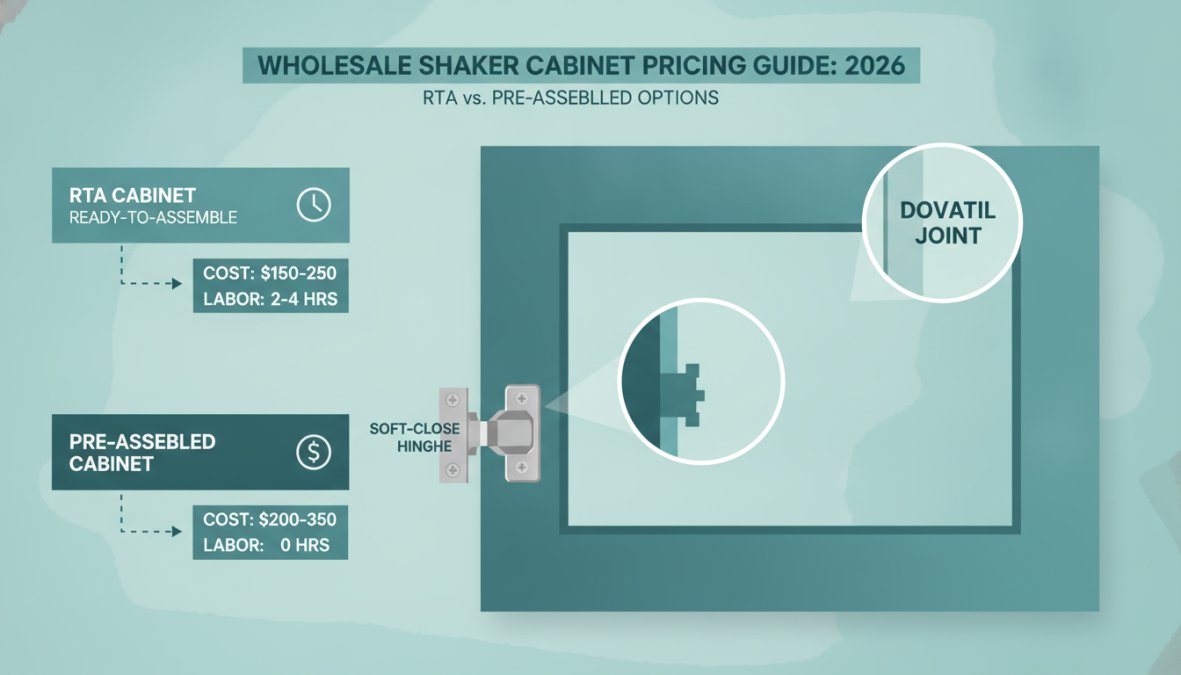
Assembly Time and Labor Considerations
RTA assembly typically takes 2-4 hours per cabinet for experienced installers. At $50-75 per hour for assembly labor, a simple 36-inch base cabinet that takes 3 hours suddenly costs an additional $150-225 in labor. Pre-assembled cabinets eliminate this variable, with installation time dropping to 30-45 minutes per cabinet. For wholesale buyers managing multiple projects, this time savings translates directly to lower total project costs.
Factors Affecting Cabinet Pricing: Material Quality and Construction
Cabinet pricing hinges on materials and construction methods. Two cabinets with identical external appearance can differ dramatically in cost and durability based on internal construction.
Plywood vs. Particle Board: Quality Differences
Plywood cabinet boxes are constructed from thin layers of wood veneer glued together in alternating grain directions. This cross-grain construction creates strength and stability. Plywood resists warping, handles moisture better than alternatives, and supports heavier loads without sagging.
Particle board consists of wood particles compressed and glued together. It's lighter and cheaper to produce, but absorbs moisture readily and loses structural integrity over time. Wholesale pricing typically reflects this difference. Plywood construction costs 20-30% more than particle board, but plywood cabinets last 3-4 times longer, making them substantially better value when calculated cost per year of service.
Door Style, Hardware, and Finish Add-ons
Cabinet door construction varies significantly. Solid wood doors cost more than veneered MDF doors, but they accept stain finishes that highlight grain character. Hardware selection significantly impacts wholesale pricing. Soft-close hinges, which close slowly and silently, add cost but improve user experience dramatically.
Paint finishes offer unlimited Sherwin-Williams colors at consistent pricing. Stain finishes on solid wood vary based on wood species and stain color.
How to Buy Kitchen Cabinets Wholesale: Step-by-Step Process
Start by determining your exact cabinet requirements. You need to know how many linear feet of base cabinets, wall cabinets, pantry units, and specialty pieces you need. You need to know your door style, wood species or paint color, hardware preferences, and any special features like soft-close hinges.
Next, request quotes from multiple wholesale suppliers. Provide identical specifications to each supplier so you're comparing apples to apples.
Measuring Your Kitchen Layout for Accurate Quotes
Accurate measurements are non-negotiable for wholesale cabinet pricing. Start with a scaled floor plan of your kitchen. Note the location of windows, doors, appliances, and plumbing. Measure the wall lengths where cabinets will go, noting any corners, angled walls, or obstacles. Convert your measurements to linear feet and cabinet configurations.
Evaluating Wholesale Suppliers and Lead Times
Lead time is critical in wholesale cabinet purchasing. RTA cabinets typically ship within 2-4 weeks for standard configurations. Pre-assembled cabinets take longer, often 5-8 weeks. Custom options, such as Custom Order Inset or Special Order Oak Inset Kitchen Cabinets, extend lead times to 8-12 weeks, but allow you to achieve a truly tailored look.
Evaluate suppliers based on lead time reliability. Request samples of the cabinets you're considering and examine the door fit, drawer alignment, hardware installation, and finish quality. Confirm whether the wholesale price includes delivery or if shipping is additional.
Hidden Costs of Kitchen Cabinets: What Buyers Often Miss
Wholesale cabinet pricing is transparent on the surface but often hides costs that emerge during installation or use. Many wholesale quotes include basic hinges and pulls, but upgrading to soft-close hinges and premium pulls adds cost. Some quotes exclude filler strips, toe kicks, or trim pieces that are essential for a finished installation.
Shipping, Installation, and Regional Labor Variance
Shipping costs vary dramatically based on location and cabinet weight. Some wholesale suppliers include shipping in their pricing; others quote shipping separately. Installation labor varies by region and complexity. Factor regional labor costs into your project budget.
Warranty, Sustainability, and VOC Ratings
Warranty coverage varies significantly across wholesale suppliers. Some offer limited 1-year warranties covering defects only. Others provide comprehensive 5-year warranties covering hardware, finishes, and structural components.
Sustainability matters to many buyers. Cabinets made from sustainably harvested wood may cost slightly more but align with environmental values. VOC (volatile organic compound) ratings indicate chemical emissions from finishes and adhesives. Lower-VOC products are healthier for indoor air quality.
Wholesale Shaker Cabinet Pricing Guide: Comparison Framework
Comparing wholesale options requires a structured approach that accounts for quality, construction, customization, and service. Create a comparison matrix that evaluates each wholesale supplier across multiple criteria: cabinet cost per linear foot, construction materials, hardware options, available finishes, lead time, shipping terms, warranty coverage, and customer support responsiveness.
Inset vs. Overlay Cabinet Options
Inset cabinets feature doors that sit flush with the cabinet frame, creating a traditional, refined appearance. Inset cabinets cost more to manufacture because they demand tighter tolerances and more skilled labor. Overlay cabinets feature doors that overlap the cabinet frame, covering the frame edges partially or completely. The wholesale pricing difference between inset and overlay is significant. Inset cabinets typically cost 15-25% more than equivalent overlay cabinets. If you're drawn to the inset aesthetic, Custom Color Inset options allow you to personalize the look while maintaining the refined appearance.
Frameless vs. Framed Construction
Frameless cabinets (also called European-style) have no front frame; doors and drawers mount directly to the cabinet sides. This design maximizes interior storage space and creates a modern aesthetic. Framed cabinets have a front frame that provides structural support and creates traditional styling. Wholesale pricing for frameless and framed cabinets is comparable when comparing similar quality levels. The choice is primarily aesthetic and functional.
Budgeting Your Kitchen Renovation: Total Cost of Ownership
Cabinets typically represent 40-50% of total kitchen cost. Calculate your total kitchen renovation budget first. If your total budget is $50,000 and you allocate 45% to cabinets, that's $22,500 for cabinetry. Knowing this target helps you evaluate wholesale options realistically.
Within your cabinet budget, allocate funds across different components. Base cabinets typically cost more per linear foot than wall cabinets. Specialty pieces like islands or pantry units may cost more still. Hardware, finish upgrades, and delivery add to the base cost. Build contingency into your budget, a typical contingency is 10-15% of total project cost.
| Budget Component | Percentage of Cabinet Budget | Notes |
|---|---|---|
| Base cabinets | 35-40% | Typically cost more per linear foot |
| Wall cabinets | 25-30% | Lower per-foot cost than base units |
| Specialty pieces | 10-15% | Islands, pantry units, open shelving |
| Hardware & upgrades | 8-12% | Soft-close hinges, premium pulls |
| Delivery & installation | 10-15% | Varies by location and complexity |
Conclusion
Navigating wholesale shaker cabinet pricing requires understanding construction quality, comparing multiple suppliers fairly, and calculating total cost of ownership rather than just initial purchase price. Start your project with accurate measurements and detailed specifications, then request comprehensive quotes that account for all components: cabinets, hardware, delivery, and installation support.
Frequently Asked Questions
How much do wholesale shaker cabinets cost per linear foot?
Wholesale shaker cabinet pricing varies based on construction quality, materials, and customization. RTA (ready-to-assemble) options typically offer better value than pre-assembled alternatives. Factors like plywood vs. particle board construction, door style, hardware quality, and finish options significantly influence per-linear-foot costs. Custom sizes and colors may adjust pricing. For accurate wholesale shaker cabinet pricing tailored to your project, consider consulting suppliers who offer design services to evaluate your specific kitchen layout and requirements.
What factors affect wholesale shaker cabinet pricing the most?
The primary factors affecting cabinet pricing include material quality (solid wood doors vs. MDF), cabinet grade and construction method (plywood vs. particle board), hardware type (soft-close hinges, dovetail drawer boxes), finish options (wood stain colors or paint finishes like Sherwin-Williams), customization (custom sizes and colors), lead time, and shipping logistics. Pre-assembled cabinets command higher prices than RTA options due to factory assembly labor. Regional labor cost variance also impacts total project costs when installation is factored in.
Is it worth buying shaker cabinets wholesale for a small kitchen?
Yes, wholesale pricing can benefit small kitchen projects. RTA cabinets reduce labor costs through DIY assembly, and wholesale suppliers often provide factory-direct pricing on base cabinets, wall cabinets, and pantry units. Small kitchens require fewer linear feet, so per-unit savings are meaningful. Additionally, many wholesale suppliers offer free kitchen design services to optimize layout and minimize waste. Comparing total cost of ownership, including assembly time, shipping, and hardware, helps determine if wholesale purchasing aligns with your budget and timeline.
Do wholesale cabinet prices include shipping and hardware?
Wholesale pricing structures vary by supplier. Some include standard hardware (hinges, handles) and filler strips; others charge separately. Shipping logistics, especially for nationwide delivery, may be bundled or itemized. Pre-assembled cabinets typically include more complete hardware packages, while RTA options may require additional purchases for soft-close upgrades or specialty hinges. Always clarify what's included in quoted prices: base cabinets, wall cabinets, toe kicks, and whether hardware, finishing materials, and shipping are separate line items or bundled into the wholesale price.


