 833-377-8663

Custom Kitchen Cabinets: A 2026 Buyer's Guide

Table of Contents
- Understanding Custom Kitchen Cabinets vs. Semi-Custom Options
- Cabinet Door Styles and Profiles That Define Your Kitchen
- Best Wood Species and Material Options for Durability
- Finish and Color Customization: Stain vs. Paint
- Evaluating Cabinet Construction Quality and Joinery
- Kitchen Cabinet Installation Timeline and Process
- Custom Kitchen Cabinet Cost Estimator and Budget Planning
- Maintenance, Longevity, and Long-Term Care
Last Updated: July 6, 2026
Understanding Custom Kitchen Cabinets vs. Semi-Custom Options
Choosing between custom kitchen cabinets and semi-custom options fundamentally shapes your project's timeline, budget, and final appearance. Custom cabinets are built to your exact specifications, every dimension, material choice, finish, and hardware detail is tailored to your kitchen's unique layout. Semi-custom cabinets offer a middle ground: manufacturers provide standard sizes you can customize within predetermined parameters.
Custom cabinets become practical when you have an unusual kitchen layout, specific storage needs that stock options don't address, or design preferences outside standard offerings. If your kitchen has angled walls, odd ceiling heights, or architectural details demanding precision fitting, custom construction solves real problems.
Why Custom Design Matters
Kitchens are not interchangeable boxes. Your kitchen has a specific footprint, lighting conditions, traffic patterns, and aesthetic context. A one-size-fits-all approach inevitably creates compromises: gaps between cabinets and walls, wasted corner space, or misaligned hardware.
Working with custom kitchen cabinets solves for your actual kitchen, not hoping a standard solution fits. This precision reduces installation headaches, maximizes usable storage, and ensures every visible surface reflects your design intent. RTA Wholesalers offers a free kitchen design service that translates your vision into specifications before production begins, preventing costly mistakes and ensuring seamless integration.
Cabinet Door Styles and Profiles That Define Your Kitchen
Your cabinet doors set the visual tone for the entire kitchen. The style you choose, shaker, raised panel, flat modern, or ornamental, communicates design intent and affects how the cabinets feel to use, age, and coordinate with other finishes.
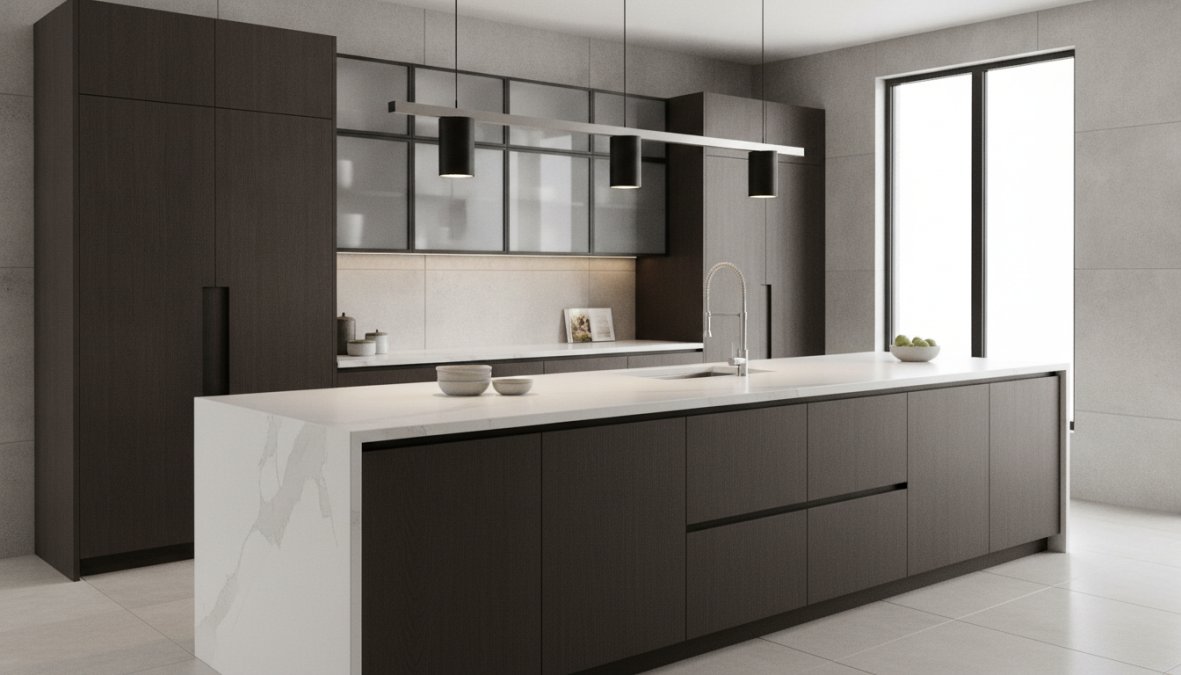
Shaker style remains the most versatile option across design contexts. These cabinets feature a five-piece door frame with a flat center panel, creating clean lines that work equally well in farmhouse, transitional, and contemporary kitchens. The simplicity also means fewer dust traps and more reliable quality.
Raised panel doors add dimensional detail and visual richness, working well in traditional and transitional kitchens. Flat-front modern doors eliminate the frame entirely, creating seamless surfaces ideal for contemporary kitchens, though they show fingerprints more readily.
:::pro The door profile you choose affects how your kitchen evolves over time. Shaker and raised panel styles hide minor wear better than flat fronts, making them practical choices if you want your cabinets to age gracefully. :::
Shaker Style and Inset vs. Overlay Construction
Shaker doors come in two primary construction methods: inset and overlay. This distinction determines how the door sits relative to the cabinet frame and dramatically affects the final appearance.
Inset cabinets feature doors that sit flush within the face frame, creating a traditional, built-in appearance. The door edge aligns with the cabinet frame edge, producing clean sight lines and refined aesthetics. Inset construction requires precision manufacturing because there's no margin for error, signaling quality craftsmanship.
Overlay cabinets have doors that sit on top of the face frame, covering it partially (half overlay) or completely (full overlay). Full overlay construction maximizes visual cabinet space and minimizes the visible frame, creating a more modern appearance. This method is more forgiving during installation because minor cabinet dimension variations don't create visible gaps.
RTA Wholesalers specializes in inset cabinetry available in custom sizes and colors at wholesale pricing. Inset construction delivers that premium, built-in look that photographs beautifully and ages with sophistication.
Best Wood Species and Material Options for Durability
The wood species you select determines not just color and grain pattern, but how the wood performs over decades, resisting moisture, handling humidity changes, and developing patina.
Oak remains popular for kitchen cabinetry. It's durable, readily available, and takes stain beautifully across the full spectrum from light honey to deep espresso. Oak's prominent grain pattern creates visual interest and masks dust better than tighter-grained woods.
Maple offers a tighter grain and lighter natural color. It's harder than oak, making it exceptionally durable for high-traffic kitchens. Maple stains evenly and accepts many finishes without blotching.
Cherry brings warmth and sophistication, developing a rich patina as it ages. The trade-off: cherry is more expensive and more sensitive to UV exposure, meaning direct sunlight accelerates color changes.
Walnut delivers dramatic dark grain and exceptional hardness, making a bold design statement. Its natural color is so distinctive it typically doesn't require staining.
Plywood Construction vs. Particleboard
Cabinet box construction matters as much as visible doors and frames. Plywood and particleboard represent fundamentally different approaches with profound implications for durability.
Plywood is manufactured by laminating thin wood veneers in alternating grain directions. This cross-grain construction creates material stronger than solid wood in many respects, resists warping, and handles moisture better than particleboard. When plywood absorbs moisture, it swells uniformly; when it dries, it returns to original dimensions. This reversibility is crucial in kitchens where humidity fluctuates seasonally.
Particleboard is made from wood particles and resin binder compressed into sheets. It's cheaper but absorbs moisture like a sponge. Once water penetrates the surface, it swells irreversibly. The resin binder breaks down, the material loses structural integrity, and the cabinet fails. In kitchens where steam, leaks, and humidity are inevitable, particleboard is a liability.
High-quality custom kitchen cabinets use plywood construction throughout. When you're investing in custom cabinetry, plywood construction is non-negotiable.
Finish and Color Customization: Stain vs. Paint
Your finish choice, stain or paint, transforms raw wood into the final visual statement. These aren't interchangeable options; they create fundamentally different aesthetics and maintenance approaches.
Stain penetrates the wood grain, highlighting natural figure and character. Stain finishes range from light, naturalistic tones to deep, rich colors. The grain pattern remains visible, creating visual depth and authenticity. Stain typically requires a clear topcoat for protection and durability.
Paint covers the wood entirely, creating a uniform, opaque surface in any color imaginable. Paint is exceptionally versatile for design and offers practical advantages: it's easier to touch up than stain, hides minor wood imperfections, and can be refreshed if you want to change colors later.
RTA Wholesalers offers custom color inset cabinetry with unlimited Sherwin Williams paint color choices. This flexibility means you can match your kitchen's color palette precisely. Paint finishes work beautifully with inset cabinetry, where refined lines deserve a flawless, uniform surface.
Stain celebrates the wood itself and works beautifully in traditional, transitional, and rustic kitchens. Paint prioritizes color precision and works across all design styles.
Evaluating Cabinet Construction Quality and Joinery
How cabinet boxes are assembled determines whether your cabinets remain structurally sound for decades or develop loose joints and sagging shelves within years. Joinery, the method used to connect wood pieces, is where quality separates premium cabinets from mediocre ones.
Dowel joinery uses wooden dowels inserted into holes to align and strengthen joints. When executed well, it creates solid joints, though strength depends on glue quality and hole precision.
Pocket hole joinery uses specially angled screws driven through one piece into another. It's fast and economical, with reliable mechanical strength, though less elegant than other methods.
Mortise and tenon joinery involves cutting a rectangular recess (mortise) in one piece and a corresponding projection (tenon) on another. This traditional method creates incredibly strong joints because the mechanical fit is so precise. It represents the gold standard for premium cabinetry.
Dovetail Drawer Boxes and Hardware Standards
Drawers endure more stress than any other cabinet component. Quality drawer construction directly affects how long your cabinets feel solid and perform reliably.
Dovetail joinery is the hallmark of premium drawer construction. The dovetail joint features interlocking wedge-shaped tails and pins that lock together mechanically. This joinery is exceptionally strong, resists racking, and distributes load evenly.
Soft-close hinges and drawer glides represent another quality marker. Soft-close hardware uses hydraulic dampers to slow the door or drawer as it closes, preventing slamming and extending component life. Ball-bearing drawer glides outperform cheaper roller glides, maintaining smooth operation for decades.
Kitchen Cabinet Installation Timeline and Process
Understanding the timeline for custom kitchen cabinets helps you plan your renovation realistically and coordinate with other trades.
Design and specification typically takes 1-2 weeks. During this phase, you work with a designer to finalize dimensions, materials, finishes, hardware, and special features. Accurate measurements are critical; even small errors compound during manufacturing. RTA Wholesalers offers a free kitchen design service that handles this phase thoroughly.
Manufacturing is where custom cabinetry takes time. Building cabinets to exact specifications requires precision milling, careful assembly, and quality control at each stage. RTA Wholesalers delivers assembled cabinets in approximately 5 weeks, which is competitive for fully custom production.
Delivery and installation represent the final phase. Installation typically takes 2-5 days depending on kitchen complexity. The total project timeline from initial consultation to completed installation typically spans 8-12 weeks.
Professional Installation vs. DIY Assembly
Custom kitchen cabinets arrive either fully assembled or as RTA (ready-to-assemble) components. This choice affects installation complexity and total project cost.
Fully assembled cabinets arrive ready to install. Professional installation ensures cabinets are level, plumb, and properly secured, with expertise to handle unexpected complications. RTA cabinets require on-site assembly. If you're mechanically inclined with the right tools, RTA assembly is manageable. However, mistakes during assembly are difficult to correct after the fact. For most homeowners, professional installation remains the practical choice.
Custom Kitchen Cabinet Cost Estimator and Budget Planning
Planning your budget for custom kitchen cabinets requires understanding what factors drive costs and where you have flexibility.
Cabinet size is the primary cost driver. Larger kitchens with more linear feet of cabinetry cost more than smaller kitchens. Strategic cabinet placement, focusing storage in high-traffic areas and reducing cabinetry in less-used zones, optimizes both functionality and cost.
Material selection significantly affects price. Plywood construction costs more than particleboard but is the only acceptable choice for kitchen cabinets. Wood species vary; oak and maple are moderate-priced options, while cherry and walnut command premiums. Paint finishes typically cost less than stain finishes.
Construction details add cost. Dovetail drawer joinery, soft-close hardware, and premium hinges increase the price but deliver disproportionate improvements in quality and longevity. If budget-conscious, prioritize soft-close hinges on frequently-used drawers and doors.
Customization complexity matters. Simple rectangular cabinets cost less than cabinets with curved edges or specialty storage solutions. Prioritize customizations that address your actual kitchen workflow.
| Budget Factor | Impact | Flexibility |
|---|---|---|
| Cabinet Size | Primary cost driver | Reduce linear feet strategically |
| Wood Species | Moderate impact | Oak/maple are cost-effective |
| Finish Type | Moderate impact | Paint is slightly less expensive |
| Hardware Quality | Smaller impact | Prioritize soft-close on key pieces |
| Customization | Variable | Focus on features you'll use |
RTA Wholesalers provides inset cabinets at wholesale pricing, purchasing directly from the manufacturer without retail markup. Combined with the free kitchen design service, the value proposition is clear: professional guidance and quality construction without premium pricing.
Maintenance, Longevity, and Long-Term Care
Custom kitchen cabinets represent a significant investment. Proper maintenance ensures they remain beautiful and functional for decades.
Dust accumulation is inevitable in kitchens. Weekly dusting with a soft, dry cloth prevents grime buildup. For painted or stained surfaces, a slightly damp microfiber cloth works well; avoid soaking the wood. Spill management is critical, wipe spills promptly with a dry cloth, then follow with a slightly damp cloth if needed. Never let liquid sit on the cabinet surface.
Hardware maintenance ensures smooth operation. If a drawer begins to stick or a door closes less smoothly, dust accumulation in the glide mechanism is usually the issue. A dry cloth run along the glide channel often restores smooth operation. Avoid lubricating glides with oil or grease; these attract dust and create buildup.
Finish touch-ups address minor wear. Paint finishes occasionally chip at corners; a matching paint pen handles these spots quickly. Stain finishes can be refreshed with matching stain applied to worn areas, then sealed with clear topcoat.
Seasonal humidity management protects wood. In dry climates or during winter heating, wood naturally shrinks slightly. In humid climates or summer months, wood swells. This movement is normal; quality construction accommodates it. Using a humidifier in dry seasons and a dehumidifier in humid seasons helps moderate these swings.
Refinishing is rarely necessary with quality cabinetry. A well-maintained cabinet with a quality finish should remain beautiful for 20-30 years without refinishing.
:::pro The best maintenance is prevention. Protect your cabinet investment by managing humidity, wiping spills immediately, and addressing minor issues promptly. A few minutes of preventive care per month extends cabinet life by years. :::
Understanding custom kitchen cabinets means recognizing they're not simply furniture but infrastructure that shapes how you use your kitchen daily. The decisions you make about wood species, construction methods, finishes, and hardware compound over years of use, creating either a kitchen that feels solid and performs reliably or one that deteriorates and frustrates.
RTA Wholesalers specializes in inset cabinetry available in custom sizes and colors at wholesale pricing. Our free kitchen design service ensures your specifications are precise before production, and our approximately 5-week delivery timeline keeps your renovation moving. When you choose custom kitchen cabinets built with plywood construction, dovetail drawer joinery, and soft-close hardware, you're investing in a kitchen that will serve your home beautifully for decades.
Frequently Asked Questions
What is the difference between custom and semi-custom kitchen cabinets?
Custom kitchen cabinets are built to your exact specifications, any size, wood species, finish, hardware, and design detail. Semi-custom cabinets offer limited customization within preset dimensions and options. Custom cabinets provide complete control over plywood construction, drawer glides, soft-close hinges, and door profiles like shaker style, while semi-custom choices are predetermined. Custom options take longer to produce but deliver precisely what your kitchen layout requires.
How long does it take to get custom kitchen cabinets installed?
The kitchen cabinet installation timeline typically spans 8-16 weeks from order to completion, depending on customization complexity and lead time. Factory-direct options can reduce this to 5 weeks for assembled cabinets in standard wood species and stain colors. Professional installation adds 1-3 weeks. Measuring your kitchen space accurately and finalizing your design upfront prevents delays. Lead time varies by manufacturer and whether you choose RTA (ready-to-assemble) or fully assembled cabinetry.
What are the best wood species for custom kitchen cabinets?
Popular choices include oak, maple, cherry, and hickory, each offering distinct grain patterns and durability. Oak provides visible grain and warmth; maple offers fine, uniform texture; cherry develops rich color over time; hickory shows dramatic variation. Plywood construction with quality wood veneer ensures stability and resists warping. Your choice depends on desired aesthetic, budget, and how the wood species complements your kitchen design. Stain vs. paint finishes also affect how wood grain appears in your final custom design.
Do custom kitchen cabinets increase home value?
Yes, custom kitchen cabinets typically improve resale value and buyer appeal. Quality cabinetry is one of the highest-ROI kitchen upgrades, often recouping 50-80% of investment at resale. Custom cabinets signal attention to detail and superior construction quality, especially when featuring soft-close hinges, dovetail drawer boxes, and durable plywood construction. The kitchen is a primary decision point for home buyers, making professional-quality cabinet storage solutions a tangible selling feature. Proper maintenance and timeless design choices maximize long-term value.


