 833-377-8663

Custom vs Semi-Custom Cabinets: Pros and Cons

Table of Contents
- Custom vs Semi-Custom Cabinets: A Side-by-Side Comparison
- What Separates Custom, Semi-Custom, and Stock Cabinets
- Inset vs Overlay Cabinet Construction: What Changes in the Box
- Kitchen Cabinet Lead Times: What to Expect From Each Option
- Ready-to-Assemble Kitchen Cabinets: Where RTA Fits the Custom Debate
- Cost, Durability, and Layout: Three Decisions Competitors Skip
- Which Cabinet Type Fits Your Project?
- Frequently Asked Questions
Last Updated: September 13, 2026
Custom vs Semi-Custom Cabinets: A Side-by-Side Comparison
The pros and cons of custom vs semi-custom cabinets come down to three trade-offs: lead time, design freedom, and how much of your kitchen budget goes into the boxes. What we can do is show you where each option earns its money and where it quietly costs you a month of your timeline.
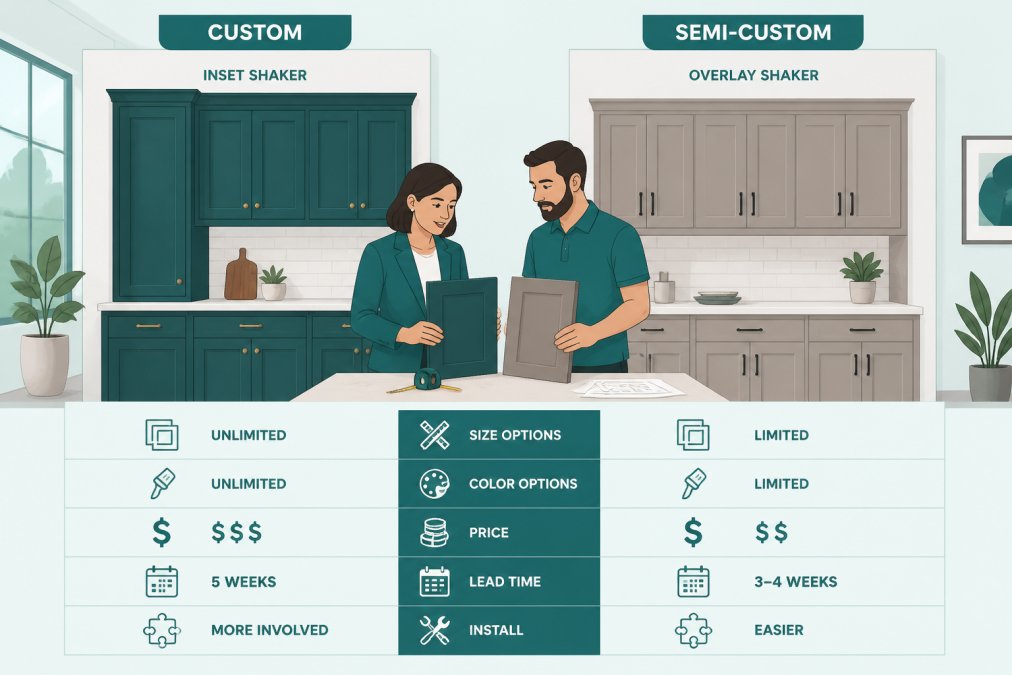
Custom cabinets are built to your exact dimensions, door style, and finish, with no standard sizing grid. Semi-custom cabinets start from a manufacturer's standard size list and let you adjust within it, which is why they cost less and arrive faster.
Here is the short version before we get into the details:
| Factor | Semi-Custom | Custom |
|---|---|---|
| Sizing | Standard widths, some adjustment | Any size to the nearest 1/4" |
| Finish | Fixed factory colors | Any color, single price |
| Lead time | Shorter production window | 8-11 weeks to build |
| Best for | Straightforward layouts, tight budgets | Odd dimensions, inset detailing |
| Biggest risk | Compromising on a filler strip | Ordering wrong, since orders are final |
The rest of this guide breaks down what actually separates the two, and where ready-to-assemble cabinets fit into the picture.
What Separates Custom, Semi-Custom, and Stock Cabinets
Stock cabinets are pre-built boxes in fixed sizes, sold off the shelf. Semi-custom cabinets use that same standard size grid but let you choose door style, finish, and hardware. Custom cabinets throw out the grid entirely and build to your measurements.
That distinction matters most when your kitchen has a wall that isn't square, a window that lands awkwardly, or a run that ends in a spot no standard box fills cleanly. The U.S. Department of Energy guidance on kitchen remodeling is worth reading before you commit to a layout, because cabinet placement drives lighting, ventilation, and appliance clearances.
Where Semi-Custom Ends and Custom Begins
The line is sizing tolerance. A semi-custom line might offer a 9", 12", 15", 18", and 21" base cabinet, which covers most filler situations. A custom line lets you order the nearest larger size and specify the exact width to the closest 1/4".
If your layout needs a 17-1/4" cabinet, semi-custom can't do it without a filler strip. Custom can.
Inset vs Overlay Cabinet Construction: What Changes in the Box
Inset construction sets the door flush inside the face frame, so you see crisp, even reveals on every cabinet. Overlay construction puts the door in front of the frame, which is faster to build and more forgiving of small measurement errors.
The trade-off is real. Inset doors need a face frame built to tighter tolerances, and that precision is where much of the cost difference lives. Overlay hides more sins.
- Inset: furniture-grade look, flush reveals, harder to install perfectly
- Overlay: cleaner install, wider door options, less expensive to produce
- Frameless: no face frame at all, maximum interior access, common in European-style kitchens
For inset, the box construction still matters. Look for plywood rather than particle board, dovetail drawer joints, and soft-close hinges and glides. A cabinet grade box with a beautiful door and a weak drawer box will fail long before the finish does.
Kitchen Cabinet Lead Times: What to Expect From Each Option
Lead time is where the custom-versus-semi-custom decision usually gets made, because it is the one variable you cannot buy your way out of. A finish you love and a size that fits perfectly are worthless if the boxes show up three weeks after your countertop template.
Here is how the windows typically break down once you account for every stage, not just the factory build:
| Stage | Semi-Custom | Custom |
|---|---|---|
| Order to production start | 1-2 weeks | 2-3 weeks |
| Production build | 3-5 weeks | 8-11 weeks |
| Freight and delivery | 1-2 weeks | 1-2 weeks |
| On-site assembly (if RTA) | 1-3 days | 1-3 days |
| Installation | 2-5 days | 3-7 days |
Those ranges assume nothing goes wrong. A finish change, a door style swap, or a single dimension correction can add weeks to the front end, and custom orders are the least forgiving because production does not start until the order is locked.
The number that actually matters is not total lead time. It is the gap between when cabinets must be on site and when your other trades are scheduled. Countertop templating cannot happen until base cabinets are set and level. Appliance delivery should land after cabinet installation, not before, or you are storing a refrigerator in a hallway. Flooring and paint usually need to be finished before cabinets go in, which means the cabinet order is the first domino, not the last.
This is where assembled cabinets change the math. Cabinets that arrive assembled and ready to set skip the on-site assembly stage entirely, which compresses the back end of the timeline.
A free design review earns its keep here. Having someone else check your measurements against your layout catches the errors that are hardest to see when you are the one holding the tape, and catching them before the order locks is the only time they are cheap to fix.
If your timeline is the binding constraint, semi-custom or assembled cabinets usually win. If your dimensions or finish are the binding constraint, custom wins and the calendar has to flex around it. Decide which constraint is real before you fall in love with a door style.
Ready-to-Assemble Kitchen Cabinets: Where RTA Fits the Custom Debate
Ready-to-assemble kitchen cabinets arrive flat-packed and go together on site with the hardware included. They sit outside the custom-versus-semi-custom question because the sizing and finish flexibility depends entirely on the line you buy.
RTA isn't automatically the budget compromise. What changes is who does the final assembly and how the cabinets ship, which affects both cost and how quickly you can get them on the wall.
For a straightforward kitchen, RTA is often the fastest path to a finished room. For a kitchen with unusual dimensions or a specific inset look, RTA can still deliver it, but you're now in custom-order territory and the timeline reflects that.
Cost, Durability, and Layout: Three Decisions Competitors Skip
Most comparisons stop at the purchase price. The three factors that actually determine whether you will be happy in five years are how the cabinets age, how they handle modern kitchen technology, and whether the layout you designed survives contact with a real kitchen. None of those show up on a quote sheet.
How Cabinets Age Over 10+ Years
Finish quality drives long-term maintenance more than cabinet type does. A factory-applied, UV-cured lacquer finish resists chipping, moisture, and yellowing far better than paint applied on site (woodworkingnetwork.com). Site-painted cabinets can look identical on day one and noticeably different after three years of cooking.
The aging pattern differs by construction, too. Inset doors with tight reveals tend to stay aligned because the face frame was built to hold them, but they are less forgiving if a hinge loosens. Overlay doors hide small shifts better but can sag at the hinge over time if the box is not solid. Frameless boxes offer the most interior access but depend entirely on the panel quality, since there is no face frame to add rigidity.
Material sourcing matters for the same reason. Plywood boxes hold up to moisture and load better than particle board. Solid wood face frames and dovetail drawer boxes take decades of daily use. And if indoor air quality is a concern, look for cabinets that meet California CARB2 compliance, which sets limits on formaldehyde emissions from composite wood products (California Air Resources Board composite wood regulation).
A common pattern is that the door finish and the drawer box fail on different clocks. The finish is a cosmetic issue you can live with. A drawer box that separates at the joint is a functional failure, which is why dovetail construction and quality glides matter more than the door style you pick.
Planning for Smart Kitchen Integration
Smart kitchen integration is the factor almost nobody plans for, and it is where custom cabinets pull ahead. Under-cabinet lighting, charging drawers, appliance garages, and hidden outlets for countertop appliances all need power and clearance designed in before the boxes are ordered, not after.
Semi-custom lines can accommodate some of this through standard filler strips and accessory panels, but the routing is constrained by the size grid. Custom cabinets let you specify the interior depth, the back panel cutout, and the drawer configuration around the tech you actually plan to use. If you want a charging drawer that fits a specific device, or a microwave drawer that vents into a cabinet run, that is a custom conversation.
The practical rule: decide your tech list before you order cabinets, not after. Retrofitting power into a finished cabinet run means cutting into a box you already paid for.
A Layout Decision Matrix
The layout question is simpler than it looks. Match your kitchen shape to the cabinet type that fits it:
- Small galley: Standard widths usually cover the run. Semi-custom or assembled cabinets are the efficient choice unless the wall is out of square.
- L-shaped kitchen with a corner: Corner cabinets are where the size grid breaks down. Measure the corner first, then decide.
- Large island kitchen: Custom sizing pays off here because island dimensions are rarely standard, and the island is the focal point.
- Open-plan with a window run: Windows land awkwardly against standard sizes. Custom lets you size around the window instead of filling the gap.
- Historic or irregular walls: Custom is almost always the answer, because no standard grid fits a wall that was never square.
Run your kitchen through that list before you price anything. The layout usually decides the cabinet type for you, and the finish and door style are the fun part you get to choose afterward.
- Confirm every cabinet run against actual wall measurements
- Decide inset or overlay before pricing anything
- Verify plywood box and dovetail drawer construction
- Check finish type and where it is applied
- Plan outlets and lighting inside cabinet runs
- Confirm lead time against your install date
- Get a second set of eyes on the measurements
Which Cabinet Type Fits Your Project?
Choose semi-custom when your layout fits standard sizes, your timeline is tight, and you want a proven finish without a custom production window. Choose custom when your dimensions don't fit the grid, when you want inset detailing, or when the color needs to match something specific.
For projects that need both, RTA Wholesalers builds custom inset base cabinets in widths from 9" to 36", sized to the nearest 1/4" and painted in any Sherwin-Williams color at one price with no color upcharge. We also stock semi-custom overlay base cabinets for the runs where standard sizing works fine, and our custom oak inset drawer base cabinets cover projects that want real solid white oak rather than paint. If you want to see how a full custom inset order comes together, our Custom Order Inset and Custom Color Inset lines let you specify exact sizing and any Sherwin-Williams color, and for a natural wood look, the Special Order Oak Inset Kitchen Cabinets cover solid white oak inset builds.
Frequently Asked Questions
Are semi-custom cabinets good quality?
Yes. Semi-custom cabinets use the same core materials as many custom lines: plywood cabinet boxes, solid wood face frames, dovetail drawer boxes, and soft-close hinges and drawer glides. The difference is usually size range and finish options, not construction grade. A semi-custom base cabinet with a 7-ply plywood box and a solid birch face frame will hold up as well as a comparable custom unit. What you give up is unlimited sizing and full color freedom, not durability.
What is the typical price difference between custom and semi-custom cabinets?
Custom cabinets cost more because every box is built to order. Semi-custom sits lower because manufacturers build in fixed size increments. At RTA Wholesalers, a semi-custom Taupe Gray Shaker base cabinet starts at $188.86, while a custom inset base cabinet in any Sherwin-Williams color starts at $334.66. A custom oak three-drawer inset base runs $852.80. The gap comes from material, construction type, and whether the size is standard or built to your measurement.
How do lead times compare for custom vs. semi-custom cabinets?
Semi-custom and ready-to-assemble cabinets typically ship from stock, so your kitchen cabinet lead times are measured in days, not months. Custom-order inset cabinets from RTA Wholesalers require 8 to 11 weeks of production before shipping begins. That window matters on a flip or a tight remodel schedule. Plan your order date around the longer custom timeline, and confirm measurements before submitting, because custom orders cannot be changed once production starts.
Which cabinet option offers the most design flexibility?
Custom inset cabinets win on flexibility. You can size a cabinet to the closest 1/4 inch, choose from more than 1,500 Sherwin-Williams paint colors at one price, and pick inset or overlay construction. Semi-custom covers most standard kitchen layouts well, and RTA options like the 9 to 21 inch Taupe Gray Shaker base cabinet handle narrow filler spaces. If your kitchen has odd dimensions or a specific color target, custom gives you the room to match it exactly.
The hardest part of this decision isn't picking a side. It's getting the measurements right before you commit, because that's the one mistake no production line can undo. RTA Wholesalers offers inset and overlay options, custom sizes to the nearest 1/4", custom colors at no upcharge, and a free kitchen design service that reviews your layout before anything goes into production. Get started with RTA Wholesalers and order cabinets that fit your kitchen the first time.


