 833-377-8663

Are Soft Close Hinges Worth the Extra Cost? (2026)

Table of Contents
- What Soft Close Hinges Actually Do
- Soft Close vs Standard Hinges: The Real Difference
- The Case for Spending More on Soft Close Hinges
- When Soft Close Hinges Are Not Worth the Cost
- Common Problems with Soft Close Hinges and How to Fix Them
- How to Install Soft Close Hinges: Retrofit vs. Replace
- The Verdict: Are Soft Close Hinges Worth the Extra Cost?
- Frequently Asked Questions
Last Updated: September 5, 2026
Every kitchen renovation reaches the same crossroads: standard hinges are free, but soft close hinges cost more. The question of are soft close hinges worth the extra cost comes down to how much you value daily quiet, cabinet longevity, and the safety of small children.
What Soft Close Hinges Actually Do
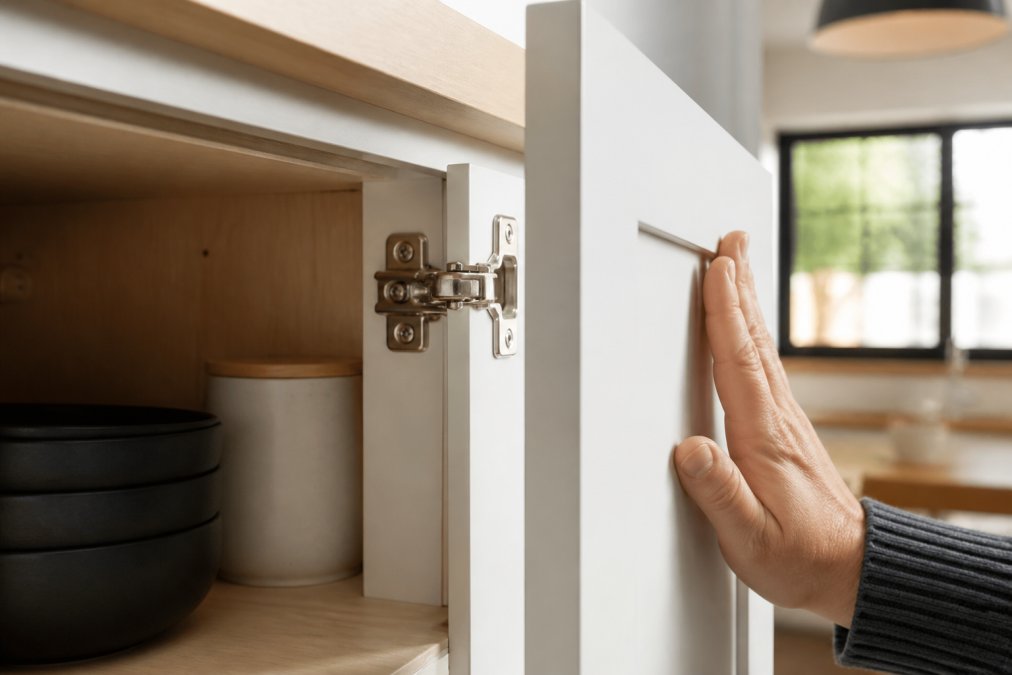
Soft close hinges integrate a hydraulic dampener into the hinge mechanism itself, catching the door before it slams and easing it closed. The dampener engages only in the final portion of the swing, so the door moves freely when opened but slows to a gentle stop when released.
The practical effect is simple: no more slamming doors. The dampening absorbs the force of the door, protecting the cabinet frame and reducing noise throughout the home.
A door that slams repeatedly stresses the hinge mounting points and cabinet frame. Soft close hardware distributes that force gradually, supporting cabinet longevity and keeping doors aligned longer.
Soft Close vs Standard Hinges: The Real Difference
The core difference is the built-in dampening mechanism that controls the closing motion. A standard hinge relies on the user to close the door gently and offers no resistance if the door is pushed or let go. A soft close hinge catches the door and controls its speed regardless of how forcefully it is pushed.
Standard hinges are simple, inexpensive, and have no moving parts beyond the pivot point. They are the default on most builder-grade cabinetry because they cost less and rarely fail.
Soft close hinges remove that human factor. The dampener does the work, so the closing speed is consistent every time.
Standard hinges are typically cheaper to replace and easier to find. Soft close hinges have more components, including the dampener, which means more that can wear out over a decade of use.
The Case for Spending More on Soft Close Hinges
The strongest argument for soft close hinges is the daily quality-of-life improvement. Every cabinet open and close becomes silent and controlled, which matters most in open-concept homes where the kitchen shares space with living areas.
Safety is a compelling secondary reason. The hydraulic dampening prevents doors from slamming shut on fingers, a genuine concern in households with young children.
Doors that slam create stress on hinge screws and the cabinet frame, causing doors to sag or misalign over years. Soft close hardware eliminates that repeated impact, supporting alignment and extending the life of the cabinetry.
When Soft Close Hinges Are Not Worth the Cost
Soft close hinges are not always the right call, especially on a tight budget with a short ownership horizon. If you are flipping a property for quick resale, the premium may not translate into a higher sale price.
Rental properties are another case where the upgrade is questionable. Tenants generally do not treat cabinetry with the care of an owner, and the more complex soft close mechanism is more vulnerable to damage from rough handling.
Soft close hinges add value to well-built cabinetry with solid doors and sturdy frames. On low-quality, lightweight doors, the dampener can strain the mounting points because the door lacks the mass to close smoothly under resistance.
Common Problems with Soft Close Hinges and How to Fix Them
Soft close hinges are mechanical devices with predictable failure points. Understanding them helps you decide whether to repair, replace, or skip the upgrade.
Failure Point 1: The Hydraulic Dampener Loses Resistance
The most common failure is the dampener itself. Most soft close hinges use a sealed hydraulic cartridge, a small cylinder filled with oil that forces fluid through a tiny orifice as the door closes. Over years of use, the internal seals can wear, allowing air into the cartridge and turning the hinge back into a standard one.
Diagnosis: Open the door to about 45 degrees and let it go. If it swings shut freely with no slowing in the final two inches, the dampener has failed.
The fix: This is not a repair, the cartridge is sealed and not serviceable. The hinge must be replaced. A standard hinge can be replaced for a few dollars, while a soft close hinge costs several times more per unit.
Failure Point 2: The Door Slams Despite the Dampener Working
A door that closes slowly but slams in the final half-inch points to a different issue: the dampener is engaging too late or the door is too heavy for the hinge's rated capacity. Soft close hinges are rated for specific door weights, typically 10 to 25 pounds.
Diagnosis: Check the hinge's weight rating (usually stamped on the hinge arm or listed in the manufacturer's spec sheet). Weigh the door if necessary. If the door exceeds the rating, the hinge is undersized for the application.
The fix: Replace the hinge with a higher-rated model. This is not a defect, it is a specification mismatch. This is also why factory-installed soft close hinges on new cabinetry perform better than retrofits. investing in bespoke furniture.
Failure Point 3: The Door Drifts Open or Won't Stay Closed
This issue is rarely the dampener. It is almost always the spring mechanism that provides the closing force. Soft close hinges combine a spring that pulls the door closed and a dampener that slows that motion.
Diagnosis: Open the door halfway and release it. If it stays in place rather than slowly closing, the spring tension is insufficient.
The fix: Many soft close hinges have an adjustable spring tension screw. Turning this screw increases or decreases the closing force. If the hinge is at maximum tension and the door still drifts, the spring has fatigued and the hinge needs replacement.
Failure Point 4: Loose Mounting Screws and Stripped Holes
This is the most common issue that is not a hinge failure at all. Repeated motion gradually loosens the mounting screws that hold the hinge plate to the cabinet frame, causing the door to sag and misalign.
Diagnosis: Open the door and check for play at the hinge plate. If the plate moves when you push on it, the screws are loose.
The fix: Tighten the screws. If the screw holes are stripped, which happens when screws are overtightened or the cabinet frame is made of particleboard rather than plywood, options include longer screws that reach into solid wood, wood dowels with glue, or specialized hinge-screw repair inserts.
The Maintenance Reality
Soft close hinges are not maintenance-free, but the maintenance is minimal. A well-made hinge from a reputable manufacturer will typically last 10 to 15 years with normal use (peer-reviewed research). When one fails, the problem is almost always the sealed dampener or the spring, and the fix is replacement rather than repair.
The cost of replacing a failed soft close hinge is higher than replacing a standard hinge. If you are installing on a budget, choose a mid-range hinge from a known manufacturer rather than the cheapest option, cheap hinges fail sooner, and replacement cost erases the upfront savings.
How to Install Soft Close Hinges: Retrofit vs. Replace
Most articles on soft close hinges assume you are buying new cabinets. But the most common real-world scenario is different: you have existing cabinets with standard hinges and want to know whether you can upgrade without replacing them.
The Compatibility Check: Three Measurements That Decide Everything
Before buying a single hinge, measure three things on your existing cabinet door. Getting these wrong is the most common reason retrofit projects fail.
1. Hinge cup diameter. European-style concealed hinges (the most common type on modern cabinets) require a 35mm bore hole drilled into the back of the door (cabinetmakers.org). Some older or budget cabinets use smaller 26mm or larger 40mm cups. Measure the existing hole with a caliper. If it is not 35mm, your retrofit options are severely limited.
2. Overlay dimension. The overlay is how much the door overlaps the cabinet frame when closed. A full overlay door covers the entire frame; a half overlay covers half; an inset door sits flush inside the frame. Soft close hinges are manufactured for each overlay type and are not interchangeable.
3. Mounting plate pattern. The mounting plate attaches to the cabinet frame. Standard hinges use either a slide-on plate with two screws or a clip-on plate with a release lever. A non-standard pattern requires drilling new pilot holes, which is more invasive.
The Retrofit Process: What It Actually Takes
If your existing hinges are standard 35mm cup, full overlay, and use a standard mounting plate pattern, retrofitting is straightforward:
- Remove the door. Remove the screws from the mounting plates on the cabinet frame; the door comes off with the hinge arms attached.
- Remove the old hinge arms. Remove the arm from the cup, leaving the cup in the door.
- Remove the old cup. Remove the two screws holding the cup in the 35mm bore hole and pull it out.
- Install the new soft close hinge. Insert the new hinge cup into the existing 35mm hole and secure it with the provided screws.
- Attach the mounting plates. Screw the new mounting plates to the cabinet frame using the existing screw holes where possible.
- Hang the door and adjust. Clip the door onto the mounting plates and adjust the three axes, up/down, left/right, and in/out, using the adjustment screws on the hinge.
A full kitchen of 30 doors typically takes 3 to 4 hours for a first-time DIYer (thisoldhouse.com). Tools required: a screwdriver, a drill with a 35mm Forstner bit (only if drilling new holes), and a caliper.
When Retrofitting Is Not Worth It
The retrofit math changes when your existing hinges are not standard:
- Non-standard cup size. If your doors have 26mm or 40mm cups, you will need to drill new 35mm holes, which risks overlapping the old hole and weakening the door.
- Inset doors. Inset doors require special hinges with a different geometry, they exist but are more expensive and harder to source. If you are considering new inset cabinetry, options like a Custom Order Inset or Custom Color Inset come with hinges matched to the door style from the factory.
- Particleboard cabinet frames. Screw holes strip easily in particleboard, and retrofitting new mounting plates often requires reinforcement.
- Doors with damage. Retrofitting new hinges onto a warped, delaminating, or cracked door is wasted effort.
The Decision Framework: Retrofit vs. Replace vs. New Cabinets
| Scenario | Recommended Approach | Why |
|---|---|---|
| Standard 35mm cup, full overlay, plywood frame | Retrofit | Straightforward swap, no drilling, 3-4 hours of labor |
| Non-standard cup size or overlay | Replace doors and hinges | Drilling new holes risks door damage; new doors come pre-bored |
| Particleboard frame with stripped holes | Replace cabinets | Retrofitting into particleboard is unreliable |
| New kitchen or full renovation | Order new cabinets with soft close | Factory pre-drilled and pre-adjusted, no compatibility questions |
The Cost Reality of Retrofitting
Retrofitting saves the cost of new cabinets but adds labor. New cabinets come with hinges pre-installed and pre-adjusted, eliminating the risk of drilling errors and misalignment. For a homeowner comfortable with DIY, retrofitting is a viable weekend project. For anyone hiring a professional, the labor cost of swapping 30 hinges can approach the cost difference of ordering new cabinets with soft close pre-installed.
For those with standard hinges, retrofitting is a practical, cost-effective way to get the soft close experience without replacing cabinetry. For everyone else, the cleaner path is ordering new cabinets with soft close hinges factory-installed, and for those building a new kitchen, a Special Order Oak Inset Kitchen Cabinets package can include the right inset hinges from the start.
The Verdict: Are Soft Close Hinges Worth the Extra Cost?
Soft close hinges are worth the extra cost for most homeowners planning to stay in their home for several years, but they are a poor investment for short-term flips and rental properties. The upgrade delivers daily noise reduction, protects the cabinet frame from impact, and adds a safety benefit for households with children.
If you are renovating a kitchen you will live with for five years or more, the upgrade is a reasonable investment. If you are flipping a property or furnishing a rental, the added cost across every hinge is hard to justify when standard hinges perform adequately and cost less to replace.
For new cabinetry, the decision is easier because the cost difference is smaller than a full retrofit. Ordering cabinets with soft close hinges pre-installed avoids the labor and compatibility risks of adding them later.
The real question is not whether soft close hinges are better, they are. The question is whether the upgrade fits your timeline and your budget.
Choosing the right cabinet hardware comes down to how you plan to use your kitchen and how long you will live with the result. At RTA Wholesalers, we help you match the right options to your project, whether that means soft close hinges on new cabinetry or guidance on what to skip. Our ready-to-assemble cabinets are available in inset and overlay styles with a range of finish options, and our free kitchen design service helps you plan the details before you order. Get started with RTA Wholesalers and build a kitchen that fits the way you actually live.
Frequently Asked Questions
Are soft close hinges worth it for high-traffic kitchens?
Yes, especially in high-traffic kitchens where doors get opened and closed dozens of times a day. The hydraulic dampening mechanism prevents slamming, which reduces wear on the cabinet frame and door over time. This means less maintenance and a longer lifespan for your cabinetry. For busy households, the noise reduction and safety benefits of preventing finger pinching also make the upgrade a practical choice.
Can you add soft close mechanisms to existing cabinets?
Yes, you have two main options. You can retrofit your existing cabinets with adhesive or screw-on soft close dampeners that attach to the inside of the door. This is a budget-friendly DIY project. The more reliable method is to replace your standard hinges with soft close hinges, which requires checking your current hinge type and screw hole alignment. Retrofit kits work best on standard overlay doors.
Do soft close hinges increase the resale value of a home?
Soft close hinges are considered a standard expectation in modern kitchens, especially in renovated homes. While they alone won't drastically increase your home's appraised value, they do make your kitchen feel more premium and up-to-date to potential buyers. Along with quality cabinet hardware and soft close drawer glides, they contribute to a positive first impression that can help your home sell faster.
How much does it cost to put soft close hinges on cabinets?
The cost varies significantly based on whether you retrofit or replace and the quality of the hinges you choose. Retrofitting with dampeners is the most affordable option. Replacing hinges costs more per hinge, and the total depends on how many doors you have. For new cabinetry, the upgrade cost is typically a small percentage of the overall cabinet budget. Contact RTA Wholesalers for current pricing on cabinetry that includes soft close hardware.


