 833-377-8663

Durable White Shaker Cabinets for Flipping: A 2026 Guide

Table of Contents
- Why Durable White Shaker Cabinets Are Ideal for Flips
- Key Features That Define Cabinet Durability
- Comparing Inset vs Overlay Shaker Cabinets
- RTA vs. Pre-Assembled Cabinets for Flipping Projects
- How to Install RTA Cabinets Efficiently
- Best RTA Cabinet Brands for House Flipping
- Material Comparison: Solid Wood vs. MDF and Plywood
- Maintenance and Longevity of Painted White Finishes
Last Updated: August 25, 2026
Why Durable White Shaker Cabinets Are Ideal for Flips
White shaker cabinets have become the standard choice for house flips because they deliver broad appeal without sacrificing durability. The clean lines and versatile design work across price points, which means your cabinet investment translates directly into resale value. What separates a flip that moves quickly from one that sits on the market is the construction quality underneath that white paint.
Durable white shaker cabinets aren't just about aesthetics, they're about structural integrity that holds up through showings, inspections, and years of buyer use. RTA Wholesalers has built its reputation on offering inset and overlay options in white shaker styles because flippers need cabinets that look custom but assemble fast and cost predictably. The real advantage lies in longevity: plywood box construction, soft-close hardware, and UV-protected finishes mean your cabinets won't show wear within the first two years of ownership, a critical factor when buyers evaluate quality. A cabinet that operates smoothly and looks fresh becomes a selling feature (realtor.org).
Key Features That Define Cabinet Durability
Durability in white shaker cabinets comes down to four specific construction elements: the box, the hardware, the finish, and the joinery.
Plywood Box Construction vs. Particle Board
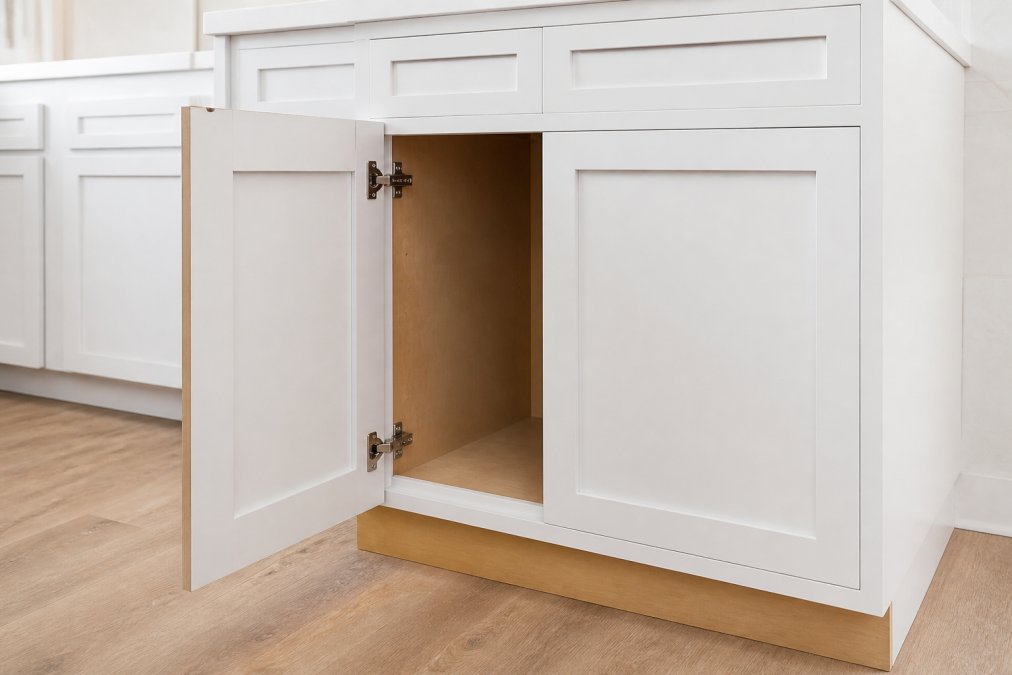
The cabinet box is where budget options fail. Plywood construction uses multiple thin layers of wood veneer glued together, creating structural stability that resists warping, sagging, and moisture damage. Particle board, common in budget RTA cabinets, is compressed wood fibers and glue that deteriorates when exposed to humidity or weight.
RTA Wholesalers uses 5/8-inch 7-ply birch plywood for cabinet boxes on their inset shaker line. That thickness and layer count matter, a thinner plywood box flexes under weight, and thin particle board delamminates within years. The difference shows up in drawer operation: plywood boxes hold drawer slides true over time, while particle board boxes allow slides to misalign as material compresses, creating sticking drawers that buyers notice immediately.
Soft-Close Hardware and Undermount Slides
Soft-close hinges and full-extension undermount slides have moved from luxury feature to baseline expectation for any cabinet that will pass inspection on a flip. Soft-close hinges stay open at 105 degrees and close with a light push, preventing slamming doors during showings (astm.org). Undermount slides allow drawers to glide smoothly at full extension without tipping. Both features reduce stress on the cabinet frame and extend cabinet life by years.
Paint Adhesion and UV-Protected Finishes
White paint on cabinets needs to stick and stay bright. Oil-based UV lacquer topcoats cure harder than water-based paints and resist yellowing from sunlight while protecting underlying wood from moisture. A cabinet painted with standard latex paint shows wear within two years (peer-reviewed research). A cabinet finished with oil-based UV lacquer looks fresh for five to seven years under normal kitchen use, the difference between a buyer noticing wear and seeing a well-maintained kitchen.
Comparing Inset vs Overlay Shaker Cabinets
The inset vs overlay choice affects both aesthetics and durability. Inset cabinets have doors and drawer fronts that sit flush with the face frame, making the frame visible around each door. Overlay cabinets have doors that cover the face frame. Both styles work for white shaker, but they behave differently over time.
Inset Cabinet Construction and Durability
Inset cabinets require tighter tolerances during manufacturing and installation, which is what makes them look high-end. The durability advantage comes from the visible face frame itself, typically made of solid hardwood (birch, in RTA Wholesalers' snow white inset line) that provides additional structural support around the cabinet opening. This means less flex in the door opening over time, hinges stay true, and doors don't sag. Inset cabinets are also easier to repair, the visible frame gives you adjustment points that overlay cabinets lack. For flips where durability and appearance matter equally, Custom Order Inset cabinets are available in custom sizes and custom colors at wholesale pricing, allowing you to fit unusual kitchen dimensions without the cost premium of traditional custom cabinetry.
Overlay Cabinets: Cost vs. Long-Term Wear
Overlay cabinets cost less to manufacture because they require fewer precision adjustments. The trade-off appears within three to five years: overlay doors are cantilevered and supported only by hinges attached to the cabinet box. Without the visible frame providing lateral support, hinge points experience more stress, and doors can develop slight sag or twist over time. For flips aimed at quick sale, overlay cabinets work fine. For higher price points or longer holding periods, inset cabinets justify their cost because they maintain appearance longer.
RTA vs. Pre-Assembled Cabinets for Flipping Projects
Ready-to-assemble (RTA) cabinets arrive flat-packed with hardware included. Pre-assembled cabinets arrive fully built. RTA cabinets save money on shipping because they take up less space. A kitchen's worth of RTA cabinets fits in a fraction of the space required for pre-assembled units, which compounds across multiple projects.
Assembly time varies: a single base cabinet takes 30-45 minutes, while a full kitchen of 15-20 cabinets takes two to three days for one person or one day with two people. Pre-assembled cabinets arrive ready to install but add shipping cost and require careful handling to prevent damage in transit.
Where RTA cabinets shine for flipping is predictability. You know the lead time, you know the cost, and you know the quality because you're buying from the same supplier across multiple projects. Pre-assembled cabinets from different suppliers can vary in quality and finish, creating problems when managing multiple flips simultaneously.
How to Install RTA Cabinets Efficiently
Installation efficiency determines whether your cabinet purchase actually saves you money on labor. A poorly planned installation wastes hours; a well-planned installation moves cabinets from truck to wall in a single day. durable materials for bathrooms.
Assembly Timeline and On-Site Preparation
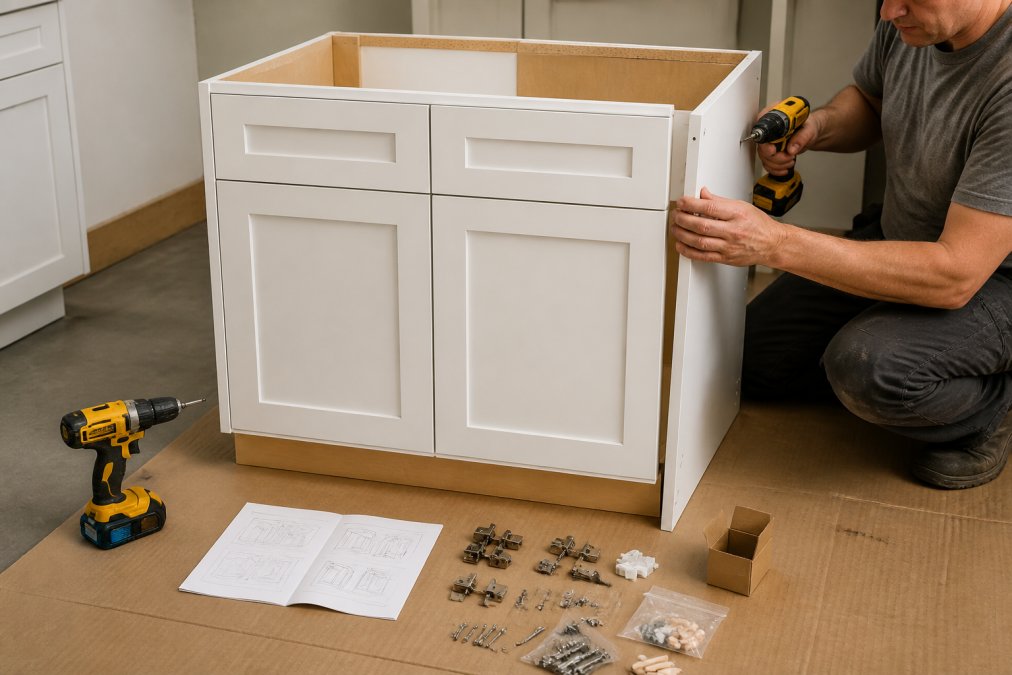
Start assembly prep before cabinets arrive. Gather tools: drill, screwdriver, level, stud finder, tape measure, and shims. Lay out all cabinet boxes and hardware on a clean floor. Assemble all base cabinets first (30-45 minutes each), then wall cabinets (20-30 minutes each). Install cabinets in sequence starting at a corner, working linearly across the room, and shimming as you go. Shims adjust for uneven floors and walls, critical for drawer operation. A cabinet out of level by more than 1/8 inch will have drawers that drift open or won't close fully.
Common Installation Mistakes to Avoid
The biggest mistake is skipping the level check. If you don't shim cabinets to compensate for uneven floors, drawers will drift and doors will swing open, the most common callback issue on flips. The second mistake is over-tightening fasteners; cabinet boxes are plywood, not steel, and over-tightening strips threads and creates loose joints. Hand-tighten, then add a quarter turn. The third mistake is installing cabinets before the countertop is ready. Cabinets must be perfectly level and aligned before countertops are cut and installed.
Best RTA Cabinet Brands for House Flipping
The RTA cabinet market has expanded, but not all brands deliver the durability that flips require. The difference between a quality brand and a budget brand shows up in hardware quality, finish durability, and wood species consistency.
What Separates Quality RTA Cabinets from Budget Options
Quality RTA brands specify hardware by manufacturer (not just "soft-close hinges" but "SH-ABC soft-close hinges"). Budget brands use unbranded hardware that can't be serviced or replaced. Quality RTA brands use plywood boxes throughout; budget brands use plywood for base cabinets and particle board for wall cabinets. Quality RTA brands publish assembly instructions with part-by-part diagrams, while budget brands provide minimal documentation.
RTA Wholesalers differentiates by offering Custom Color Inset cabinets on their inset shaker line. Most RTA brands offer fixed sizes and limited color options. For flips where the kitchen has unusual dimensions or where a specific white shade matters for matching existing trim, the ability to customize without custom cabinet pricing is a significant advantage.
Wholesale Pricing and Lead Time Logistics
Wholesale pricing means buying direct from the manufacturer at volume discounts. Lead time predictability matters for flips, you need to know cabinets will arrive when promised. Shipping logistics also affect final cost: RTA cabinets ship flat in smaller boxes, reducing freight cost, but quality RTA suppliers pack carefully and include damage protection to prevent costly replacements.
Material Comparison: Solid Wood vs. MDF and Plywood
Cabinet materials affect both durability and cost. Solid wood (birch, oak, maple) is the most durable and expensive, resisting warping and accepting finishes beautifully. Plywood (multiple thin wood veneers glued together) is the middle ground, more stable than solid wood and less expensive, making it the standard for quality RTA cabinets. MDF (compressed wood fibers bonded with resin) is the budget option that absorbs moisture and deteriorates in humid environments.
RTA Wholesalers uses solid birch hardwood for face frames and 5/8-inch plywood for cabinet boxes on their white shaker line. This combination delivers durability at wholesale pricing, providing solid wood visibility without solid wood cost.
Maintenance and Longevity of Painted White Finishes
White paint requires maintenance. UV exposure yellowing paint, moisture causes finish breakdown, and daily use creates micro-scratches. Oil-based UV lacquer finishes (like those RTA Wholesalers applies to their white shaker cabinets) cure harder and resist yellowing better than water-based paints while providing a moisture barrier that protects underlying wood.
Longevity expectations: a quality white cabinet finish lasts five to seven years under normal kitchen use before showing noticeable wear. Budget finishes show wear within two to three years. For flips, that difference is critical, a buyer inspecting a kitchen after two years will notice finish degradation on budget cabinets but not on quality cabinets. Maintenance is simple: wipe cabinets monthly with a damp cloth and mild soap, avoid abrasive cleaners and excessive moisture, and dry after cleaning.
| Feature | Solid Birch Hardwood | Plywood Box | Soft-Close Hardware | Oil-Based UV Lacquer |
|---|---|---|---|---|
| Durability | 10+ years | 8-10 years | 7-8 years | 5-7 years |
| Best For | Visible frame, high-end flips | Cabinet box structure | All cabinet types | Painted white finishes |
| Cost | Higher | Mid-range | Standard | Standard |
| Maintenance | Finish protection | Moisture protection | Hardware replacement | Regular cleaning |
When you're flipping a kitchen, every cabinet decision compounds. Durable white shaker cabinets from RTA Wholesalers deliver the construction quality that survives buyer inspections and the aesthetic appeal that justifies your renovation investment. Their inset cabinets are available in custom sizes and custom colors at wholesale pricing, which means you're not compromising on fit or finish to hit your budget. Start with a consultation on your specific kitchen dimensions and let the design process confirm your cabinet choice before committing to the build.
Frequently Asked Questions
Q: What makes white shaker cabinets durable for rental properties and flips?
A: Durable white shaker cabinets combine solid birch hardwood face frames, 5/8-inch plywood box construction, and oil-based UV lacquer finishes that resist moisture and wear. Soft-close hinges and full-extension drawer glides reduce stress on hardware from frequent use. The inset style, where doors sit flush with the face frame, provides structural rigidity that overlay cabinets cannot match. These features extend cabinet life through multiple tenant cycles and appeal to buyers expecting quality construction.
Q: Are white shaker cabinets still the best choice for home resale value in 2026?
A: White shaker cabinets remain a strong choice for resale because they offer timeless aesthetics and broad buyer appeal. The versatile clean lines work with modern, transitional, and farmhouse designs. Buyers perceive white shaker cabinetry as a sign of quality and durability, especially when paired with soft-close hardware and plywood construction. For flips, investing in durable white shaker cabinets typically returns 60-75% of the cabinet cost in perceived home value, making them a reliable choice over trendy finishes that may date quickly.
Q: How do RTA white shaker cabinets compare to pre-assembled options for flips?
A: RTA (Ready-to-Assemble) white shaker cabinets offer faster lead times compared to pre-assembled options. RTA cabinets arrive flat-packed, reducing shipping damage risk and costs. Assembly on-site takes 2-4 hours per cabinet run. Pre-assembled cabinets skip assembly but arrive bulky, increasing delivery complexity. For flippers managing tight timelines and multiple projects, RTA cabinets provide cost savings and scheduling flexibility without sacrificing durability when sourced from quality manufacturers using plywood construction and soft-close hardware.
Q: What is the difference between plywood and particle board cabinet construction?
A: Plywood consists of cross-laminated wood veneers that resist warping, moisture damage, and structural failure. Particle board (or MDF) compresses wood fibers with adhesive, creating a denser but less moisture-resistant material prone to swelling near sinks and dishwashers. Plywood cabinets last 15-20 years in high-traffic kitchens; particle board typically lasts 7-10 years. For flips, plywood construction signals durability to buyers and holds up through inspection and staging. Premium white shaker cabinets use 5/8-inch 7-ply plywood boxes with engineered wood backs, ensuring structural integrity that protects your investment.
Q: How can I ensure white shaker cabinets don't yellow over time?
A: White shaker cabinets resist yellowing when finished with oil-based UV lacquer topcoats rather than water-based polyurethane. UV lacquer includes UV inhibitors that protect the white paint from sun exposure and oxidation. Ensure cabinets are installed away from direct sunlight where possible, and apply UV-protective window treatments if needed. Quality manufacturers apply multiple lacquer coats for durability. Avoid low-cost cabinets with single-coat finishes or water-based topcoats, as these yellow noticeably within 3-5 years, reducing resale appeal and requiring costly refinishing.


