 833-377-8663

Lily Ann vs The RTA Store: A 2026 Comparison

Table of Contents
- Lily Ann vs The RTA Store: Quick Comparison
- Material Quality and Construction Standards Compared
- Pros and Cons of RTA Cabinets From Both Retailers
- How to Choose Kitchen Cabinets Online: A Framework
- RTA Cabinet Assembly Tips: What to Expect
- The Value of Kitchen Cabinet Design Services
- Shipping, Lead Times, and Damage Policies
- Conclusion: Which Cabinet Retailer Wins?
- Frequently Asked Questions
Last Updated: September 4, 2026
Choosing between Lily Ann vs The RTA Store often comes down to a handful of deal-breakers: construction materials, customization options, and how much hand-holding you get before you click buy. At RTA Wholesalers, we've spent years helping contractors and homeowners sort through these exact trade-offs, and the honest answer is that neither retailer is a universal winner. The right choice depends on whether you prioritize a specific door style, a truly custom fit for odd dimensions, or the lowest possible sticker price on a standard box.
The real difference between cabinet retailers shows up in the details most comparison guides skip: plywood thickness, dovetail joinery, soft-close hardware quality, and whether the company can actually deliver a custom color or size when your layout demands it. This guide breaks down those specifications side by side so you can make an informed choice rather than guessing from marketing photos. We'll cover material quality, the true pros and cons of RTA cabinets, how to choose kitchen cabinets online, assembly expectations, and what free design services should actually catch before you order.
Lily Ann vs The RTA Store: Quick Comparison
Both Lily Ann Cabinets and The RTA Store sell ready-to-assemble cabinetry at factory-direct pricing, but they target slightly different buyers. Lily Ann leans heavily on a broad catalog of trendy finishes and frequent sales, while The RTA Store positions itself around a straightforward, no-frills selection of shaker and traditional styles. Neither offers the level of true customization that a project with unusual dimensions often requires.
The table below summarizes the key differences that matter for a kitchen remodel:
| Feature | Lily Ann Cabinets | The RTA Store | RTA Wholesalers |
|---|---|---|---|
| Construction | Plywood boxes, MDF doors on some lines | Plywood boxes, varied door cores | 5/8" plywood, solid hardwood fronts |
| Custom Sizes | Limited to stock widths | Limited to stock widths | Most any size on inset orders |
| Custom Colors | Standard finish palette | Standard finish palette | Unlimited Sherwin Williams colors |
| Inset Option | Rare | Rare | Yes, custom order |
| Design Service | Basic layout help | Limited support | Free full kitchen design |
| Lead Time | Varies by stock | Varies by stock | Assembled in about 5 weeks |
What this quick view misses is the nuance. For a standard 10x10 kitchen with no odd angles, any of these retailers can work. The moment you need a 14-inch filler that doesn't exist, a color that matches your tile, or inset doors for a period home, your options narrow considerably.
Material Quality and Construction Standards Compared
Cabinet box integrity is the single best predictor of how long your cabinets will last. Particle board boxes swell and sag around sinks and dishwashers, while plywood construction resists moisture and holds screws far better over decades of use. Most RTA retailers, including Lily Ann and The RTA Store, use plywood for the box, but the grade and thickness vary, and the door and drawer front materials differ significantly between budget and premium lines.
A common mistake is assuming all plywood is equal. Some retailers use thin 1/2-inch panels with a hollow feel, while others spec 5/8-inch plywood with solid hardwood face frames. Drawer construction matters just as much: dovetail drawer joints indicate a cabinet built to last, while stapled or glued butt joints will loosen under heavy use. Full-extension soft-close drawer glides and soft-close hinges are now standard expectations, but the brand of that hardware affects reliability. At RTA Wholesalers, we build our inset and overlay cabinets with 5/8-inch plywood boxes, solid hardwood fronts, and full-extension soft-close glides, which is the construction standard serious remodelers look for.
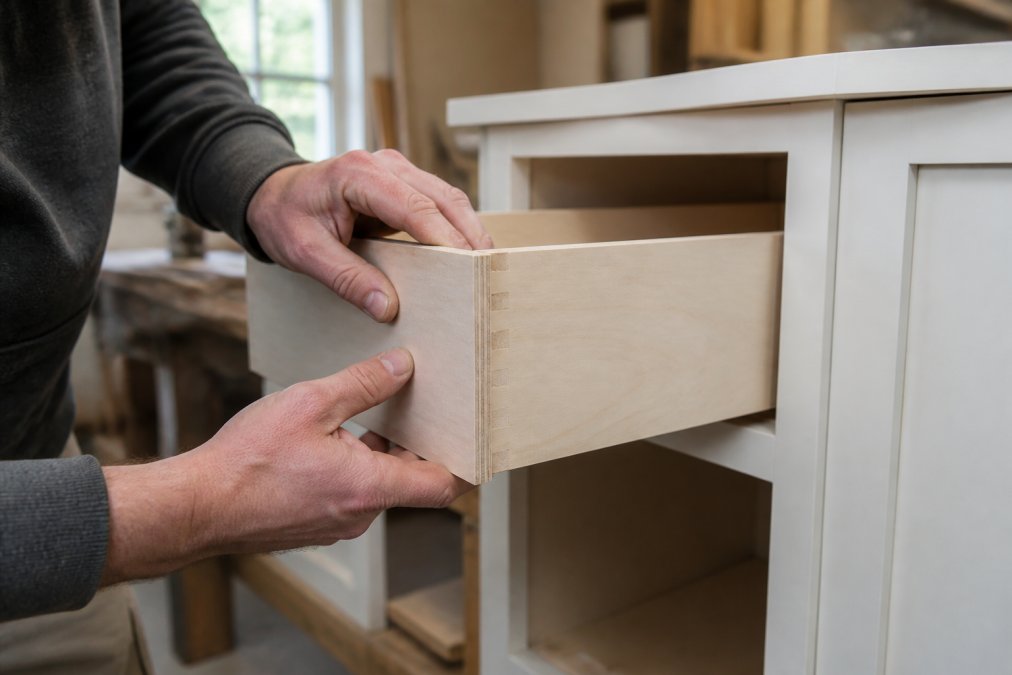
The catch with both Lily Ann and The RTA Store is that their premium construction features often sit on specific product lines, not across the entire catalog. You have to read the fine print on each cabinet to confirm whether you're getting plywood or MDF doors, and whether the drawer boxes are dovetailed. That homework is worth doing because finish durability and hardware quality are what separate a 10-year cabinet from a 30-year cabinet.
Pros and Cons of RTA Cabinets From Both Retailers
The pros and cons of RTA cabinets are consistent across most retailers, but the weight of each factor shifts depending on your project type. For a property flipper, the budget-friendly pricing and DIY installation of RTA cabinets are the entire point. For a homeowner planning to stay put for 15 years, the assembly labor and potential for shipping damage are more significant concerns.
The clear advantages of buying RTA from either retailer:
- Cost savings: Flat-pack shipping cuts freight costs dramatically compared to assembled cabinets.
- DIY installation: With basic tools and a weekend, most homeowners can assemble and hang a standard kitchen.
- Factory-direct value: You pay for materials and construction, not showroom overhead.
Where RTA cabinets fall short:
- Assembly time: A full kitchen can take 10 to 20 hours of your time, and mistakes in cam-lock assembly compromise cabinet box integrity (familyhandyman.com).
- Shipping damage: Flat-pack boxes are still vulnerable, and a damaged panel mid-project kills your timeline.
- Hidden costs: You may need to buy assembly tools, wood glue for dowels, and skin panels to match toe kicks and exposed ends.
That last point is the hidden cost of RTA that forums love to debate. Skin panels, filler pieces, and trim to match your cabinet finish are often sold separately, and they add up faster than first-time buyers expect. A retailer that offers assembled options or clearer package pricing can save you that headache.
How to Choose Kitchen Cabinets Online: A Framework
Choosing kitchen cabinets online without touching them first feels risky, but a disciplined framework removes most of the guesswork. Start by measuring your space precisely, including ceiling height, window and door trims, and any out-of-square walls. Then decide on your door style and finish before you look at a single catalog, because that decision narrows your retailer list faster than anything else.
The decision framework we recommend to our clients at RTA Wholesalers follows five steps:
- Confirm your cabinet box construction: Plywood boxes are non-negotiable for longevity. Ask what thickness and grade.
- Verify the door and drawer front material: Solid hardwood fronts with a plywood center panel on shaker doors outperform MDF.
- Check the hardware spec: Soft-close hinges and full-extension drawer glides from a known manufacturer are worth the premium.
- Map your layout against available sizes: List every cabinet you need, then flag dimensions that fall outside standard widths.
- Ask about design support: A free kitchen design service should catch clearance and fit errors before you order, not after.
For a standard layout, both Lily Ann and The RTA Store have enough sizes to work. The framework breaks down when you have a 15-inch gap, a corner that needs a blind base, or a vanity depth that doesn't match standard 21-inch or 24-inch boxes. In those cases, a retailer that offers custom sizes, like our Custom Order Inset line, is the only way to avoid expensive filler pieces and awkward gaps.
RTA Cabinet Assembly Tips: What to Expect
Assembling RTA cabinets is genuinely doable for a competent DIYer, but it is not a 30-minute-per-box job. Expect to spend 45 to 60 minutes per cabinet the first time you build one, with that time dropping as you learn the cam-lock assembly pattern (thisoldhouse.com). A standard 10-cabinet kitchen will consume a full weekend, and that assumes your boxes arrive undamaged and your instructions are clear.
The thing nobody tells you about RTA assembly is that the quality of your build directly affects how the doors align. A cabinet assembled slightly out of square will have doors that bind, drawers that rub, and gaps that show. Use a carpenter's square on every box before you tighten the cam locks, and glue the dowel joints where the manufacturer recommends it. Dovetail drawer boxes should also be glued during assembly to lock the joint.
If you are flipping multiple houses or managing a large remodel, the assembly math changes. Your labor has a cost, and spending 20 hours building cabinets might not beat the convenience of assembled units. Retailers like RTA Wholesalers offer assembled cabinets that ship in about 5 weeks, which shifts the trade-off from your time to your timeline.
The Value of Kitchen Cabinet Design Services
A kitchen cabinet design service is not a luxury add-on; it is the cheapest insurance you can buy for a remodel. Professional design software catches clearance issues, appliance fit problems, and fillers you forgot to measure. The error rate on self-designed kitchens is high, and a single mistake in cabinet sizing can delay your entire project by weeks while you wait for a replacement box (nkba.org).
What most guides miss is that the quality of the design service varies wildly between retailers. Some offer a basic layout tool that generates a parts list with no human review. Others, including RTA Wholesalers, provide a free kitchen design service where a designer reviews your measurements, flags potential issues, and produces a layout that accounts for your appliances, countertop overhangs, and toe kick requirements. That human review is what catches the mistakes that cause some buyers experience on self-ordered kitchens.
Lily Ann and The RTA Store both offer design tools, but the depth of support varies. If you are a contractor who has done 50 kitchens, you may not need the hand-holding. If you are a homeowner doing your first remodel, the value of a designer who can explain the difference between inset and overlay doors, or why your sink base needs a specific width, is substantial. Ask each retailer what their design service actually includes before you rely on it.
Shipping, Lead Times, and Damage Policies
Shipping is where RTA purchases go wrong most often, and the policies differ meaningfully between retailers. Flat-pack boxes are heavy and can sit in warehouse queues for days, so lead times quoted at checkout are often optimistic. If you are flipping houses or working against a hard move-in date, ask for the current lead time in writing before you order, and build in a buffer for freight delays.
Shipping damage is the other wildcard. A crushed corner or a cracked door panel mid-project is not just an inconvenience; it is a full stop on your timeline while you file a claim and wait for a replacement. The best protection is a retailer with strong packaging and a clear damage policy that does not require you to fight the freight carrier. Ask how they handle damage claims and how quickly they ship replacements before you commit.
:::warning Do not assume a damage claim will be resolved in days. Some retailers require you to document damage on the delivery receipt and file with the carrier yourself, which can stretch into weeks. Confirm the retailer handles the claim process directly or you risk owning the delay.
For stock cabinets, Lily Ann and The RTA Store often ship within a week or two. Custom work is a different story. At RTA Wholesalers, our assembled cabinets are available in about 5 weeks, and our custom inset options in most any size and an unlimited choice of Sherwin Williams paint colors take similar time. If speed on standard sizes matters most, a stock retailer wins. If a precise fit and color matter more than a few weeks, custom is the better trade.
Conclusion: Which Cabinet Retailer Wins?
The honest answer is that Lily Ann and The RTA Store both sell serviceable RTA cabinets for standard kitchens, and neither is a bad choice if your layout fits their stock sizes. The winner depends on what you are optimizing for. For the lowest price on a common shaker cabinet in a standard size, both retailers are competitive. For a kitchen with unusual dimensions, a specific custom color, or a preference for inset doors, both fall short.
That is where RTA Wholesalers differentiates. We offer inset and overlay options, including white shaker cabinets, at wholesale pricing, and our custom color inset cabinetry is available in most any size. Our free kitchen design service reviews your layout before you order, and our assembled cabinets ship in about 5 weeks in a multitude of wood species and stain colors or an unlimited choice of Sherwin Williams paint colors. If you want options beyond the standard catalog and a team that walks you through the difference between inset and overlay, browse our custom collections and get started with RTA Wholesalers for a kitchen built around your exact measurements.
Frequently Asked Questions
Who has the best quality RTA cabinets?
Quality varies by manufacturer. Look for 1/2-inch or 5/8-inch plywood cabinet boxes, solid wood face frames, dovetail drawer joints, and soft-close hardware. Particle board and MDF doors are lower grade. Compare these specs side-by-side rather than relying on brand claims. A warranty that covers defects and hardware is also a key sign of a manufacturer confident in its build quality.
Are RTA cabinets actually cheaper than pre-assembled options?
Yes, RTA cabinets are generally cheaper because you save on assembly labor and the flat-pack shipping is more efficient. The trade-off is your time and effort. If you are comfortable with basic tools and following instructions, the savings are significant.
What should I look for when comparing RTA cabinet suppliers?
Compare the construction specs first: plywood vs. particle board, dovetail vs. stapled drawers, and soft-close vs. standard hardware. Second, check the warranty and return policy. Third, read recent customer reviews about shipping damage and how the company resolves it. Finally, use a free kitchen cabinet design service to avoid costly layout mistakes.
Do RTA cabinets require professional installation?
No, RTA cabinets are designed for DIY installation. Assembling the boxes typically takes 30-45 minutes each. The installation itself, including leveling and securing to the wall, is the same as any other cabinet. If you are comfortable with basic carpentry, you can save money by doing it yourself. If not, hiring a contractor is a standard option.


